
Atlantic Southwest Europe (712–723 CE): Islamic Conquest, …
Years: 712 - 723
Atlantic Southwest Europe (712–723 CE): Islamic Conquest, Christian Resistance, and Emergence of the Asturian Kingdom
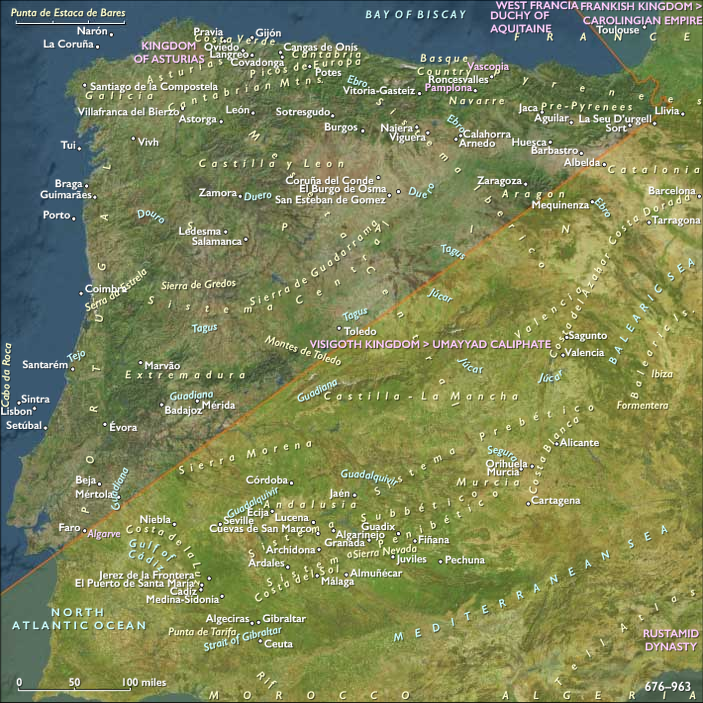
Between 712 and 723 CE, Atlantic Southwest Europe—encompassing Galicia, northern and central Portugal, Asturias, Cantabria, and northern Spain south of the Franco-Spanish border (43.05548° N, 1.22924° W)—experienced a dramatic transformation. Following the swift and decisive Islamic conquest of Visigothic Iberia (711–718 CE), the region faced unprecedented challenges. While the southern and eastern parts of Iberia rapidly fell under Islamic rule, Atlantic Southwest Europe emerged as a nucleus of determined Christian resistance, leading directly to the founding of the Kingdom of Asturias.
Political and Military Developments
Islamic Conquest and Initial Domination
In 711 CE, Islamic forces under Tariq ibn Ziyad decisively defeated Visigothic King Roderic at the Battle of Guadalete, triggering the rapid collapse of Visigothic rule. By 712–715 CE, Muslim armies swiftly occupied much of central and southern Iberia, including key regional cities such as Emerita Augusta (Mérida) and Olissipo (Lisbon), imposing direct Umayyad governance over these territories. However, due to the region's mountainous terrain and strong local resistance, their control over the far northwest remained tenuous.
Christian Resistance and Foundation of the Kingdom of Asturias
In the northwestern territories of Galicia, Asturias, and Cantabria, resistance emerged immediately, led by Visigothic nobles and local aristocrats. By 718 CE, under the leadership of the Visigothic nobleman Pelagius (Pelayo), Asturian warriors openly resisted Islamic authority, culminating in the symbolic but strategically significant Battle of Covadonga (718 or 722 CE). This battle, traditionally dated to 722 CE, represented a decisive turning point, marking the formal beginning of the Kingdom of Asturias and the initiation of the centuries-long Christian Reconquista.
Economic Developments
Economic Disruption and Localized Stability
The initial Islamic conquest and subsequent military conflicts significantly disrupted regional economies, especially in areas directly impacted by warfare or occupation. Despite this upheaval, rural areas and mountainous territories (Galicia, Asturias, northern Lusitania) retained substantial economic continuity. Agricultural production, livestock husbandry, artisanal crafts, and mining activities continued, albeit at reduced scales.
Decline of Maritime Trade
Coastal commerce, especially through cities such as Olissipo (Lisbon), was temporarily diminished due to shifting trade routes, reduced regional security, and initial Islamic control of maritime access points. However, smaller ports and coastal villages retained limited regional trade networks.
Cultural and Religious Developments
Ecclesiastical Institutions as Centers of Resistance
During this period of upheaval, influential bishoprics—particularly Braga and Asturica Augusta—emerged as critical symbols and organizers of resistance against Islamic rule, reinforcing their central leadership role within local communities. Bishops and monastic communities provided essential social cohesion, education, and support, becoming vital rallying points for emerging Christian resistance.
Growth of Monasticism in Northern Iberia
Monastic communities expanded significantly in remote regions, promoting education, manuscript preservation, and social welfare. Monasteries became centers of resistance, cultural preservation, and refuge, significantly contributing to the establishment of distinct medieval Christian identities.
Cultural Syncretism and Identity
The distinctive blend of orthodox Christianity and indigenous Iberian and Celtic traditions remained resilient and essential in rural Galicia, Asturias, and northern Portugal. These enduring practices became central to the emerging Asturian Christian identity, contrasting sharply with the Islamic culture introduced to southern Iberia.
Civic Identity and Governance
Emergence of New Political Identities
The collapse of Visigothic and partial Islamic rule led to new civic identities and political structures. The establishment of the Kingdom of Asturias under Pelagius significantly reshaped regional governance, laying foundations for medieval Christian kingdoms in Iberia. Local leadership structures transformed from aristocratic autonomy into formalized royal and ecclesiastical governance.
Notable Tribal Groups and Settlements
-
Astures and Cantabri: Provided the core strength of early Christian resistance, quickly establishing Asturias as a powerful symbol of independent governance and identity.
-
Galicians and Lusitanians: Maintained autonomous governance in rural areas, cautiously balancing interactions with Islamic occupiers and early Asturian resistance.
-
Vascones: Continued their historical neutrality and territorial independence, largely insulated from the broader political upheaval, though closely monitoring developments in neighboring territories.
Long-Term Significance and Legacy
Between 712 and 723 CE, Atlantic Southwest Europe:
-
Experienced transformative political shifts triggered by the rapid Islamic conquest, resulting in the collapse of Visigothic governance.
-
Witnessed the birth of determined Christian resistance in Asturias, marking the beginning of the Kingdom of Asturias and laying foundations for the centuries-long Reconquista.
-
Solidified ecclesiastical institutions, monastic traditions, and regional identities, decisively influencing subsequent medieval social and political development.
This era set a critical historical trajectory for the region, profoundly shaping its cultural identity and establishing enduring political foundations that defined Atlantic Southwest Europe throughout the medieval period.
People
Groups
- Polytheism (“paganism”)
- Vascones
- Lusitanians, or Lusitani
- Astures (Celtic tribe)
- Gallaeci
- Cantabri (Celtic tribe)
- Moors
- Christianity, Chalcedonian
- Visigothic Kingdom of Spain
- Islam
- al-Andalus (Andalusia), Muslim-ruled
Topics
Commodoties
- Fish and game
- Weapons
- Oils, gums, resins, and waxes
- Grains and produce
- Fibers
- Textiles
- Ceramics
- Strategic metals
- Salt
- Beer, wine, and spirits
- Lumber
Subjects
- Commerce
- Architecture
- Engineering
- Labor and Service
- Conflict
- Mayhem
- Faith
- Government
- Scholarship
- Custom and Law
- Technology
- religious movement
Regions

Subregions
Years: 712 - 723
People
Groups
- Polytheism (“paganism”)
- Vascones
- Lusitanians, or Lusitani
- Astures (Celtic tribe)
- Gallaeci
- Cantabri (Celtic tribe)
- Moors
- Christianity, Chalcedonian
- Visigothic Kingdom of Spain
- Islam
- al-Andalus (Andalusia), Muslim-ruled
Topics
Commodoties
- Fish and game
- Weapons
- Oils, gums, resins, and waxes
- Grains and produce
- Fibers
- Textiles
- Ceramics
- Strategic metals
- Salt
- Beer, wine, and spirits
- Lumber
Subjects
- Commerce
- Architecture
- Engineering
- Labor and Service
- Conflict
- Mayhem
- Faith
- Government
- Scholarship
- Custom and Law
- Technology
- religious movement
Regions
Subregions