
Atlantic Southwest Europe (676–687 CE): Late Visigothic …
Years: 676 - 687
Atlantic Southwest Europe (676–687 CE): Late Visigothic Stability and Growing Internal Tensions
In the era between 676 and 687 CE, Atlantic Southwest Europe initially enjoyed a brief period of stability under Visigothic rulers based in Toledo. However, beneath this stability, political fractures emerged, driven by succession conflicts, regional rivalries, and increasing tensions between the centralized royal court and local aristocratic powers.
Political and Military Developments
Centralized Authority under King Wamba and Successors
King Wamba (672–680 CE) maintained unified Visigothic authority and political coherence throughout the peninsula. His relatively successful rule preserved internal stability and sustained regional autonomy, especially in distant northwestern regions like Galicia, Asturias, and northern Lusitania. Following Wamba's forced abdication, his successor, King Erwig (680–687 CE), struggled to maintain the same degree of unity. His reign, though politically stable on the surface, masked growing factionalism among nobles, bishops, and regional leaders.
Increasing Aristocratic Autonomy
Local aristocratic families, particularly in Galicia, Asturias, and northern Portugal, solidified their independence from Toledo. The Visigothic kingdom's gradual decentralization allowed regional magnates to expand their local authority and governance structures, setting a foundation for independent political identities that would soon become significant.
Economic Developments
Continuation of Regional Economic Stability
Despite increasing political uncertainties, rural villa-based economies sustained stable production in agriculture (grains, olives, vineyards), livestock husbandry, mining (especially gold and silver in Galicia and Asturias), and artisanal crafts (textiles, pottery, metalwork). Local economies demonstrated resilience, largely insulated from distant political turbulence.
Stable Maritime Trade Networks
Coastal settlements, particularly Bracara Augusta (Braga) and Olissipo (Lisbon), maintained their modest but steady commercial links with broader Atlantic and Mediterranean markets. The continued strength of maritime trade provided essential economic stability despite internal Visigothic tensions.
Cultural and Religious Developments
Ecclesiastical Dominance and Monastic Influence
Ecclesiastical authorities in influential bishoprics—Braga, Emerita Augusta, and Asturica Augusta—remained powerful figures, shaping local governance, community life, and education. Monastic communities continued expanding their role, fostering manuscript production, agricultural innovation, social welfare, and education.
Sustained Cultural Syncretism
The blending of orthodox Christianity with indigenous Iberian and Celtic practices continued unabated, particularly in rural and mountainous areas such as Galicia, Asturias, and northern Portugal. These enduring traditions contributed significantly to the region’s cultural distinctiveness.
Civic Identity and Governance
Persistent Decentralized Governance
Civic identities remained deeply local, governed by powerful regional aristocrats, tribal leaders, and influential bishops. Despite nominally acknowledging Visigothic authority from Toledo, these local leaders effectively governed their territories independently, strengthening regional autonomy and identity.
Notable Tribal Groups and Settlements
-
Galicians and Lusitanians: Continued effectively governing their territories, skillfully balancing local interests with the weakening centralized Visigothic power.
-
Astures and Cantabri: Maintained strong indigenous governance structures and local autonomy, with minimal external interference.
-
Vascones: Persisted in political neutrality and territorial independence, continuing their longstanding cultural and political isolation.
Long-Term Significance and Legacy
Between 676 and 687 CE, Atlantic Southwest Europe:
-
Experienced the final years of relatively unified Visigothic governance, marked increasingly by internal tensions and regional fragmentation.
-
Preserved regional autonomy and local governance structures, positioning itself effectively for future transformations.
-
Reinforced ecclesiastical institutions and cultural syncretism, creating resilient regional identities that would endure beyond Visigothic decline.
This era thus marked a crucial transitional phase, setting the stage for subsequent political fragmentation, Islamic incursions, and the emergence of independent Christian kingdoms that characterized the following age.
People
Groups
- Polytheism (“paganism”)
- Vascones
- Lusitanians, or Lusitani
- Gallaeci
- Cantabri (Celtic tribe)
- Astures (Celtic tribe)
- Christianity, Chalcedonian
- Baetica (Visigothic province)
- Tarraconensis (Visigothic province)
- Lusitania (Visigothic province)
- Carthaginensis (Visigothic province)
- Visigothic Kingdom of Spain
- Roman Empire, Eastern: Justinian dynasty
Commodoties
- Fish and game
- Weapons
- Oils, gums, resins, and waxes
- Grains and produce
- Fibers
- Textiles
- Ceramics
- Strategic metals
- Salt
- Beer, wine, and spirits
- Lumber
Subjects
- Commerce
- Architecture
- Engineering
- Labor and Service
- Faith
- Government
- Scholarship
- Custom and Law
- Technology
- religious movement
Regions
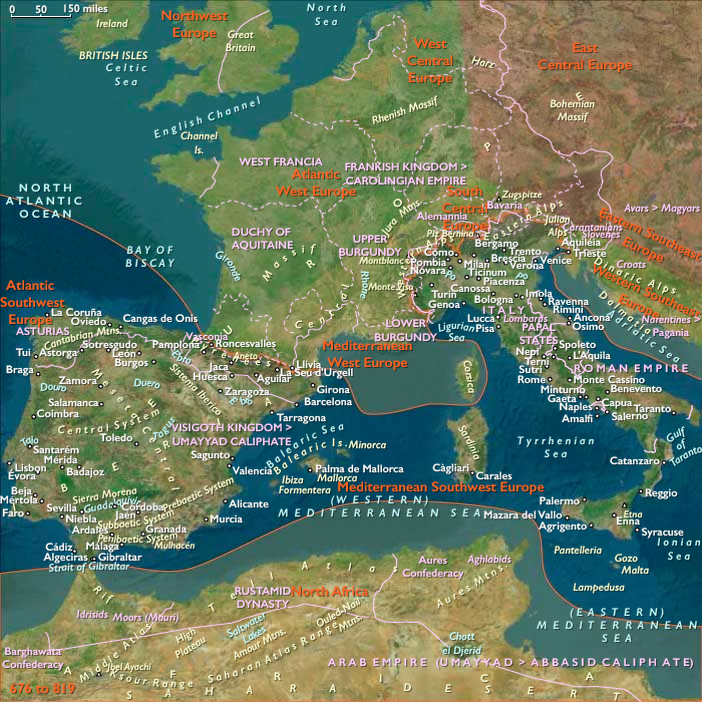
Subregions
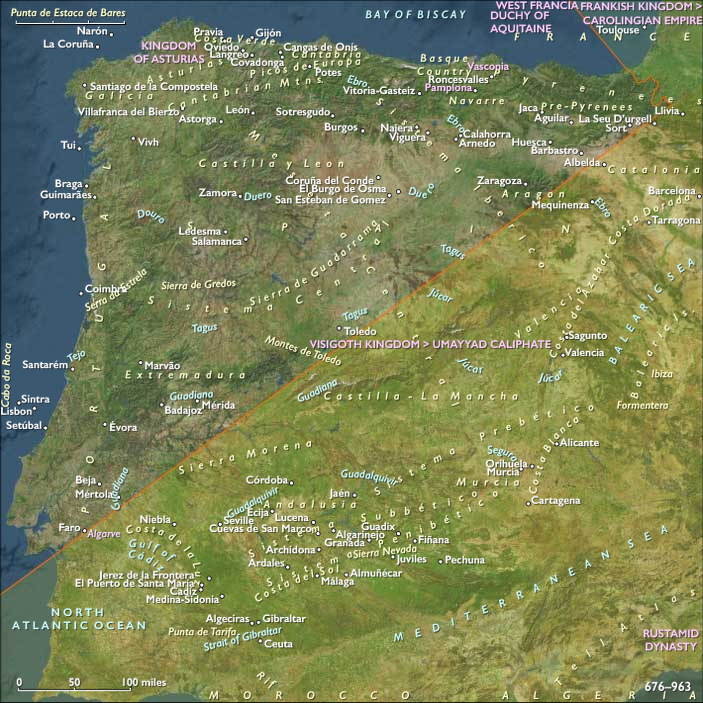
Related Events
Showing 4 events out of 4 total
Years: 676 - 687
People
Groups
- Polytheism (“paganism”)
- Vascones
- Lusitanians, or Lusitani
- Gallaeci
- Cantabri (Celtic tribe)
- Astures (Celtic tribe)
- Christianity, Chalcedonian
- Baetica (Visigothic province)
- Tarraconensis (Visigothic province)
- Lusitania (Visigothic province)
- Carthaginensis (Visigothic province)
- Visigothic Kingdom of Spain
- Roman Empire, Eastern: Justinian dynasty
Commodoties
- Fish and game
- Weapons
- Oils, gums, resins, and waxes
- Grains and produce
- Fibers
- Textiles
- Ceramics
- Strategic metals
- Salt
- Beer, wine, and spirits
- Lumber
Subjects
- Commerce
- Architecture
- Engineering
- Labor and Service
- Faith
- Government
- Scholarship
- Custom and Law
- Technology
- religious movement
Regions
Subregions