
Atlantic Southwest Europe (1780–1791): Enlightenment Reforms, Rising …
Years: 1780 - 1791
Atlantic Southwest Europe (1780–1791): Enlightenment Reforms, Rising Tensions, and Prelude to Upheaval
From 1780 to 1791, Atlantic Southwest Europe—including northern and central Portugal (Lisbon), Galicia, Asturias, Cantabria, northern León and Castile, northern Navarre, northern Rioja, and the Basque Country—experienced profound political, economic, and cultural shifts. The ongoing influence of enlightened absolutism deepened modernization efforts but also generated increasing tensions between traditional authorities and centralizing monarchies. Economic prosperity from maritime trade continued, yet underlying social unrest and regional assertiveness hinted at future upheavals, influenced significantly by the reverberations of revolutionary ideas emerging from France.
Political and Military Developments
Portugal: Post-Pombaline Adjustments
-
The death of King José I in 1777 and the subsequent ascension of Queen Maria I (r.1777–1816) led to a rollback of some aggressive Pombaline reforms, relaxing tensions with the aristocracy and clergy but slowing administrative modernization.
-
Political stability prevailed in Lisbon and Porto, though underlying dissatisfaction persisted among reform-minded intellectuals and middle-class merchants who favored continued progressive governance.
Spain: Enlightenment under Charles III and Charles IV
-
Charles III (r.1759–1788) continued ambitious Enlightenment reforms in Spain, expanding public education, agriculture, trade liberalization, and infrastructure improvements, significantly benefiting Galicia, Asturias, Cantabria, and the Basque regions.
-
After his death in 1788, Charles IV (r.1788–1808) ascended the throne, maintaining enlightened policies initially but gradually weakening under court intrigues and reactionary pressures, prompting disillusionment among regional elites.
Regional Autonomy and Fueros
-
The Basque Country and northern Navarre maintained robust autonomy, firmly defending their fueros against attempts at fiscal and administrative centralization, emphasizing regional governance and economic independence.
Economic Developments: Continued Maritime Prosperity
Portuguese Maritime and Commercial Success
-
Northern Portugal, particularly Porto, continued to thrive through expanded exports of wine, textiles, and manufactured goods, leveraging strong British and colonial trade networks.
-
Lisbon solidified its commercial significance as the principal Portuguese maritime hub, experiencing increased prosperity through trade with Brazil, Africa, and Asia, despite challenges posed by growing competition.
Industrial and Commercial Expansion in Northern Spain
-
Bilbao and Santander further strengthened their maritime economies through robust trade, fisheries, shipbuilding, and iron production. Economic prosperity fostered urban expansion and infrastructural improvements, enhancing regional affluence.
-
Galicia’s ports, notably Vigo and A Coruña, grew through maritime trade and fishing industries, expanding their economic influence and reinforcing regional commercial vitality.
Agricultural and Rural Prosperity
-
Improved agricultural productivity, due to enlightened agrarian reforms, benefited Galicia, Asturias, and northern Castile and León, stabilizing rural economies and reducing acute poverty in some areas, though rural-urban inequalities persisted.
Religious and Cultural Developments
Enlightenment Influence on Education and Culture
-
Enlightenment ideals permeated education in Portugal and northern Spain, notably at the University of Coimbra, Santiago de Compostela, and Valladolid, promoting scientific inquiry, rationalism, and secular learning within orthodox Catholic parameters.
-
Educational reforms facilitated the rise of a well-educated, socially engaged middle class, increasingly critical of traditional social structures and sympathetic to new revolutionary ideas emerging from France.
Artistic and Architectural Transition
-
Neoclassical architecture and urban planning became predominant in Lisbon, Porto, Bilbao, and Santander, reflecting Enlightenment rationalism, symmetry, and civic ideals, transforming the urban landscapes of these cities.
-
The arts flourished, especially in Lisbon and northern Portuguese cities, as patrons supported intellectual and cultural institutions, fostering a lively, enlightened cultural atmosphere.
Social and Urban Developments
Urbanization and Social Mobility
-
Porto, Bilbao, and Santander experienced significant urban growth, reflecting commercial prosperity and improved infrastructure, including roads, public buildings, and civic institutions, enhancing quality of life and economic vitality.
-
Increasingly affluent urban merchant and artisan classes gained influence in civic governance, challenging traditional aristocratic dominance, especially evident in cities like Porto, Lisbon, Bilbao, and Vitoria-Gasteiz.
Rising Social Tensions and Emerging Revolutionary Ideas
-
Underlying social tensions intensified, driven by economic disparities, discontent with taxation policies, and inspired by revolutionary events abroad, notably the French Revolution (beginning in 1789).
-
Intellectual circles in Lisbon, Porto, Valladolid, and Bilbao increasingly discussed Enlightenment ideals such as liberty, equality, and representative governance, laying the groundwork for future political unrest.
Legacy and Significance
The period from 1780 to 1791 served as a critical prelude to broader upheavals in Atlantic Southwest Europe. Enlightenment reforms continued modernizing regional economies and governance, fostering prosperity yet simultaneously deepening social tensions. The preservation of regional autonomy, particularly Basque and Navarrese fueros, reinforced distinctive regional identities, while rising intellectual currents challenged traditional political and social structures. As revolutionary ideas from France began permeating local intellectual discourse, the stage was set for significant transformations, marking this era as a turning point toward profound political and social change in the years ahead.
People
Groups
- Portuguese people
- Basque people
- Christians, Roman Catholic
- Galicians
- Asturias, Principality of
- Portuguese Empire
- Ottoman Empire
- Portuguese Gold Coast
- Inquisition, Spanish
- Christians, New
- Marranos
- Portuguese Mozambique
- Portuguese Malacca
- Spaniards (Latins)
- Spain, Habsburg Kingdom of
- Protestantism
- Inquisition, Portuguese
- Brazil, Colonial
- Spain, Habsburg Kingdom of
- France, (Bourbon) Kingdom of
- Portugal, Bragança Kingdom of
- England, (Orange and Stewart) Kingdom of
- England, (Stuart) Kingdom of
- Britain, Kingdom of Great
Topics
- Colonization of the Americas, Portuguese
- Colonization of the Americas, Spanish
- Colonization of Asia, Spanish
- Colonization of Asia, Portuguese
- French Revolution
Commodoties
- Domestic animals
- Grains and produce
- Fibers
- Textiles
- Strategic metals
- Sweeteners
- Beer, wine, and spirits
- Manufactured goods
- Spices
Subjects
Regions
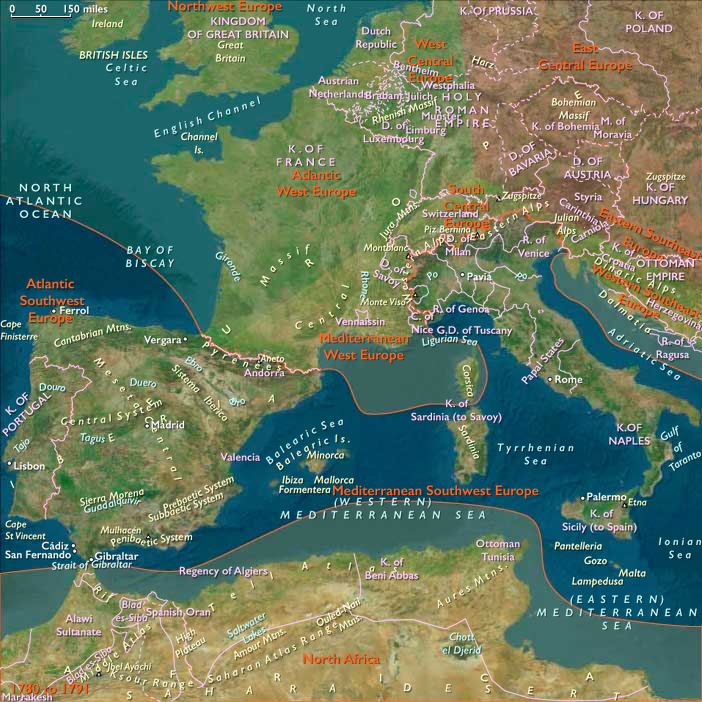
Subregions
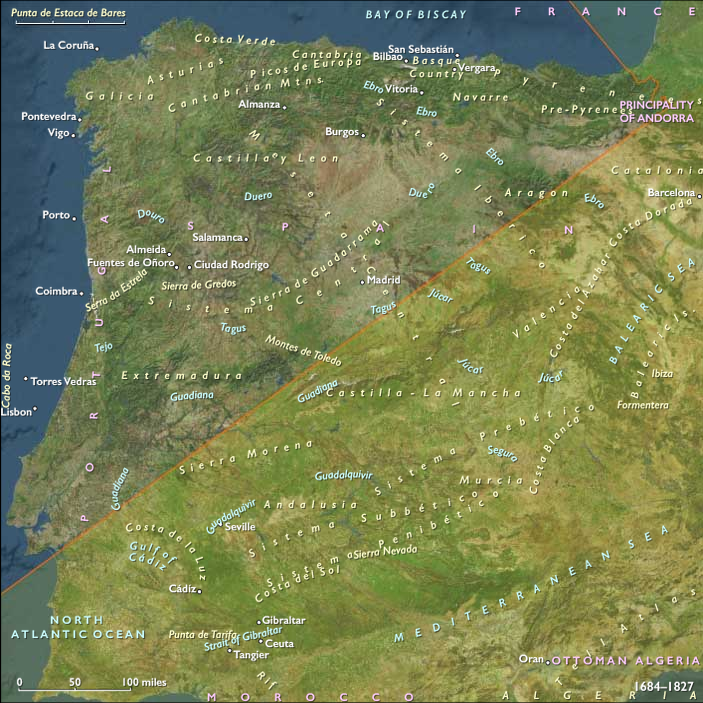
Years: 1780 - 1791
People
Groups
- Portuguese people
- Basque people
- Christians, Roman Catholic
- Galicians
- Asturias, Principality of
- Portuguese Empire
- Ottoman Empire
- Portuguese Gold Coast
- Inquisition, Spanish
- Christians, New
- Marranos
- Portuguese Mozambique
- Portuguese Malacca
- Spaniards (Latins)
- Spain, Habsburg Kingdom of
- Protestantism
- Inquisition, Portuguese
- Brazil, Colonial
- Spain, Habsburg Kingdom of
- France, (Bourbon) Kingdom of
- Portugal, Bragança Kingdom of
- England, (Orange and Stewart) Kingdom of
- England, (Stuart) Kingdom of
- Britain, Kingdom of Great
Topics
- Colonization of the Americas, Portuguese
- Colonization of the Americas, Spanish
- Colonization of Asia, Spanish
- Colonization of Asia, Portuguese
- French Revolution
Commodoties
- Domestic animals
- Grains and produce
- Fibers
- Textiles
- Strategic metals
- Sweeteners
- Beer, wine, and spirits
- Manufactured goods
- Spices
Subjects
Regions
Subregions