
Athenian tradition relates that during the time …
Years: 1053BCE - 910BCE
Athenian tradition relates that during the time of the Dorian “invasion” of the Peloponnesus, around 1068 BCE, the Dorians had consulted the Delphic Oracle, who prophesied that their invasion would succeed as long as the king was not harmed.
The news of this prophecy, that only the death of an Athenian king would ensure the safety of Athens, quickly found its way to the ears of Codrus.
In devotion to his people, Codrus disguised himself as a peasant and made it to the vicinity of the Dorian encampment across the river, where he provoked a group of Dorian soldiers.
He was put to death in the quarrel, and the Dorians, realizing Codrus had been slain, decided to retreat in fear of their prophesied defeat.
In the aftermath of these events, no one thought himself worthy to succeed Codrus, the title of king was abolished, and that of archon substituted for it.
The first such archon was Codrus' son, Medon, who rules from 1068 to 1048; his successor is Acastus.
The later Athenian tradition varies on the exact position of this line; they held archonship for life, and exercised the sacral powers of kingship, as did the archon basileus later.
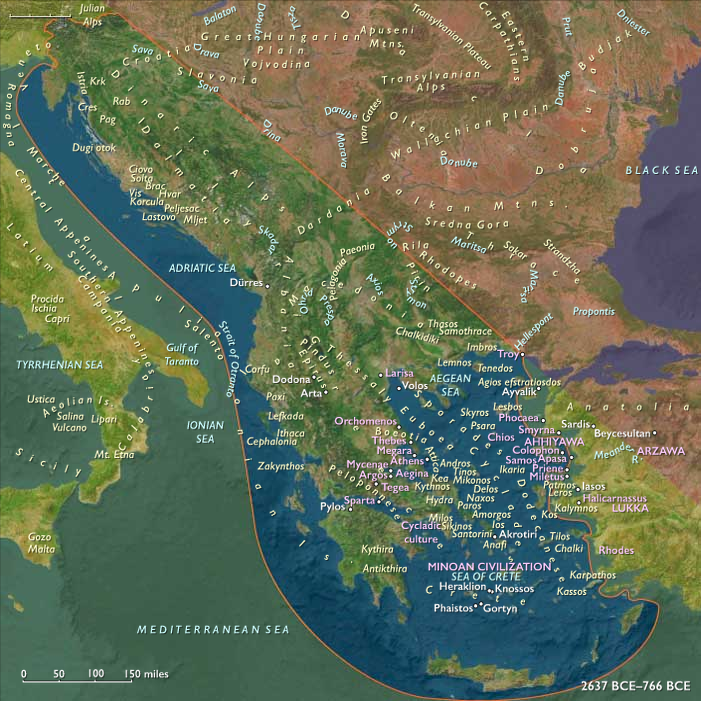
The hybrid post-Mycenaean culture of southern Greece, a blend of the formerly barbarous invaders and the remnants of the indigenous population, evolves in some areas, notably Attica, into a cohesive Greek civilization about the middle of the eleventh century BCE.
The former Mycenaeans’ close contact with the more advanced civilizations of the East is quickly elevating the level of their culture.
Locations
Groups
Topics
Subjects
Regions

Subregions
Years: 1053BCE - 910BCE
Locations
Groups
Topics
Subjects
Regions
Subregions