Emperor Ming, following a suggestion by his …
Years: 59 - 59
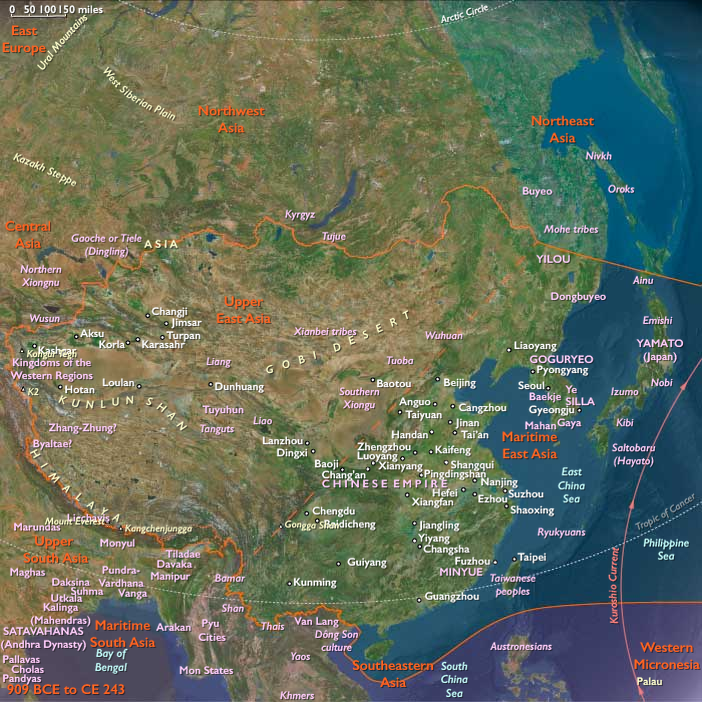
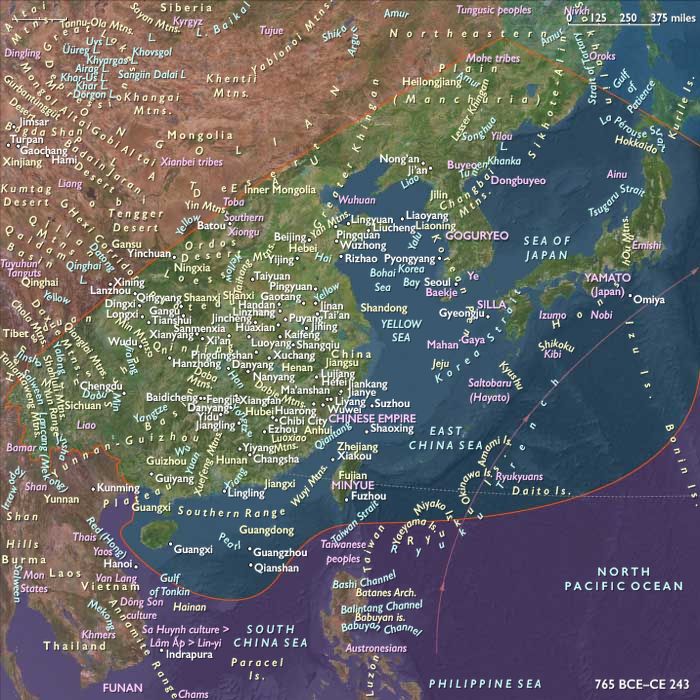
Emperor Ming, following a suggestion by his brother Liu Cang, the Prince of Dongping, in 59, institutes a number of Confucian rituals, in which the emperor, to show humility, personally honors the officials who had helped him.
Locations
People
Groups
Topics
Commodoties
Subjects
Regions
Subregions
Related Events
Filter results
Showing 10 events out of 61700 total
Nero’s wife Octavia is meanwhile caught up in the power struggles between Nero and his mother, which conclude when Nero murders his mother in March 59.
Tacitus claims that Poppaea was the reason that Nero murdered his mother.
Poppaea induced Nero to murder Agrippina in 59 so that she could marry him.
Modern sources, though, question the reliability of this story as Nero did not marry Poppaea until 62.
Additionally, Suetonius mentions how Poppaea's husband, Otho, was not sent away until after Agrippina's death, which makes it very unlikely that an already married woman would be pressing Nero to marry her.
Some modern historians, however, theorize that Nero's decision to kill Agrippina was prompted by her plotting to set Gaius Rubellius Plautus (Nero's maternal second cousin) on the throne, rather than as a result of Poppaea's motives.
According to Suetonius, Nero had tried to kill his mother through a planned shipwreck, which had taken the life of her friend, Acerronia Polla, but when Agrippina survived, he had her executed and framed it as a suicide.
The incident is also recorded by Tacitus.
Emperor Ming creates his favorite Consort Ma (who is also a favorite of his mother Empress Dowager Yin) empress in 60, and creates her adopted son Prince Da crown prince.
The same year, to honor the generals and officials who had assisted his father Emperor Guangwu in reestablishing the Han Dynasty, Emperor Ming, perhaps echoing what Emperor Xuan had done, had the portraits of twenty-eight of them drawn on a palace tower (known as the "Yuntai 28 Generals").
Later, four more portraits will be added.
However, Ma Yuan, because he was the father of the empress, did not receive this honor, although his reputation is posthumously restored.
Restrictions are put on the amount of bail and fines under Nero.
Also, fees for lawyers are limited.
There is a discussion in the Senate on the misconduct of the freedmen class, and a strong demand is made that patrons should have the right of revoking freedom.
Nero supports the freedmen and rules that patrons have no such right.
The Senate tries to pass a law in which the crimes of one slave applied to all slaves within a household.
Despite riots from the people, Nero supports the Senate on their measure, and deploys troops to organize the execution of four hundred slaves affected by the law.
However, he vetoes strong measures against the freedmen affected by the case.
After tax collectors are accused of being too harsh to the poor, Nero transfers collection authority to lower commissioners.
Nero bans any magistrate or procurator from exhibiting public entertainment for fear that the venue is being used as a method to sway the populace.
Additionally, there are many impeachments and removals of government officials along with arrests for extortion and corruption.
When further complaints arise that the poor are being overly taxed, Nero attempts to repeal all indirect taxes.
The Senate persuades him that this action will bankrupt the public treasury.
As a compromise, taxes are cut from four and a half percent to two and a half percent.
Additionally, secret government tax records are ordered to become public.
To lower the cost of food imports, merchant ships are declared tax-exempt.
In imitation of the Greeks, Nero builds a number of gymnasiums and theaters.
Enormous gladiatorial shows ware also held.
Nero also establishes the quinquennial Neronia.
The massive Greek-style festival includes games, poetry, and theater.
Historians indicate that there was a belief that theater led to immorality.
Others considered that to have performers dressed in Greek clothing was old fashioned.
Some questioned the large public expenditure on entertainment.
Junia Silana, sister of Caligula's first wife Junia Claudilla, a rival of Empress Agrippina the Younger and the ex-wife of Messalina's lover Gaius Silius, had in 55 accused Agrippina of plotting to overthrow Nero to place Plautus on the throne.
Nero had taken no action at the time, but over time, Nero's relationship with Silana had warmed while his relationship with his mother soured.
After a comet appears in 60, public gossip renews rumors of Nero's fall and Plautus' rise.
Nero exiles Plautus in 60 to his estate in Asia with his family.
Prasutagas, king of the British Iceni tribe centered in present Norfolk, may have been one of the eleven kings who surrendered to Claudius following the Roman conquest in 43, or he may have been installed as king in 47 following the defeat of a rebellion of the Iceni.
In any case, as an ally of Rome, his tribe has been allowed to remain nominally independent, and to ensure this Prasutagus names the Roman emperor as co-heir to his kingdom, along with his two daughters.
Tacitus says he lived a long and prosperous life of conspicuous wealth.
It is normal Roman practice to allow allied kingdoms their independence only for the lifetime of their client king, who would agree to leave his kingdom to Rome in his will—the provinces of Bithynia and Galatia, for example, were incorporated into the Empire in just this way.
Roman law also allows inheritance only through the male line, so when Prasutagus dies in CE 60, his attempts to preserve his line are ignored and his kingdom is annexed as if it had been conquered; lands and property are confiscated and nobles treated like slaves.
Cassius Dio says that Roman financiers, including Seneca the Younger, chose this time to call in their loans.
Tacitus does not mention this, but does single out the procurator, Catus Decianus, for criticism for his "avarice".
Prasutagus, it seems, had lived well on borrowed Roman money, and on his death his subjects had become liable for the debt.
According to Tacitus, Boudica was flogged and their daughters raped.
All this leads to the revolt of the Iceni, under the leadership of Boudica.
Tacitus and the Greek historian Dio Cassius agree that Boudica was of royal descent.
Dio says that she was "possessed of greater intelligence than often belongs to women", that she was "tall and terrifying in appearance ... a great mass of red hair fell over her shoulders"; that she had a harsh voice and a piercing glare, and habitually wore a large golden necklace (perhaps a torc), a many-colored tunic, and a thick cloak fastened by a brooch.
Tacitus commented on the "red hair and large limbs of the inhabitants of Caledonia [Scotland]" (The Life of Agricola, Ch. 11), which he linked with some red haired German/Belgic Gaulish tribes.
While the current governor, Gaius Suetonius Paulinus, is leading a campaign against the island of Mona (modern Anglesey) in the north of Wales, which is a refuge for British rebels and a stronghold of the druids, the Iceni conspire in CE 60 or 61 with their neighbors the Trinovantes, among others, to revolt.
Boudica is chosen as their leader.
According to Tacitus, they draw inspiration from the example of Arminius, the prince of the Cherusci who had driven the Romans out of Germany in CE 9, and their own ancestors who had driven Julius Caesar from Britain.
Dio says that at the outset, Boudica employed a form of divination, releasing a hare from the folds of her dress and interpreting the direction in which it ran, and invoked Andraste, a British goddess of victory.

The speed with which Suetonius takes Wales suggests that Veranius had already done much of the work.
The Romans mount a successful campaign across Wales, famously destroying the druidical center at Mona or Anglesey in CE 60 at what historians later called the Menai Massacre, named for the Menai Strait separating the island from the mainland.
Tacitus is the only source on the massacre and no details are known beyond what is given in Annals 14.30 and the later account on Boudica's revolt in Cassius Dio's History of Rome (62.1-11).
Tacitus' account in the translation of Church and Brodbribb (1876) is as follows,
"[Paulinus] prepared to attack the island of Mona which had a powerful population and was a refuge for fugitives.
He built flat-bottomed vessels to cope with the shallows, and uncertain depths of the sea.
Thus the infantry crossed, while the cavalry followed by fording, or, where the water was deep, swam by the side of their horses.
On the shore stood the opposing army with its dense array of armed warriors, while between the ranks dashed women, in black attire like the Furies, with hair dishevelled, waving brands.
All around, the Druids, lifting up their hands to heaven, and pouring forth dreadful imprecations, scared our soldiers by the unfamiliar sight, so that, as if their limbs were paralysed, they stood motionless, and exposed to wounds.
Then urged by their general's appeals and mutual encouragements not to quail before a troop of frenzied women, they bore the standards onwards, smote down all resistance, and wrapped the foe in the flames of his own brands.
A force was next set over the conquered, and their groves, devoted to inhuman superstitions, were destroyed.
They deemed it indeed a duty to cover their altars with the blood of captives and to consult their deities through human entrails."
Tigranes invades the neighboring Kingdom of Adiabene in 61 and deposes its King Monobazes, who is a Parthian vassal.
The so-called Villa of the Mysteries is a large Roman country villa located near Pompeii, initially built in the third century BCE, and surrounded on at least three sides by a terrace with a colonnade.
The villa is remodeled sometime before the earthquake of CE 62-63, the colonnade being replaced on the main axis of the villa by a rectangular verandah.
Decorating a large (twenty-nine by nineteen feet/nine by six meters) rectangular hall in the villa are the superb paintings—dating from the first century BCE and late Hellenistic in style—that give the villa its name, featuring numerous life-size figures of humans and deities in a Dionysiac ceremony against vivid red walls.
The rebels' first target is Camulodunum (Colchester), the former Trinovantian capital and now a Roman colonia.
The Roman veterans who had been settled there have mistreated the locals and a temple to the former emperor Claudius has been erected there at local expense, making the city a focus for resentment.
The Roman inhabitants seek reinforcements from the procurator, Catus Decianus, but he sends only two hundred auxiliary troops.
Boudica's army falls on the poorly defended city and destroys it, besieging the last defenders in the temple for two days before it falls.
Archaeologists have shown that the city was methodically demolished.
The future governor Quintus Petillius Cerialis, at this time commanding the Legio IX Hispana, attempts to relieve the city, but suffers an overwhelming defeat.
His infantry is wiped out—only the commander and some of his cavalry escape.
The location of this famous battle is now claimed by some to be the village of Great Wratting, in Suffolk, which lies in the Stour Valley on the Icknield Way west of Colchester, and by a village in Essex.
After this defeat, Catus Decianus flees to Gaul.
Suetonius, when news of the rebellion reaches him at Anglesey, hurries along Watling Street through hostile territory to Londinium.
A relatively new settlement, founded after the conquest of CE 43, Londinium has grown to be a thriving commercial center with a population of travelers, traders, and, probably, Roman officials.
Suetonius considers giving battle here, but considering his lack of numbers, and chastened by Petillius's defeat, decides to sacrifice the city to save the province.
Londinium is abandoned to the rebels, who burn it down, slaughtering anyone who had not evacuated with Suetonius.
Archaeology shows a thick red layer of burnt debris covering coins and pottery dating before 60 CE within the bounds of Roman Londinium.