
Anatomically modern and behaviorally modern humans in …
Years: 90765BCE - 70030BCE
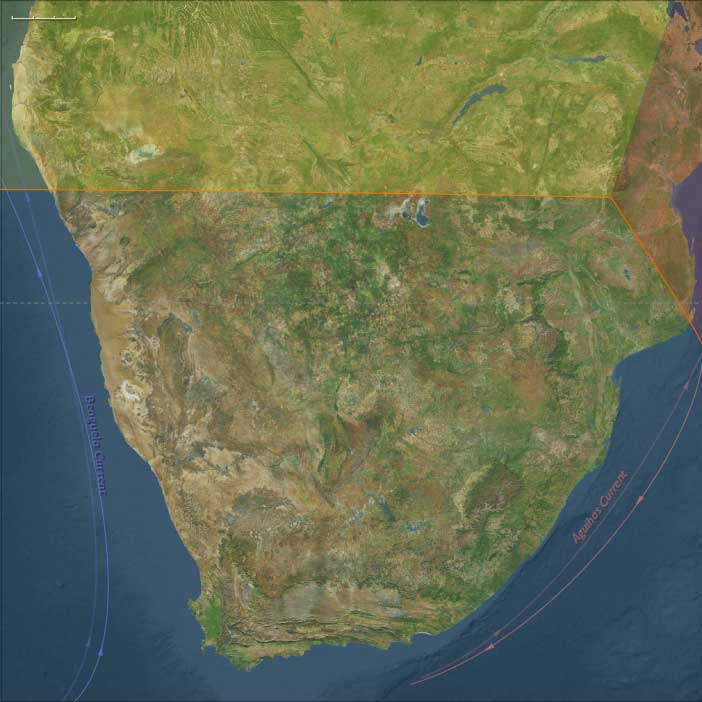
Anatomically modern and behaviorally modern humans in the southernmost tip of southern Africa inhabit the Klasies River Caves, a series of caves located to the east of the Klasies River mouth on the Tsitsikamma coast in the Humansdorp district of Eastern Cape Province, between 80,000 and 110,000 BCE.
There is a marked difference between the Paleolithic stone technology used in the earliest layers from one hundred and twenty-five thousand years ago years ago, and the superior Mesolithic blades of the seventy-thousand-year-old Howiesons Poort period that used raw material which had been 'mined' twenty kilometers inland.
There is also a differentiation between the Paleolithic food detritus that accumulated underfoot inside the caves one hundred and twenty-five thousand years ago, but is ejected and accumulated into external middens by the Mesolithic occupants circa seventy-five thousand years ago: housekeeping has now become standardized.
Locations
Subjects
Regions

Subregions
Related Events
Filter results
Showing 10 events out of 69725 total
The foundation population of the humans that today inhabit the world are the survivors of what appears to be an evolutionary bottleneck caused by a global catastrophe during the period that begins around 90,000 BCE.
The Toba supereruption (Youngest Toba Tuff or simply YTT), a supervolcanic eruption that occurs some time between sixty-nine thousand and seventy-seven thousand years ago at Lake Toba in Sumatra, Indonesia, is recognized as one of the Earth's largest known eruptions and is the most closely studied supereruption.
The related catastrophe hypothesis holds that this event plunged the planet into a six-to-ten-year volcanic winter and possibly an additional one thousand-year cooling episode.
This change in temperature results in the world's human population being reduced to ten thousand or even a mere one thousand breeding pairs, creating a bottleneck in human evolution.
Consistent with the Toba catastrophe theory, evolutionary biologist Richard Dawkins has postulated that human mitochondrial DNA (inherited only from one's mother) and Y chromosome DNA (from one's father) show coalescence at around one hundred and forty thousand and sixty thousand years ago, respectively.
In other words, all living humans' female line ancestry traces back to a single female (Mitochondrial Eve) at around one hundred and forty thousand years ago.
All humans can trace their ancestry with certainty via the male line back to a single male (Y-chromosomal Adam) at ninety thousand to sixty thousand years ago.
Homo sapiens sapiens apparently spreads rapidly from sub-Saharan Africa across the Sahara Desert and into the Near East, where the new species flourishes by 88,000 BCE.
The rapid expansion of anatomically modern humans out of Africa, beginning around 60,000 years ago, appears to coincide with the development of new stone tool-making techniques.
These innovations, which define the Upper Paleolithic period, distinguish the stone tool culture of Homo sapiens sapiens from the previously similar technologies of Neanderthals and other archaic human groups.
Key advancements include:
- The production of long, narrow flake tools, known as blades, which could be fashioned into a variety of specialized tools,
- The emergence of bone and ivory artifacts, and
- The eventual development of clothing, often sewn together and adorned with beads.
These technological advancements likely played a crucial role in the success and adaptability of early modern humans as they spread across new environments.
The history of indigenous Australians is thought to have spanned forty thousand to forty-five thousand years, although some estimates have put the figure at up to seventy thousand years before European settlement.
A genetic study of one hundred and eleven Aboriginal Australians, published in the journal Nature on March 8, 2017 (Aboriginal mitogenomes reveal 50,000 years of regionalism in Australia), implies that "the settlement of Australia comprised a single, rapid migration along the east and west coasts that reached southern Australia by 49–45 ka. After continent-wide colonization, strong regional patterns developed and these have survived despite substantial climatic and cultural change during the late Pleistocene and Holocene epochs. Remarkably, we find evidence for the continuous presence of populations in discrete geographic areas dating back to around 50 ka, in agreement with the notable Aboriginal Australian cultural attachment to their country.”
For most of this time, the Indigenous Australians lived as nomads and as hunter-gatherers with a strong dependence on the land and their agriculture for survival.
Only Africa has older physical evidence of habitation by modern humans.
There is also evidence of a change in fire regimes in Australia, drawn from reef deposits in Queensland, between seventy thousand years and one hundred thousand years years ago, and the integration of human genomic evidence from various parts of the world supports a date of before sixty thousand years for the arrival of Australian Aboriginal people in the continent.
Modern humans reach Australia by at least 58,000 BCE.
In 1990, a date of sixty thousand years was suggested for a rock shelter in the Northern Territory, but the finding, based on the use of a recently developed technique called thermoluminescence, is still being evaluated.
The first settlement would have occurred during an era of lowered sea levels, when there was an almost continuous land bridge between Asia and Australia, but watercraft must have been used at some points.
Eleven early humans, recognized as advanced members of the species Homo erectus and popularly known as Solo Man (from their grave site on a bank of the Solo River near the village of Ngandong in eastern Java, Indonesia), may have been the victims of cannibalistic activities.
Homo erectus soloensis, formerly classified as Homo sapiens soloensis, is generally now regarded as a subspecies of the extinct hominin, Homo erectus.
The only known specimens of this anomalous hominid were retrieved from sites along the Bengawan Solo River, on the Indonesian island of Java.
The remains are also commonly referred to as Ngandong, after the village near where they were first recovered.
Though its morphology was, for the most part, typical of Homo erectus, its culture was unusually advanced.
While most subspecies of Homo erectus disappeared from the fossil record roughly four hundred thousand years ago, H. e. soloensis persisted up until fifty thousand years ago in regions of Java and was possibly absorbed—or consumed—by a local Homo sapiens population at the time of its decline.
The fearsome cave bear (Ursus spelaeus) likely became extinct around 27,800 years ago, according to recent fossil reassessments.
Rather than a single cause, a combination of factors is believed to have led to its extinction. While overhunting by humans has largely been dismissed—since human populations at the time were too small to pose a significant threat—evidence suggests that cave bears and humans may have competed for shelter, particularly in caves.
Mitochondrial DNA research indicates that the cave bear's genetic decline began long before its extinction, ruling out climate change-induced habitat loss as the direct cause. However, a recent DNA study suggests that cave bear populations started declining around 50,000 years ago, coinciding with an increase in human populations.
Unlike its close relative, the brown bear, the cave bear was highly dependent on a vegetarian diet, making it less adaptable to environmental changes. Additionally, evidence suggests that cave bears exclusively used caves for hibernation, unlike brown bears, which could hibernate in thickets or other natural shelters. This specialized hibernation behavior likely contributed to high winter mortality when suitable caves were unavailable.
As human populations gradually expanded, both Neanderthals and anatomically modern humans increasingly occupied caves as living quarters, reducing the availability of essential hibernation sites for cave bears. Over time, this competition for shelter may have contributed to their gradual extinction.
Interestingly, cave bears are rarely depicted in prehistoric cave paintings, leading some researchers to speculate that human hunters may have avoided them, or that their habitat preferences simply did not overlap with early human settlements.
Cultural practices associated with modern humans—such as the careful burial of the dead, the creation of elaborate cave art, and the decoration of everyday objects—emerge during this period, reflecting an increasing sense of ritual, symbolism, and aesthetic expression.
The invention of writing was not a single event, but rather a gradual evolution, preceded by the use of symbols, possibly originating for ritual or cultic purposes.
Researchers from the University of Victoria in Canada suggest that Neolithic cave painters employed symbolism as a form of early communication.
"...Von Petzinger and Nowell were surprised by the clear patterning of the symbols across space and time—some of which remained in use for over twenty thousand years.
Their research identifies twenty-six distinct signs, which may represent the earliest evidence of a graphic code used by humans shortly after their arrival in Europe from Africa—or possibly even earlier, suggesting they brought this practice with them.
If confirmed, these findings would support the growing body of evidence that the so-called "creative explosion"—once thought to have occurred later—actually began tens of thousands of years earlier than previously believed.
Shanidar Cave, an archaeological site in the Zagros Mountains in South-Kurdistan (in Iraq), located in the valley of the Great Zab, was excavated between 1957-1961 by Ralph Solecki and his team from Columbia University and yielded the first adult Neanderthal skeletons in Iraq, dating between 60-80,000 years BP (Before Present).
The excavated area produced nine skeletons of Neanderthals of varying ages and states of preservation and completeness (labeled Shanidar I - IX).
M. Zeder recently discovered the tenth individual during examination of a faunal assemblage from the site at the Smithsonian Institution.
The remains seemed to Zeder to suggest that Neandertals had funeral ceremonies, burying their dead with flowers (although the flowers are now thought to be a modern contaminant), and that they took care of injured individuals.
Shanidar I, an elderly Neanderthal male known as Shanidar I, or ‘Nandy’ to its excavators, was aged between 40-50 years, which was considerably old for a Neanderthal, equivalent to eighty years old today, displaying severe signs of deformity.
He was one of four reasonably complete skeletons from the cave that displayed trauma-related abnormalities, which in his case would have been debilitating to the point of making day-to-day life painful.
At some point in his life, he had suffered a violent blow to the left side of his face, creating a crushing fracture to his left orbit that would have left Nandy partially or completely blind in one eye.
He also suffered from a withered right arm which had been fractured in several places and healed, but which caused the loss of his lower arm and hand.
This is thought to be either congenital, a result of childhood disease and trauma or due to an amputation later in his life.
The arm had healed but the injury may have caused some paralysis down his right side, leading to deformities in his lower legs and foot and would have resulted in him walking with a pronounced, painful limp.
All these injuries were acquired long before death, showing extensive healing and this has been used to infer that Neanderthals looked after the sick and aged, denoting implicit group concern.
Shanidar I is not the only Neanderthal at this site, or in the entire archaeological record, which displays both trauma and healing.
