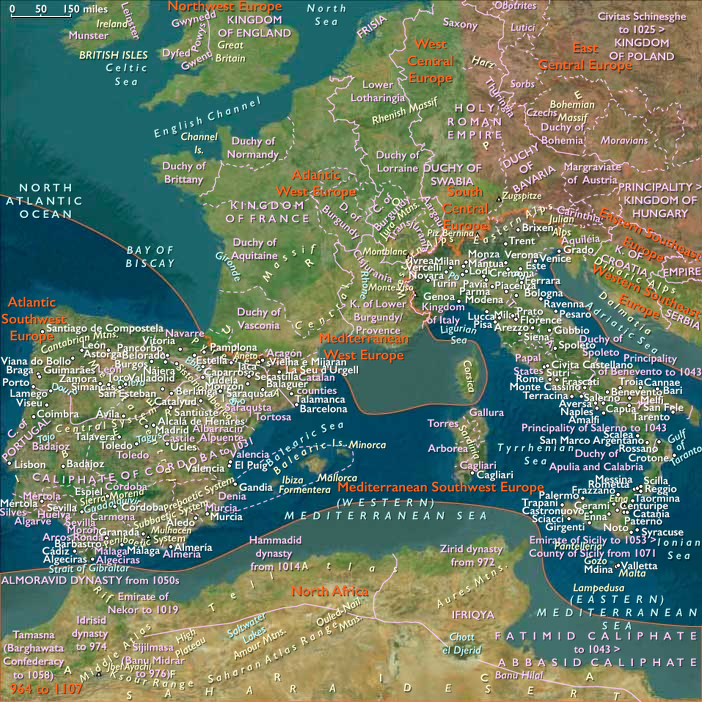
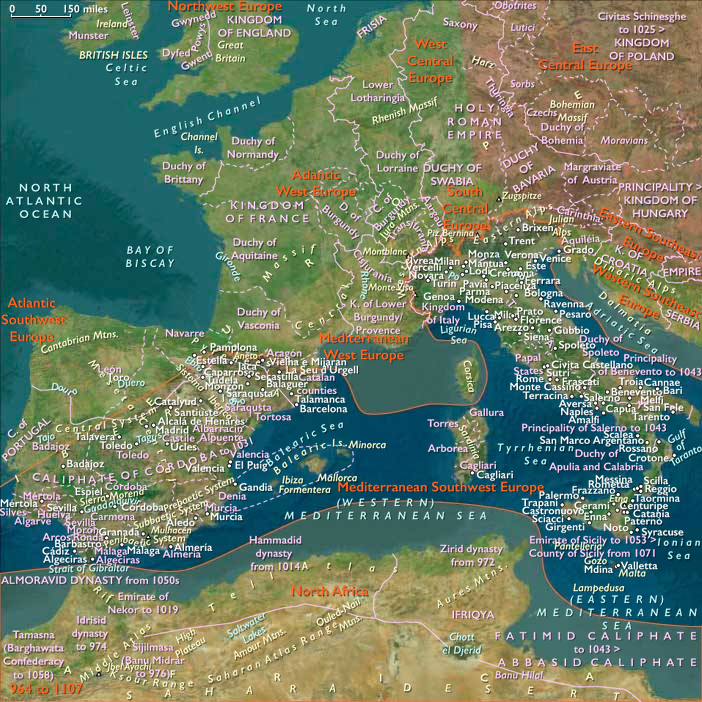
Trapani, one of two Saracen strongholds remaining …
Years: 1077 - 1077
Trapani, one of two Saracen strongholds remaining in the west of Sicily, is besieged by Roger Guiscard’s eldest son, the illegitimate Jordan of Hauteville, who leads a sortie in 1077 that successfully surprises the guards of the garrison's grazing animals.
Its food supply now cut off, the city soon surrenders.
Locations
People
Groups
Topics
Commodoties
Subjects
Regions
Subregions
Related Events
Filter results
Showing 10 events out of 50628 total
The Song have by 1077 destroyed two other Vietnamese armies and marched towards their capital at Thang Long (modern Hanoi).
Song forces halt at the Nhu Nguyet River (in modern Bac Ninh Province), where Ly Thurong Kiet has defensive ramparts built on the southern banks.
However, Song forces break through his defense line and their cavalry advances to within several kilometers of the capital city.
The Vietnamese counterattack and push Song forces back across the river while their coastal defenses distract the Song navy.
Ly Thurong Kiet also launches an offensive, but loses two Ly princes in the fighting at Kháo Túc River.
According to Chinese sources, "tropical climate and rampant disease" severely weaken Song's military forces while the Ly court fears the result of a prolonged war so close to the capital.
Anawrahta is considered one of the greatest, if not the greatest, kings of Burmese history for he has founded first "charter polity" of what will later become modern Burma.
Not only has he greatly expanded the Pagan Kingdom but he has also implemented a series of political and administrative reforms that will enable his empire to dominate the Irrawaddy valley and its periphery for another two hundred and fifty years.
Anawrahta's legacy goes far beyond the borders of modern Burma.
The success and longevity of Pagan's dominance over the Irrawaddy valley lays the foundation for the ascent of Burmese language and culture, the spread of Burman ethnicity in Upper Burma.
His embrace of Theravada Buddhism and his success in stopping the advance of the Khmer Empire, a Hindu kingdom, has provided the Buddhist school, which had been in retreat elsewhere in South and Southeast Asia, a much needed reprieve and a safe shelter.
He has helped restart Theravada Buddhism in Ceylon, the Buddhist school's original home.
The success of the Pagan dynasty makes possible Theravada Buddhism's later growth in Lan Na, Siam, Lan Xang, and Cambodia, also due in a large part to Ceylon's interactions with those lands, in the thirteenth and fourteenth centuries.
Anawrahta dies in March 1078 in the outskirts of Pagan.
The chronicles hint that his enemies ambushed and killed him and then disposed of the body in such a way that it was never found.
The chronicles state that a nat (spirit) appeared in the guise of wild buffalo and gored him to death, and then demons took away his body.
Shao Yong is a member of a group of thinkers who gathers in Luoyang toward the last three decades of the eleventh century.
This group has two primary objectives.
One of these is to draw parallels between their own streams of thought and that of Confucianism as understood by Mencius.
Secondly, the men set out to undermine any links, real or otherwise, between fourth-century Confucianism and what they viewed as inferior philosophical schools of thinking, namely Buddhism and Taoism.
Other loosely connected members of this so-called network of thinkers include: Cheng Yi, Zhang Zai, Cheng Hao and Zhou Dunyi.
Central to each of these men was the ancient text I Ching, which each had studied closely.
The way in which Shao studies this ancient text, however, differs from the other members.
During the Song Dynasty, there are two main approaches in I Ching studies.
Together with the majority of scholars, the other members of the group take the yili xue (principle study") approach, which is based on literalistic and moralistic concepts.
The other approach, taken by Shao alone, is the xiangshu xue ("image-number study") approach, which is based much more on iconographic and cosmological concepts.
An approach to I Ching divination known as Mei Hua Yi has been attributed to him.
Shao Yong also edits the "Tai Hsuan Jing" by Yang Hsiung (CE 10).
Influenced by the Base Three number system found in the Tai Hsuan, Shao Yong then sets the Hexagrams of the I Ching into a binary order (the Fu Hsi Ordering).
This in turn will influence Leibniz and his thinking on binary arithmetic, and in turn the language of modern computers.
Shao is also famous for his poetry and for his interest in the game of Go (wéiqí).
He writes a Great Ode to Watching Wéiqí, one of the longest surviving classical Chinese poems, as well as a Long Ode to Watching Wéiqí.
The octagonal, nine-story pagoda of the great Hossho-ji sanctuary, located on an island on axis with the “kondo,” and endowed by Emperor Shirakawa in fulfillment of a sacred vows, is constructed in 1077 at Heian (now Kyoto).
Shen Kuo, to allow more accurate astronomical observations and recordings, has improved the technical designs of the rotating armillary sphere, the gnomon, the clepsydra clock, and the sighting tube.
He has calibrated the standard diameter of the sighting tube's width, hence allowing the observation of the polestar indefinitely (which had shifted since the time of Zu Geng in the fiftht century).
With these, Shen and Wei have attempted to predict the mean speeds of the planets as well as the accurate positions of the planets in their orbits.
They have established a system of observing and recording on a star map the exact coordinates of the planets, done three times a night for a total of five years.
Shen Kuo has made a cosmological hypotheses in explaining the variations of planetary motions, including the concept of retrogradation.
On the other hand, Wei Pu realizes that the old calculation technique for the mean sun is inaccurate compared to the apparent sun, since the latter is ahead of it in the accelerated phase of motion, and behind it in the retarded phase.
Hence, he incorporates solar motion into the eclipse theory.
The Song Dynasty astronomers of Wei's day still retain the lunar theory and coordinates of the earlier Yi Xing (683-727), which after three hundred and fifty years has devolved into a state of considerable error.
To fix this, Shen and Wei have kept similar astronomical records, three times a night over five years, for the orbital path of the moon.
Wei and Shen's work is deeply opposed by the officials and fellow astronomers at court, who are offended by their insistence that the coordinates of the renowned Yi Xing are inaccurate.
The elite, well-educated ministers and leading astronomers are also insulted by the fact that Wei Pu had been born a commoner, yet holds more expertise in his field than many of them.
When Wei and Shen make a public demonstration using the gnomon to prove the doubtful wrong, the other ministers reluctantly agree to correct the lunar error.
Although correcting the lunar error is a success, the other ministers and officials eventually dismiss Wei and Shen's recorded course plotting of planetary motions, while the court relies upon the inefficient and older model.
This means that only the very worst errors are corrected for planetary motion.

Jaromír, an ally of Henry IV during the Investiture Controversy, is appointed chancellor by Henry and takes the name Gebhard in 1077.
Henry now takes Jaromír to Germany, to the great relief of his brother Vratislaus II.
Construction of the Hohensalzburg Castle begins in 1077 under Archbishop Gebhard von Helfenstein.
The original design is just a basic bailey with a wooden wall.
In the Holy Roman Empire, the archbishops of Salzburg are already powerful political figures and they will soon expand the castle to protect their interests.
Gebhard's conflict with Emperor Henry IV during the Investiture Controversy will influence the expansion of the castle, with the Archbishop taking the side of Pope Gregory VII and the German anti-king Rudolf of Rheinfelden.
The castle will be gradually expanded during the following centuries.
Welf, turning against the emperor, changes sides during the Investiture Controversy—supporting Pope Gregory VII as well as lending his support for the election of Rudolf of Rheinfelden as anti-king in March 1077.
Pope and emperor had been superficially reconciled in 1076, but the following year had seen them again engaged in active hostilities.
Henry, in consequence of these repeated acts of rebellion, declares Welf deposed in his newly acquired duchy.
However, supported by his faithful Bavarians, and aided by his father in Italy, Welf is able to maintain his place, and openly defy the ban of the empire in May 1077.
Welf joins the discontented princes who support he standard of Rudolph, at a time when any who refuse to follow the pope's direction can expect to be excommunicated by the church—a potent and effective threat in the social and political conditions of the time.
The Turkish conquest of Nicaea and Nicomedia prompts Emperor Michael to appeal to Pope Gregory VII for aid against the Seljuqs, promising in return his support for the reunification of the Roman Catholic and Orthodox churches.
In need of help to uphold his unstable throne, Michael arranges the marriage of his son, Constantine, to one of Robert Guiscard's daughters, Helen.
The emperor has fallen increasingly under the influence of Nicephoritzes, an official who attempts to create a state monopoly in grain.
His policy not only angers the great landowners but also leads to higher prices and discontent among the people.
When rioting breaks out in Constantinople, two rival commanders, Nikephoros Bryennios and Nikephoros Botaneiates, each proclaims himself emperor, respectively, at Adrianople and at Nicaea.
Bryennios assembles an army of Thracians, Bulgarians, Macedonians, Sclavonians, Italians, Franks, Uzes (Cumans) and Greeks.
In November 1077, his forces reach the walls of Constantinople.
Unconcerned about the inhabitants of Constantinople, he allows his troops to plunder and burn the city's suburbs.
The conduct of his troops produces so determined an opposition to his claims, that the detested Michael forces him to raise the siege and retreat into Thrace, using the excuse of a Pecheneg incursion into Thrace as cover.