…the Athenian commander Chares actually helps an …
Years: 360BCE - 360BCE
…the Athenian commander Chares actually helps an oligarchy to power on Corcyra at the end of the 360s.
Locations
People
Groups
Topics
Subjects
Regions
Subregions
Related Events
Filter results
Showing 10 events out of 64725 total
Agesilaus dies at age eighty-four on his way home to Greece in 360 BCE; his son, who had shown great courage in the defense of Sparta against Epaminondas, succeeds him as Archidamus II.
Athens, which has installed garrisons and cleruchies and has even levied tribute under the euphemistic name of “contributions” despite the charter of 377 BCE, fails even to respect its most basic political guarantees: …
Perdiccas tries to reconquer upper Macedonia from the Illyrian Bardylis in 360 BCE, but the expedition ends in disaster, with the king killed in a catastrophic battle.
Philip, originally appointed regent for his infant nephew Amyntas IV, the son of Perdiccas, soon manages to take the kingdom for himself, ascending the throne in 359 as Philip II.
The Illyrians continue to raid from the northwest, the Paeonians from the north, and foreign powers continues to support two claimants to the throne other than Philip, a man of exceptional energy, diplomatic skill, and ruthlessness.
Philip's military skills and expansionist vision of Macedonian greatness bring him early success.
He first has to reestablish a situation which had been greatly worsened by the defeat against the Illyrians, Macedon's permanent enemies.
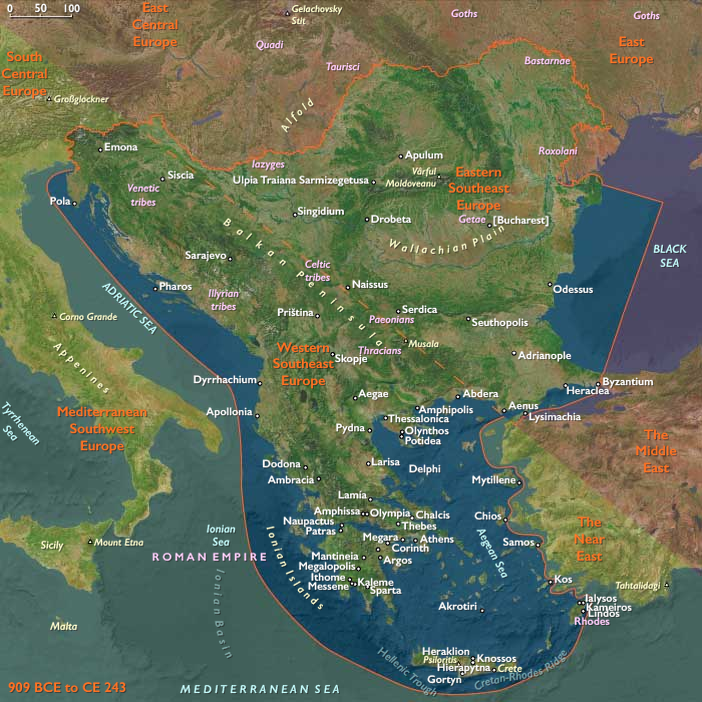
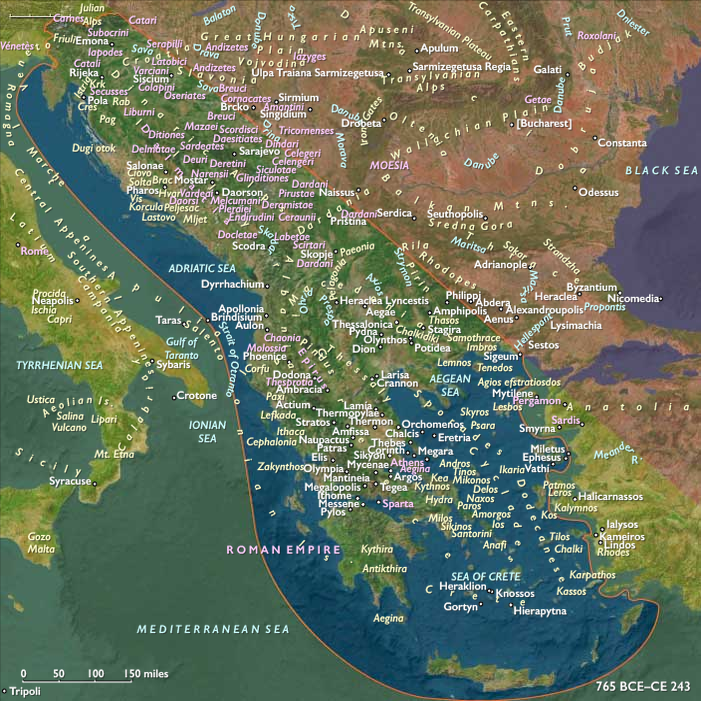
The Illyrians prepare to close in; the Paeonians, forced northward by the growth of Macedon, are raiding from the north, the Thracians have sacked and invaded the eastern regions of the country, while the Athenians have landed at Methoni on the coast, a contingent under a Macedonian pretender called Argeus.
Using diplomacy, Philip pushes back the Paeonians and Thracians promising tributes, and crushes the three thousand Athenian hoplites.
Bardyllis is killed in battle after Philip rejects his offer of peace based on retaining conquered lands.
Momentarily free from his opponents, Philip concentrates on strengthening his internal position and, above all, his army, introducing more rigorous training and employing mercenaries.
His most important innovation is doubtless the introduction of the phalanx infantry corps, armed with the famous sarissa, an exceedingly long spear, at this time the most important army corps in Macedonia.
This enables him to inflict defeats on the Illyrians and other northern enemies such as Paeonia, which he invades in 358.

The Persians have managed in the waning years of Artaxerxes II to defeat a joint Egyptian–Spartan effort to conquer Phoenicia.
Artaxerxes spends much of his wealth on building projects.
He has restored the palace of Darius I at Susa, and also the fortifications; including a strong redoubt at the southeast corner of the enclosure and given Ecbatana a new apadana and sculptures.
In inscriptions at Susa and Persepolis, Artaxerxes invokes the aid of the gods Mithra and Anahite, as well as of Ahura Mazda: an indication of a new development in the Persian religion of Zoroastrianism.
He is reported to have had a number of wives.
His main wife was Stateira, until she was poisoned by Artaxerxes' mother Parysatis in about 400 BCE.
He has also married several of his own daughters.
Another chief wife is a Greek woman of Phocaea named Aspasia (not the same as the concubine of Pericles).
Artaxerxes II is said to have more than one hundred and fifteen sons from three hundred and fifty wives.
Ochus, a son of Artaxerxes, satrap and commander of his father's army, attacks Egypt in 359 BCE as a reaction to Egypt's failed attacks on coastal regions of Phoenicia.
Artaxerxes dies in the following year at the age of 86, apparently because of a broken heart caused by his children's behavior.
Since his other sons, Darius, Ariaspes and Tiribazus had already been eliminated by plots, Ochus succeeds him as emperor.
As Artaxerxes III, his first order is the execution of over eighty of his nearest relations to secure his place as emperor.
He quickly restores royal authority over the satrapies of the west.
The insurrection (362–359), which had severely shaken Persian rule in Anatolia), results in a considerable measure of subsequent local autonomy for the Greek cities of Ionia.
Bardylis, ruler of Dardania, had assumed control of much of the region of present-day Macedonia in 359 after killing Macedon’s king Perdiccas III.
After the death of Bardylis in the following year, Grabos becomes the most powerful Illyrian king.
Bardyllis had a son named Cleitus the Illyrian, a daughter named Bircenna, and a grandson named Bardyllis II.
The Illyrian kingdom has become a formidable local power.
Philip defeats the Illyrians decisively in 358 BCE, however, in a battle that already suggests a master of war, and assumes control of their territory as far as Lake Ohrid.
An Illyrian kingdom based in modern-day Shkodër, Albania, remains an important factor in the region, however.
Philip makes a string of advantageous “marriages” at the same time, some more official than others and scarcely amounting to more than politically slanted concubinage; one of these is to an Illyrian princess, Audata.
Eastern Sicily is Greek and the west Carthaginian.
The Greeks expelled from Naxos in 403 by Dionysius the Elder at last find refuge in 358 at Tauromenium with the Siculi, whom the Syracusan tyrant had resettled there in about 392 BCE.
It flourishes under the mild rule of Andromachus, father of the historian Timaeus, who lives from about 356 BCE to about 260 BCE.
Isolated examples of copper-zinc alloys are known in China from as early as the fifth millennium BCE; in small numbers from a number of third millennium BCE sites in the Aegean, Iraq, the United Arab Emirates, Kalmikia, Turkmenistan and Georgia; and from second millennium BCE sites in West India, Uzbekistan, Iran, Syria, Iraq and Palestine.
The compositions of these early "brass" objects are very variable and most have zinc contents of between five percent and fifteen percent by weight, which is lower than in brass produced by cementation.
These may be "natural alloys" manufactured by smelting zinc rich copper ores in reducing conditions.
Many have similar tin contents to contemporary bronze artifacts and it is possible that some copper-zinc alloys were accidental and perhaps not even distinguished from copper.
However, the large number of copper-zinc alloys now known suggests that at least some were deliberately manufactured and many have zinc contents of more than twelve percent, which would have resulted in a distinctive golden color.
Assyrian cuneiform tablets from the eighth–seventh century BCE mention the exploitation of the "copper of the mountains,” which may refer to "natural" brass.
Oreichalkos, the Ancient Greek translation of this term, is later adapted to the Latin aurichalcum, meaning "golden copper" which becomes the standard term for brass.
Plato, describing Atlantis in the Critias and the Timaeus in the fourth century BCE, knew oreichalkos as rare and nearly as valuable as gold.
Pliny describes how aurichalcum had come from Cypriot ore deposits, which will be exhausted by the first century CE.
Charidemus has borne the prominent part in the ensuing contests and negotiations with Athens for the possession of the Thracian Chersonese, Cersobleptes appearing throughout as a mere cipher.
The peninsula seems to have been finally ceded to the Athenians in 357 BCE, though they will not occupy it with their settlers until 335; nor perhaps is the language of Isocrates so decisive against this early date as it may appear at first sight.
For some time after the cession of the Chersonese, Cersobleptes continues to court assiduously the favor of the Athenians, being perhaps restrained from aggression by the fear of their squadron in the Hellespont.
On the death of Berisades, before 352 BCE, Cersobleptes conceives, or rather Charidemus conceives for him, the design of excluding the children of the deceased prince from their inheritance, and obtaining possession of all the dominions of Cotys; and it is with a view to the furtherance of this object that Charidemus obtains from the Athenian people, through his party among the orators, the decree in his favor for which its mover Aristocrates is impeached, but unsuccessfully, in the speech of Demosthenes yet extant.
From a passing allusion in this oration, it appears that Cersobleptes had been negotiating with king Philip II of Macedon for a combined attack on the Chersonese, which however came to nothing in consequence of the refusal of Amadocus to allow Philip a passage through his territory.
But after the passing of the decree above-mentioned, Philip became the enemy of Cersobleptes, and in 352 BCE made a successful expedition into Thrace, gained a firm ascendancy in the country, and brought away a son of Cersobleptes as a hostage.
Both Cersobleptes and Amadocus appear to have been subjected by Philip early in 347 BCE, not long after Cetriporis, the son and successor of Berisades, suffered the same fate.
The two rulers, having appealed to the Macedonian ruler to arbitrate a dispute between them, were then been forced to acknowledge his suzereinty when the "judge" showed up with an army.
At the time of the peace between Athens and Philip in 346 BCE, we find Cersobleptes again involved in hostilities with the Macedonian king, who in fact is absent in Thrace when the second Athenian embassy arrives at his capital Pella, and does not return to give them audience until he has completely conquered Cersobleptes.