
Fujiwara no Fuhito had been the most …
Years: 720 - 720
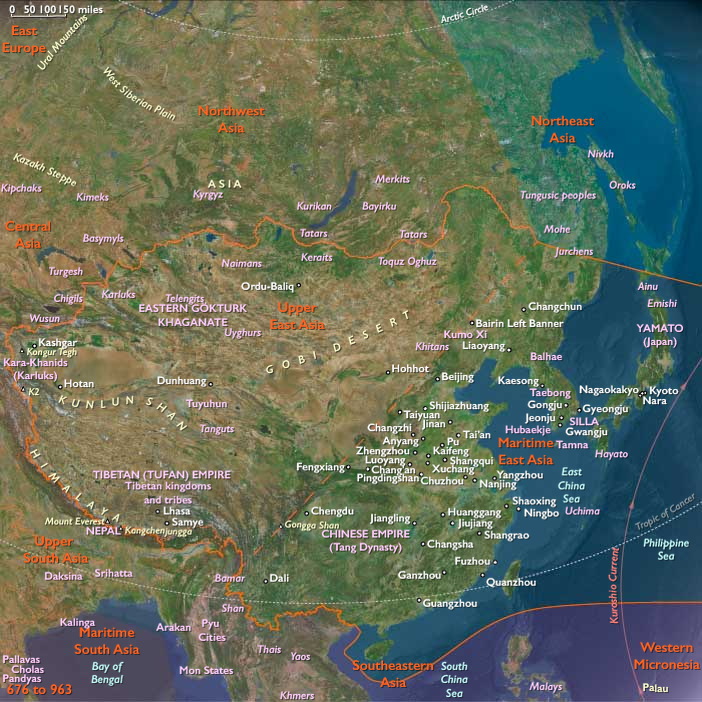
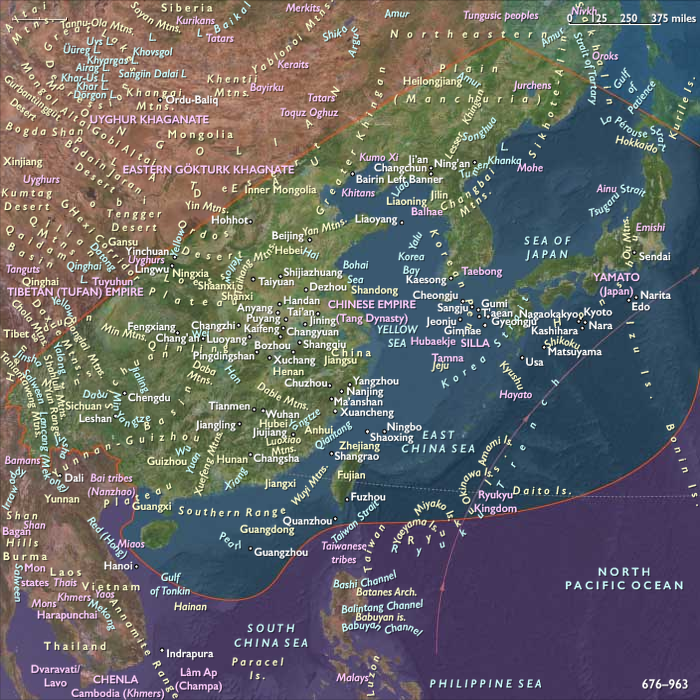
Fujiwara no Fuhito had been the most powerful courtier in Empress Gemmei's court up to his death in 720, when his first cousin Prince Nagaya, a grandson of Emperor Temmu and a cousin of the empress, assumes the powers held by Fujiwara.
A second compilation of legendary and semihistorical Japanese traditions, the Nihonshoki (“Chronicles of Japan”), completed in 720 under Empress Gensho, includes legends about the origins of the Japanese people and, like the Kojiki, attributes the foundation of the state to a mythological emperor Jimmu in 660 BCE.
The Nihonshoki focuses more on recent events and contains material on early Japanese contacts with Korea and China, including the legend of the empress Jingo, who allegedly conquered Korea in the second century CE.
The first two of the thirty books comprising the Nihonshoki present an alternate version of the creation myth that appears in the Kojiki; The remaining twenty-eight books concern the history of Japan up to the end of the seventh century.
The Kojiki and the Nihonshoki are regarded in a sense as sacred books of Shinto but they are also books about the history, topography, and literature of ancient Japan.
It is possible to construct Shinto doctrines from them by interpreting the myths and religious practices they describe.
Broadly speaking, Shinto has no founder.
When the Japanese people and Japanese culture became aware of themselves, Shinto was already there.
Nor has it any official scripture that can be compared to the Bible in Christianity or to the Qur'an in Islam.
Japanese temples begin to become larger and more splendid complexes as Buddhism, encouraged by the Nara emperors, begins to spread throughout Japan.
The Japanese Buddhist Hosso sect monastery of Yakushi-ji, founded in 680 in Kashihara, had been moved to its present location after the Japanese capital had moved to Nara and been refounded in 718.
The “kondo,” or assembly hall, constructed around 720, resembles a Chinese throne hall, with the two pagodas situated far from the center of the complex.
Dedicated to Yakushi, the Healing Buddha, it is one of the finest examples of religious architecture of the Nara period.
Among its many treasures of Japanese art are the famous Nara-period sculpture group known as the Yakushi triad (statues of Buddha, Nikko, and Gakko).
Locations
People
Groups
Topics
Subjects
Regions
Subregions
Related Events
Showing 10 events out of 55636 total
Years: 720 - 720
Locations
People
Groups
Topics
Subjects
Regions
Subregions