
unhilda’s Vengeance and the Continuation of the …
Years: 575 - 575
unhilda’s Vengeance and the Continuation of the Frankish Civil War (575–613 CE)
Following the assassination of her husband, Sigebert I, in 575 CE, Brunhilda, Queen of Austrasia, takes up the fight against Chilperic I of Neustria and his wife Fredegund, the suspected orchestrator of the murder. This dynastic feud, which had already devastated the Frankish realm, now turns into a multi-generational conflict, as Brunhilda continues the savage civil war between Austrasia and Neustria.
1. Brunhilda’s Struggle for Power in Austrasia
- With Sigebert dead, his son Childebert II (only five years old at the time) becomes King of Austrasia, with Brunhilda as his regent.
- However, her position is not secure—many Austrasian nobles resist her influence, as she is a Visigothic princess and a strong-willed woman in a male-dominated court.
- Despite opposition, Brunhilda consolidates power, relying on loyal aristocrats and her alliance with Guntram, King of Burgundy.
2. War with Neustria: Brunhilda vs. Fredegund
- Chilperic and Fredegund seize the opportunity of Sigebert’s death to try to expand Neustrian territory into Austrasia.
- Brunhilda, determined to avenge her husband, leads Austrasia in a prolonged war against Neustria.
- The war becomes a brutal power struggle between two queens—Brunhilda and Fredegund, both ruling through their sons and engaging in ruthless political maneuvers.
3. The Death of Chilperic (584 CE) and Fredegund’s Regency
- In 584 CE, Chilperic is assassinated, allegedly on Fredegund’s orders to remove a political threat.
- Fredegund becomes regent for their infant son, Chlothar II, continuing to battle Brunhilda and Childebert II for control of Frankish lands.
- The Neustrian-Austrasian conflict persists, fueled by assassinations, betrayals, and shifting alliances.
4. The Next Generation: Childebert II’s Death and Continued Conflict
- Childebert II dies in 595 CE, leaving Brunhilda as regent for her grandsons Theudebert II (Austrasia) and Theuderic II (Burgundy).
- However, the Frankish aristocracy turns against Brunhilda, eventually leading to her fall from power.
- In 613 CE, Brunhilda is captured by Chlothar II, Fredegund’s son, and is executed in a brutal fashion, marking the end of her decades-long war with Neustria.
Conclusion: A Multi-Generational Civil War
The murder of Sigebert I in 575 CE does not end the conflict between Austrasia and Neustria—instead, it escalates into a war between two queens, Brunhilda and Fredegund, and their descendants.
- Brunhilda’s determination to avenge her husband ensures that the war rages on for nearly forty years.
- Her political ambition and resilience make her one of the most formidable women in Merovingian history, though it ultimately leads to her violent downfall.
- The long conflict weakens the Merovingian dynasty, setting the stage for the rise of the Carolingians in the following century.
Brunhilda’s war redefines Frankish politics, marking the sixth and seventh centuries as an era of dynastic struggle, blood feuds, and shifting alliances that shape the future of medieval France and Western Europe.
Locations
People
Groups
- Franks
- Soissons (eventually Neustria), Frankish Kingdom of
- Paris, Frankish Kingdom of
- Orléans (eventually Burgundy), Frankish Kingdom of
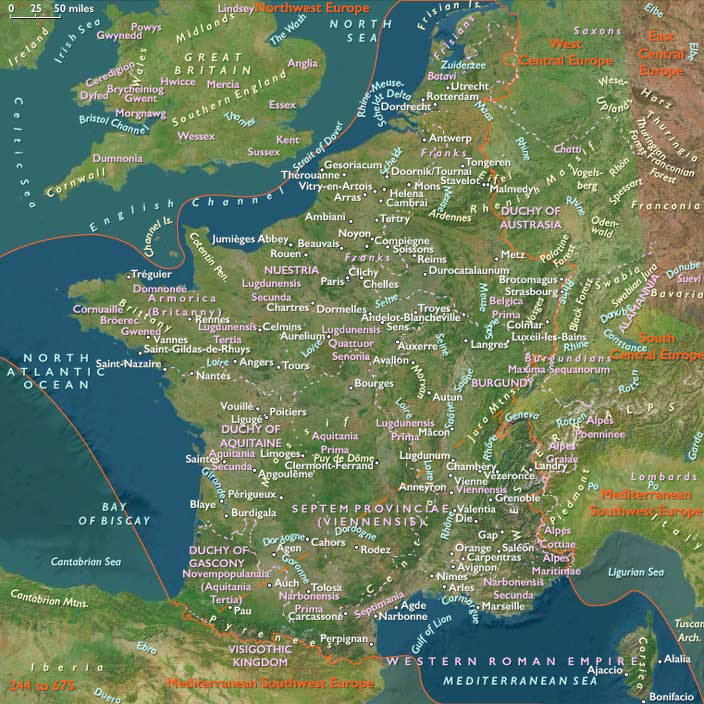
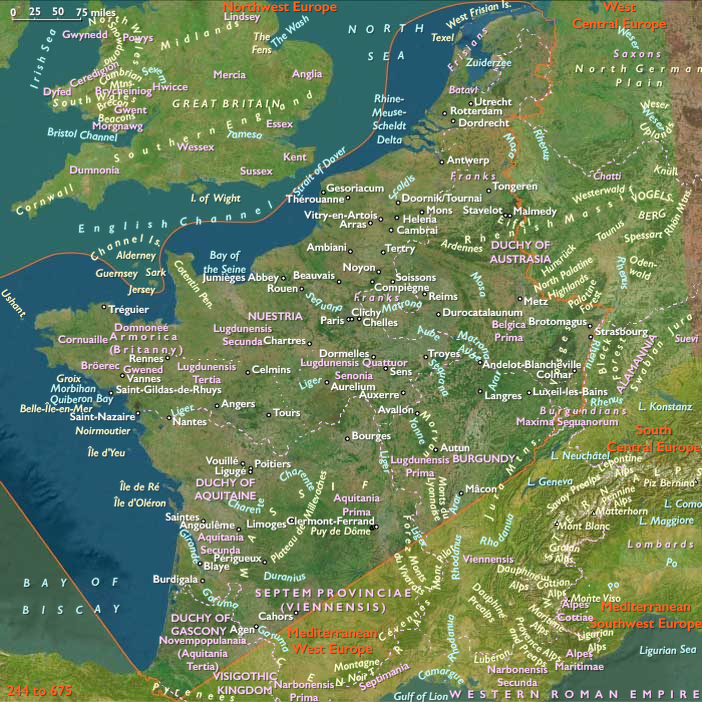
- Reims and Metz (eventually Austrasia), Frankish Kingdom of
Topics
Commodoties
Subjects
Regions
Subregions
Related Events
Showing 10 events out of 57408 total
Years: 575 - 575
Locations
People
Groups
- Franks
- Soissons (eventually Neustria), Frankish Kingdom of
- Paris, Frankish Kingdom of
- Orléans (eventually Burgundy), Frankish Kingdom of
- Reims and Metz (eventually Austrasia), Frankish Kingdom of
Topics
Commodoties
Subjects
Regions
Subregions