
A land bridge at, or shortly before, …
Years: 6237BCE - 6094BCE
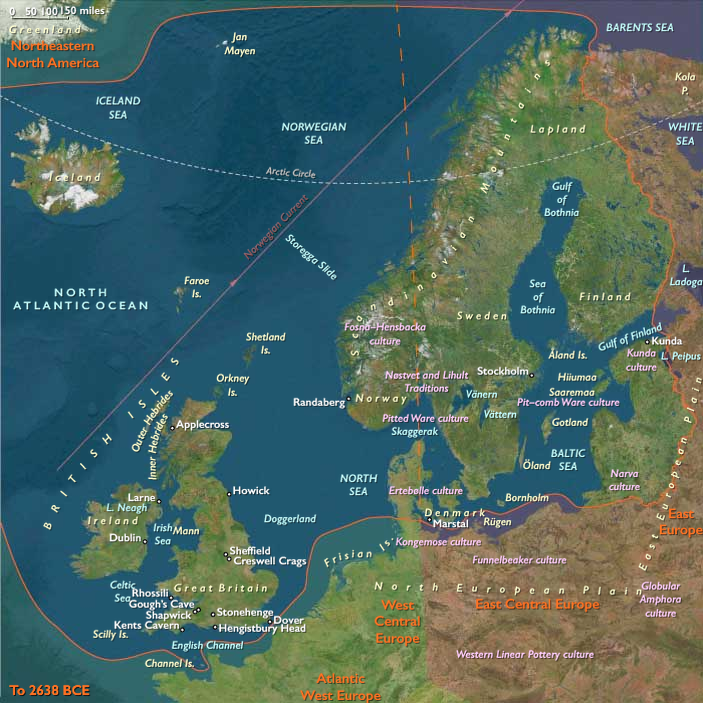
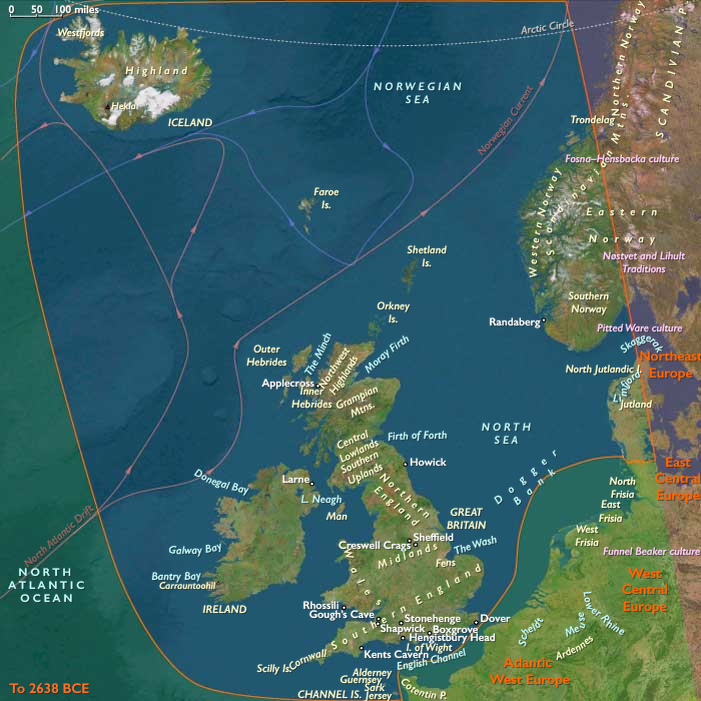
A land bridge at, or shortly before, around 6100 BCE known to archaeologists and geologists as "Doggerland" linked Great Britain with Denmark and the Netherlands across what is now the southern North Sea.
This area is believed to have included a coastline of lagoons, marshes, mudflats, and beaches, and to have been a rich hunting, fowling and fishing ground populated by Mesolithic human cultures.
Doggerland is physically submerging through a gradual rise in sea level, but it has been suggested that coastal areas of both Britain and mainland Europe, extending over areas which are now submerged, would have been inundated by a tsunami triggered by the Storegga Slide.
This event would have had a catastrophic impact on the contemporary Mesolithic population, and separated cultures in Britain from those on the European mainland.
The three Storegga Slides, considered to be among the largest known landslides, occurred under water, at the edge of Norway's continental shelf (Storegga is Norwegian for the "Great Edge"), in the Norwegian Sea, one hundred kilometers northwest of the Møre coast, causing a very large tsunami in the North Atlantic Ocean.
This collapse involves an estimated two hundred and ninety kilometer length of coastal shelf, with a total volume of thirty-five hundred square kilometers of debris.
Based on carbon dating of plant material recovered from sediment deposited by the tsunami, the latest incident occurred around 6100 BCE.
Traces of the subsequent tsunami have been recorded in Scotland, with deposited sediment being discovered in Montrose Basin, the Firth of Forth, up to eighty kilometers inland and four meters above current normal tide levels.
Locations
Topics
- Mesolithic Europe
- Atlantic Period during the Neolithic Subpluvial
- 8.2 kiloyear event during the Neolithic Subpluvial
Commodoties
Subjects
Regions
Subregions
Years: 6237BCE - 6094BCE
Locations
Topics
- Mesolithic Europe
- Atlantic Period during the Neolithic Subpluvial
- 8.2 kiloyear event during the Neolithic Subpluvial
Commodoties
Subjects
Regions
Subregions