
At Merv, a major Central Asian oasis-city …
Years: 1145 - 1145
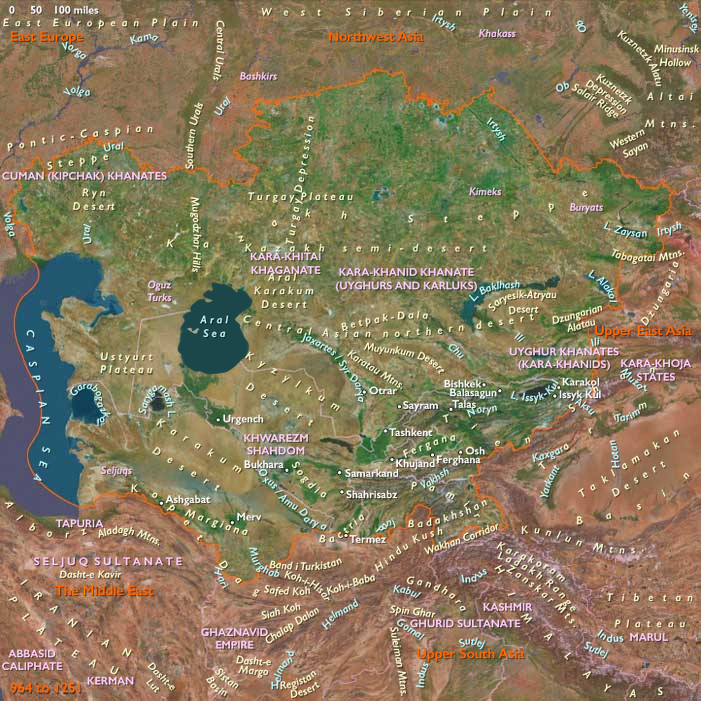
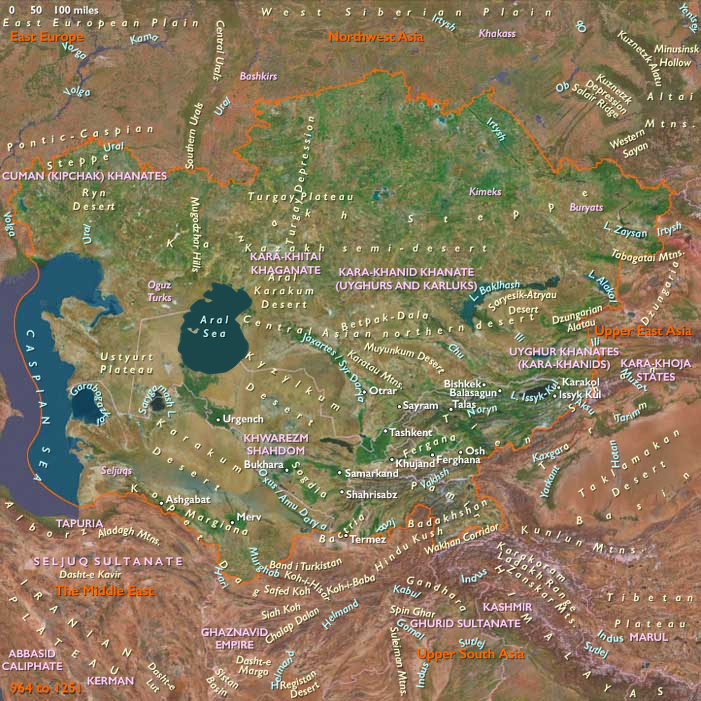
At Merv, a major Central Asian oasis-city on the historical Silk Road, located near today's Mary in Turkmenistan, the Tahirids had been in turn replaced by the Samanids and then the Ghaznavids.
In 1037, the Seljuqs, a clan of Oghuz Turks moving from the steppes east of the Aral Sea, had peacefully taken over Merv under the leadership of Toğrül Beg—the Ghaznavid sultan Masud being extremely unpopular in the city.
Toğrül’s brother Çagry had stayed in Merv as the Seljuq domains grew to include the rest of Khurasan and Iran, and it has subsequently become a favorite city of the Seljuq leadership.
Under Toğrül’s descendants, especially Sultan Ahmed Sanjar, who has made it his residence, Merv finds itself at the center of a large multicultural empire.
Alp Arslan is buried at Merv.
It is during this period that Merv has expanded to its greatest size—Arab and Persian geographers term it “the mother of the world”, the “rendezvous of great and small”, the “chief city of Khurasan” and the capital of the eastern Islamic world.
Written sources also attest to a large library and madrasa founded by the celebrated Persian scholar and vizier of the Seljuq Empire, Nizam al-Mulk, as well as many other major cultural institutions.
Perhaps most importantly, Merv is said to have a market that is “the best of the major cities of Iran and Khurasan” (Herrmann 1999).
With a population of two hundred thousand, Merv has become the largest city of the world, taking the lead from Constantinople.
Locations
People
Groups
- Iranian peoples
- Arab people
- Persian people
- Khorasan, Greater
- Oghuz Turks
- Turkmen people
- Seljuq Empire (Isfahan)
Subjects
Regions
Subregions
Years: 1145 - 1145
Locations
People
Groups
- Iranian peoples
- Arab people
- Persian people
- Khorasan, Greater
- Oghuz Turks
- Turkmen people
- Seljuq Empire (Isfahan)
Subjects
Regions
Subregions