
At least fourteen sites from Korea's Middle …
Years: 2205BCE - 2062BCE
At least fourteen sites from Korea's Middle Jeulmun period (circa 3500-2000 BCE) have yielded evidence of cultivation in the form of carbonized plant remains and agricultural stone tools. (Choe, C P and Martin T Bale (2002) Current Perspectives on Settlement, Subsistence, and Cultivation in Prehistoric Korea. For example, Crawford and Lee, using AMS dating techniques, directly dated a domesticated foxtail millet (Setaria italica ssp. italica) seed from the Dongsam-dong Shellmidden site to the Middle Jeulmun (Crawford, Gary W. and Gyoung-Ah Lee 2003. Agricultural Origins in the Korean Peninsula. Antiquity 77(295):87-95.).
Another example of Middle Jeulmun cultivation is found at Jitam-ri (Chitam-ni) in North Korea.
A pit-house at Jitam-ri yielded several hundred grams of some carbonized cultigen that North Korean archaeologists state is millet.
However, not all archaeologists accept the grains as domesticated millet because it was gathered out of context in an unsystematic way, only black-and-white photos of the find exist, and the original description is in Korean only.
Cultivation was likely a supplement to a subsistence regime that continued to heavily emphasize deep-sea fishing, shellfish gathering, and hunting.
"Classic Jeulmun" or Bitsalmunui pottery in which comb-patterning, cord-wrapping, and other decorations extend across the entire outer surface of the vessel, appeared at the end of the Early Jeulmun and is found in West-central and South-coastal Korea in the Middle Jeulmun.
Locations
Groups
Topics
Commodoties
Subjects
Regions
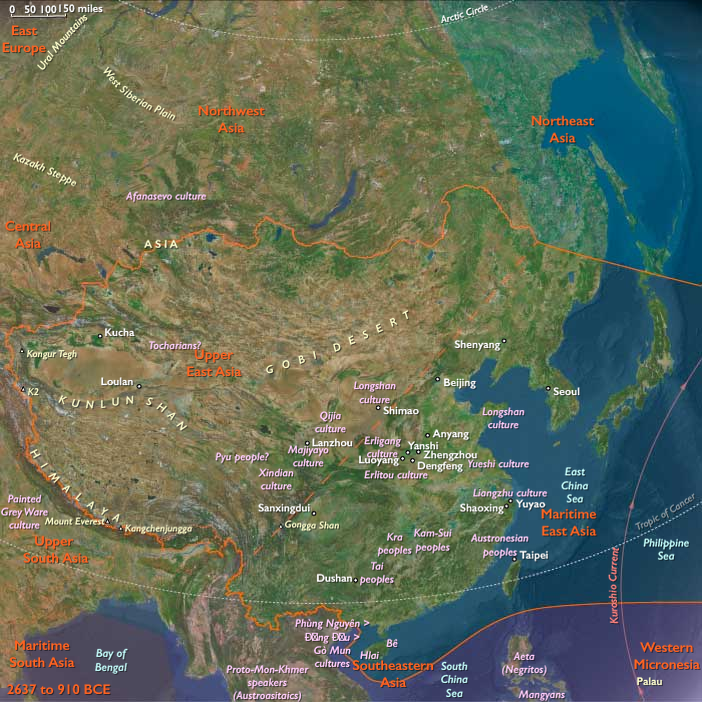
Subregions
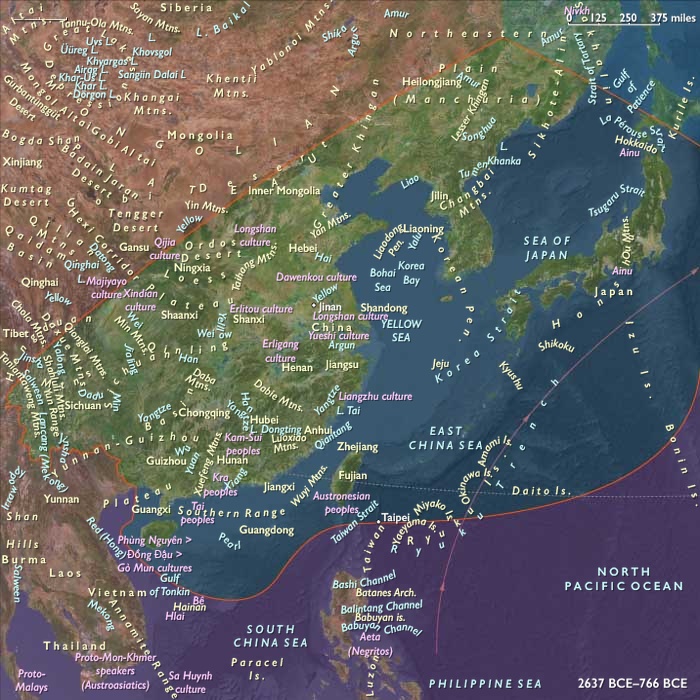
Years: 2205BCE - 2062BCE
Locations
Groups
Topics
Commodoties
Subjects
Regions
Subregions