
Ulrich Ochsenbein champions the revision of the …
Years: 1846 - 1846
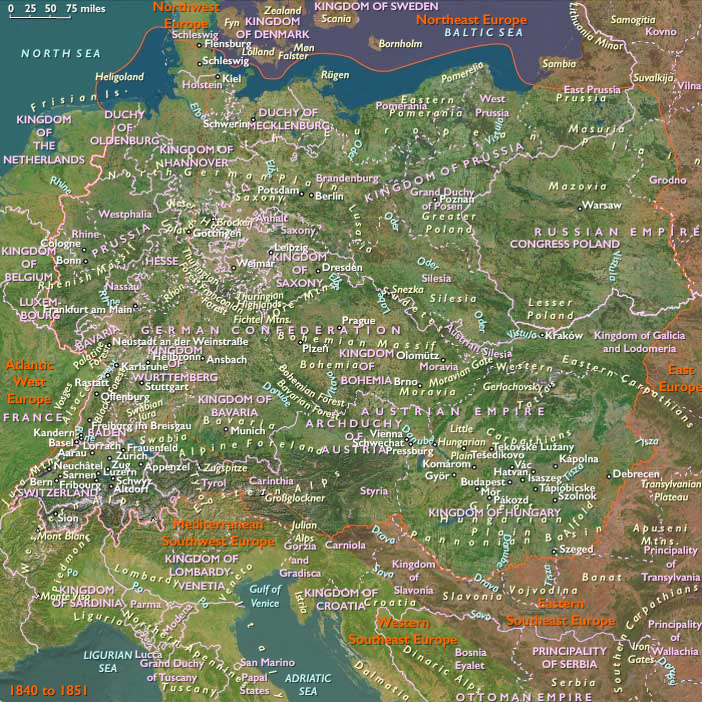
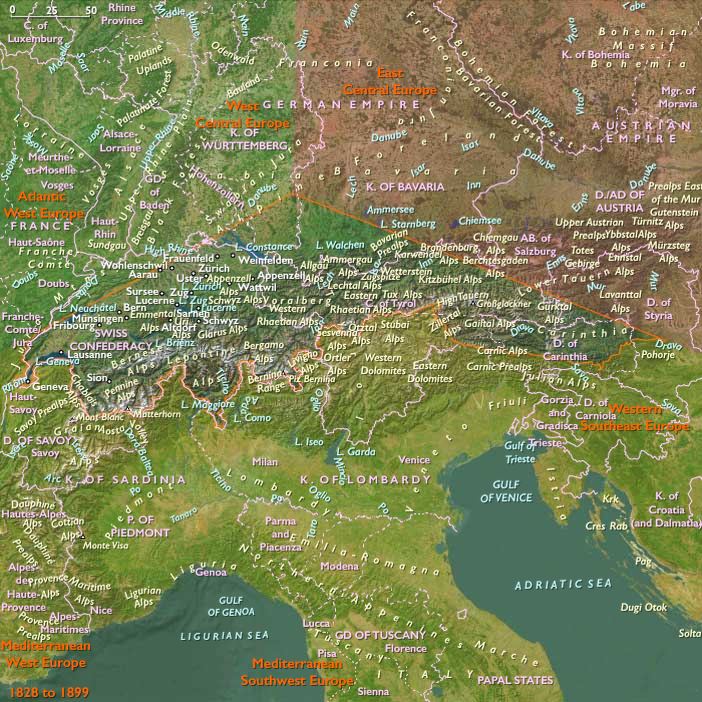
Ulrich Ochsenbein champions the revision of the cantonal constitution (1846) at Bern, and heads the department of the Sonderbund's army.
Locations
Groups
Topics
Subjects
Regions
Subregions
Related Events
Filter results
Showing 10 events out of 17048 total
Augustus Charles Gregory, an English-born surveyor who had migrated with his parents to Western Australia in 1829, explores the region north of Perth in 1846 with two brothers.
The European Economic Depression and Agricultural Crises (1845–1848)
The pan-European economic depression, accompanied by widespread crop failures, entered its second year in 1846, intensifying social unrest, economic hardship, and political instability across Europe. The continued agricultural collapse and industrial downturn exacerbated tensions between the ruling elites and the working classes, fueling the conditions that would eventually culminate in the Revolutions of 1848.
The Worsening Agricultural Crisis (1846)
-
Crop Failures Intensify
- The potato blight (Phytophthora infestans) persisted, further devastating harvests across Ireland, Scotland, and Germany, worsening famine conditions.
- Grain shortages became even more severe, leading to soaring food prices and widespread hunger.
- Rural distress deepened, particularly in France, Italy, and Austria, where peasant revolts and migrations increased.
-
Escalating Industrial Decline
- A prolonged downturn in manufacturing caused mass layoffs, especially in textile-producing regionsof Britain, Belgium, and Germany.
- Factory closures and declining wages fueled working-class agitation in urban centers.
-
Financial Strains and Government Responses
- Credit shortages and faltering investor confidence triggered bank failures in several European financial hubs.
- Governments struggled to maintain stability, with rising public debt and fiscal crises adding to the turmoil.
Escalating Social and Political Consequences
-
The Irish Great Famine deepens (1845–1852)
- Starvation and disease spread, with over a million deaths and escalating emigration.
-
Food Riots and Urban Uprisings Spread
- Hunger-driven unrest and demands for relief intensified in France, the German states, and Italy.
- The failure of authorities to address grievances led to increased revolutionary sentiment.
-
Monarchies and Conservative Regimes Weaken
- Governments across Europe faced growing pressure for constitutional reforms and social relief measures.
- Political dissatisfaction among the bourgeoisie and working classes continued to build momentum toward radical upheaval.
Toward the Revolutions of 1848
As 1846 unfolded, the deepening economic and food crisis eroded confidence in existing political structures. The inability of monarchies and conservative governments to address economic distress would accelerate calls for political change, setting the stage for the widespread revolutions that would erupt two years later.
Jews from Galicia begin to dominate trade, crafts, and money lending in the Ottoman principalities of Moldavia and Wallachia, where a native-Romanian bourgeoisie is virtually nonexistent.
The boyars, using Jews as middlemen, grow rich through the Black Sea wheat trade, but the peasants reap few benefits.
Construction of the first major roadways, beginning in the 1840s, links the principalities, and in 1846, the Paris-educated Gheorghe Bibescu, prince of Wallachia since 1842, agrees with ...
...Moldavia's Prince Mihail Sturdza to dismantle customs barriers between the principalities, marking the first concrete move toward unification.
The Dhofar, governed by Mohammad ibn-Agil al-Ajaibi in the early nineteenth century, remains culturally and politically linked to South Arabia until the 1840s, when the region is absorbed into the Al Bu Sa'id Omani state.
Ascanio Sobrero formulates nitroglycerin while working at the University of Torino in 1846 under Théophile-Jules Pelouze, who had worked with the explosive material guncotton.
He initially calls his discovery "pyroglycerin", and warns vigorously against its use in his private letters and in a journal article, stating that it is extremely dangerous and impossible to handle.
A crop failure in France in 1846 quickly develops into a full-scale economic crisis, as food becomes scarce and expensive.
Many businesses go bankrupt, and unemployment soars.
Within the French governing elite itself there are signs of a moral crisis: scandals that implicate some high officials of the regime and growing dissension among the Notables.
Along with this goes a serious alienation of many intellectuals.
Novelists such as Victor Hugo, George Sand, and Eugène Sue glorify the common man; historians such as Jules Michelet and Alphonse de Lamartine write with romantic passion about the heroic episodes of the Great Revolution; and the caricaturist Honoré Daumier exposes the foibles of the nation's leaders.
Alexandre Dumas, responding to the immense success of The Three Musketeers, produces a sequel, Twenty Years After, in 1846.
The partial crop failure of 1845 in Ireland is followed by more devastating failure in 1846.
The British government's efforts to relieve the famine are inadequate.
Prime Minister Sir Robert Peel had done what he could to provide relief in 1845 and early 1846, but under the Liberal cabinet of Lord John Russell, which assumes power in June 1846, the emphasis shifts to reliance on Irish resources and the free market, which makes disaster inevitable.
After Daniel O'Connell advises against the use of force, O'Brien leads the Young Irelanders in withdrawing from the National Repeal Association on July 27, 1846.
At creation the company purchases all the patents Cooke and Wheatstone have obtained to date.
