
Assyria’s poor agricultural land is insufficient to …
Years: 885BCE - 874BCE
Assyria’s poor agricultural land is insufficient to sustain its growing population.
With the accession of Assurnasirpal II in 883 upon the death of his father, Tukulti-Ninurta II, the Assyrian army begins to make sweeps south and west to plunder their neighbors' cities, a practice bolstered by a developing ideology that the god Ashur, the patron of the city of Ashur, deserves homage from all neighboring peoples.
A shrewd administrator, Ashurnasirpal II realizes that he can gain greater control over his empire by installing Assyrian governors rather than depending on local client rulers paying tribute.
His brutal treatment of rebels ensures that even when his army is not present, there will not be further revolts.
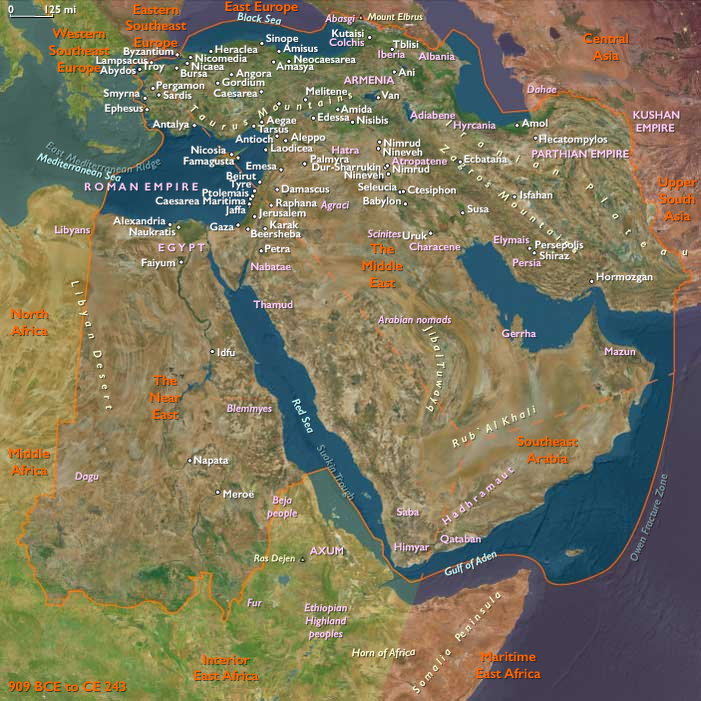
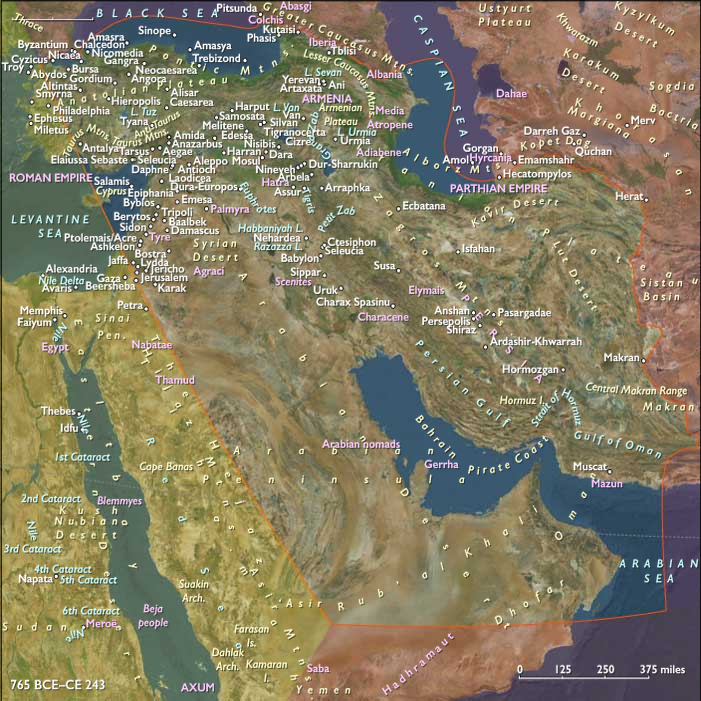
On his return back home he moves to the city of Kalhu (Nimrud), which is in modern-day Iraq slightly north of Baghdad, and where he uses enslaved captives to build a new capital.
The palaces, temples and other buildings raised by Ashurnasirpal II bear witness to a considerable development of wealth and art.
Leading his army, which is typically composed of infantry (including auxiliaries and foreigners), heavy and light cavalry and chariots, Assurnasirpal has embarked on a vast program of expansion, first conquering the peoples to the north in Asia Minor as far as Nairi and exacting tribute from Phrygia, then invading Aram (modern Syria) conquering the Aramaeans and Syro-Hittites between the Khabur and the Euphrates Rivers.
His harshness prompts a revolt in the city of Suru in Bit-Halupe, which he crushes decisively in a pitched, two-day battle.
According to his monument inscription, while recalling this massacre, he says "their men young and old I took prisoners. Of some I cut off their feet and hands; of others I cut off the ears noses and lips; of the young men's ears I made a heap; of the old men's heads I made a marinet. I exposed their heads as a trophy in front of their city. The male children and the female children I burned in flames; the city I destroyed, and consumed with fire."
Following this victory, he advances without opposition as far as the Mediterranean and exacts tribute from Phoenicia.
He does not destroy the Phoenician/Canaanite cities he conquers.
Instead they become sources of the raw materials his armies and his building programs.
Iron is needed for weapons, Lebanese cedar for construction and gold and silver for the payment of troops.
The walls of his palace, built and completed in 879 BCE, are lined with reliefs elaborately carved in alabaster, many portraying the king surrounded by winged protective spirits, or engaged in hunting or on campaign.
Each also has text inscribed in it.
This text is the same or very similar on each relief and is therefore called the Standard Inscription.
The Standard Inscription begins by tracing Ashurnasirpal II's lineage back three generations and recounts his military victories, defines the boundaries of his empire, tells how he founded Kalhu, and built the palace.
The British archaeologist A.H. Layard excavated Kalhu in the 1840s, uncovering the North-West Palace of Ashurnasirpal II.
Today, many of the reliefs from the excavations in Nimrud are displayed in the galleries of the British Museum, London, with other reliefs on display in museums in Europe (e.g., Munich), Japan and the USA.
Locations
People
Groups
- Mesopotamia
- Aramaeans
- Phoenicians
- Phrygia, Kingdom of
- Syro-Hittite states
- Aram-Damascus (Syria), Kingdom of
- Assyria, (New) Kingdom of (Neo-Assyrian Empire)
- Assyrian people
Topics
- Younger Subboreal Period
- Iron Age, Near and Middle East
- Assyrian Wars of c. 909-c. 746 BCE
- Iron Age Cold Epoch
Commodoties
Subjects
- Commerce
- Writing
- Watercraft
- Engineering
- Sculpture
- Environment
- Labor and Service
- Conflict
- Mayhem
- Faith
- Government
- Technology
- Archaeology
- Movements
Regions
Subregions
Related Events
Showing 10 events out of 25 total
Years: 885BCE - 874BCE
Locations
People
Groups
- Mesopotamia
- Aramaeans
- Phoenicians
- Phrygia, Kingdom of
- Syro-Hittite states
- Aram-Damascus (Syria), Kingdom of
- Assyria, (New) Kingdom of (Neo-Assyrian Empire)
- Assyrian people
Topics
- Younger Subboreal Period
- Iron Age, Near and Middle East
- Assyrian Wars of c. 909-c. 746 BCE
- Iron Age Cold Epoch
Commodoties
Subjects
- Commerce
- Writing
- Watercraft
- Engineering
- Sculpture
- Environment
- Labor and Service
- Conflict
- Mayhem
- Faith
- Government
- Technology
- Archaeology
- Movements
Regions
Subregions