The Achaemenids dominate the whole of the …
Years: 333BCE - 190BCE
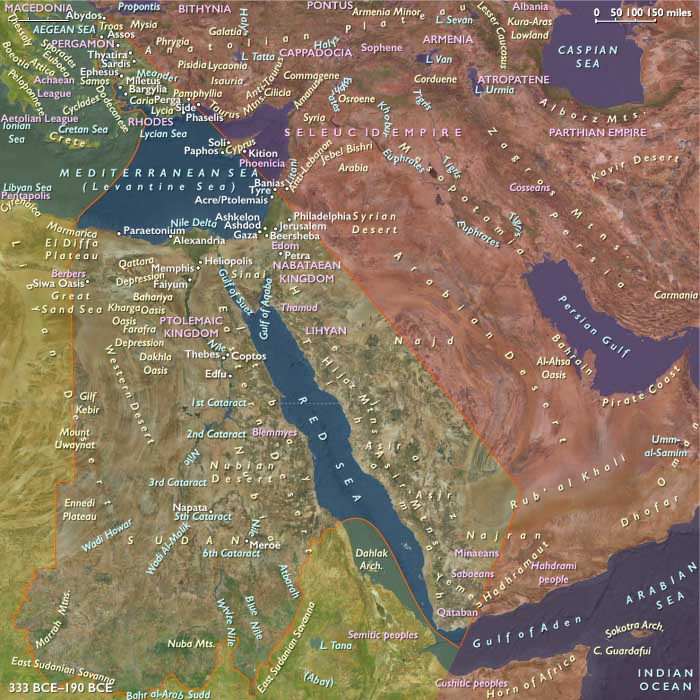
The Achaemenids dominate the whole of the Near and Middle East for two centuries until the rise of Macedonian power under Alexander the Great.
Alexander, leading a small but well-trained army, had crossed into Asia in 334 BCE, defeated Persia's forces, and within a few years has built an empire that stretches from the Nile River to the Indus River in contemporary Pakistan.
Alexander's conquests are divided among his Macedonian generals after his death in 323 BCE.
The Ptolemaic Dynasty of pharaohs in Egypt and the line of Seleucid kings in Syria are descended from two of these generals.
People
Groups
- Semites
- Hebrews
- Achaemenid Empire
- Alexander, Empire of
- Ptolemy, Kingdom of
- Seleucus, Kingdom of
- Egypt, Ptolemaic Kingdom of
- Seleucid Kingdom
- Seleucid Empire
Topics
Subjects
Regions
Subregions
Related Events
Filter results
Showing 5 events out of 5 total
Atlantic West Europe (484–495): Visigothic and Burgundian Consolidation Amid Frankish Ambitions
Between 484 and 495, Atlantic West Europe saw the Visigothic and Burgundian kingdoms solidify their territorial control, while the Salian Franks emerged as a significant new force. This era witnessed growing stability in the Visigothic territories, internal consolidation under Burgundian King Gundobad, and the rise of Clovis I, whose ambitions foreshadowed the eventual reshaping of the region.
Political and Military Developments
-
Visigothic Kingdom under Alaric II (r. 484–507):
-
After Euric's death in 484, his son Alaric II inherited a vast kingdom extending from Aquitaine across the southern and western regions of Gaul.
-
Alaric II maintained diplomatic relations with neighboring kingdoms and strengthened governance by codifying laws, balancing Visigothic authority and Roman legal traditions.
-
-
Burgundian Kingdom’s Internal Stability:
-
King Gundobad (r. 473–516) solidified control in Burgundy, quelling internal rivalries through diplomacy and force, centralizing governance around Lyon and Geneva.
-
Gundobad issued the Lex Burgundionum (c. late 5th century), codifying laws for his kingdom that balanced Germanic and Roman elements, securing internal cohesion.
-
-
Rise of the Salian Franks under Clovis I (r. 481–511):
-
The ambitious Merovingian King Clovis I united various Frankish tribes north of the Loire, significantly expanding his influence into northern Gaul.
-
His defeat of the Roman official Syagrius at the Battle of Soissons (486) ended Roman political authority in northern Gaul, marking the rise of Frankish dominance in the region.
-
Economic and Social Developments
-
Gradual Ruralization and Villa Economies:
-
With the continued decline of urban centers, rural villa estates became central to economic life, focusing on localized agricultural productivity.
-
Powerful aristocratic families and ecclesiastical institutions consolidated their landholdings, strengthening economic and political ties with the Germanic rulers.
-
-
Economic Realignment and Trade Networks:
-
Trade and commerce increasingly shifted toward regional patterns, reflecting the decentralized political environment. Bordeaux and Lyon remained significant centers of commerce, maintaining trade connections with Italy, the Mediterranean, and Iberia.
-
Despite disruptions, river systems such as the Rhône and Loire facilitated internal commerce, sustaining the exchange of luxury goods and basic commodities.
-
Religious and Cultural Developments
-
Episcopal and Aristocratic Leadership:
-
Bishops continued to consolidate their dual roles as spiritual and civic leaders, managing religious affairs and local governance. This role was exemplified by Remigius of Reims (later instrumental in Clovis's conversion) and Avitus of Vienne, who mediated between Gundobad’s Burgundian court and Roman cultural traditions.
-
Aristocratic families actively supported ecclesiastical foundations, enhancing the role of the Church in daily life, governance, and education.
-
-
Continued Religious Tolerance and Arianism:
-
Alaric II maintained his kingdom’s official Arian Christianity, tolerating the Catholic majority, ensuring internal harmony and stability.
-
Burgundian King Gundobad, though initially Arian, showed increasing openness to Catholic influences, creating an environment favorable to religious coexistence and eventual integration.
-
Legacy and Significance
By 495, Atlantic West Europe had stabilized into distinct political territories, each adapting elements of Roman governance and law:
-
Visigothic rule under Alaric II provided relative stability, maintaining coexistence of Roman and Germanic traditions.
-
Gundobad's Burgundian kingdom emerged politically cohesive, with internal stability secured by legal and cultural accommodations.
-
Clovis’s rise and expansion of Frankish power began reshaping the political landscape of Gaul, setting the stage for future regional unification and shifts in power dynamics.
This period thus laid critical foundations for the medieval political and cultural structures that would characterize the following centuries.
Atlantic West Europe (496–507): The Rise of the Franks and the Shifting Balance of Power
Between 496 and 507, Atlantic West Europe underwent a significant realignment of political authority. The dramatic rise of the Merovingian Franks under Clovis I reshaped regional power dynamics, culminating in the decisive Battle of Vouillé (507). Meanwhile, the Visigothic and Burgundian kingdoms continued their internal consolidation, adapting to an increasingly Frankish-dominated Gaul.
Political and Military Developments
-
Clovis I’s Expansion and Consolidation of Frankish Power:
-
Clovis I famously converted to Catholic Christianity (traditionally dated around 496), cementing alliances with Gallo-Roman bishops and nobility.
-
The conversion enabled Clovis to unify his Frankish subjects and gain support from the powerful Catholic Church, setting the stage for significant territorial expansions in western Europe.
-
-
Battle of Vouillé (507): Decisive Shift in Power:
-
At the pivotal Battle of Vouillé in 507, Clovis decisively defeated Visigothic King Alaric II, who died during the battle.
-
This victory allowed the Franks to conquer Visigothic territories north of the Pyrenees, including the strategic regions of Aquitaine and Toulouse, drastically shrinking the Visigothic kingdom in Gaul.
-
-
Visigothic Kingdom: Retreat to Hispania:
-
After their defeat at Vouillé, Visigothic authority retreated southward, focusing on their territories in Hispania.
-
Gesalec briefly succeeded Alaric II but struggled to maintain stability, and internal struggles further weakened Visigothic power north of the Pyrenees.
-
-
Burgundian Kingdom under Gundobad: Stability Amid Change:
-
King Gundobad (r. 473–516) navigated the shifting alliances cautiously, preserving Burgundian autonomy by diplomatic engagement with Clovis and limited territorial compromises.
-
Economic and Social Developments
-
Integration under Frankish Rule:
-
Frankish control promoted economic integration between northern Gaul and newly conquered southern territories, facilitating commerce and trade via revived river networks (Loire and Garonne).
-
The Frankish elite integrated Gallo-Roman aristocratic structures, preserving continuity in local governance and administration.
-
-
Strengthening of Rural Aristocratic and Ecclesiastical Power:
-
The Church and local aristocrats solidified control over rural economies, managing extensive agricultural estates. Episcopal authority expanded further, especially with Frankish support for bishops as key intermediaries.
-
Religious and Cultural Developments
-
Clovis's Conversion and the Catholic Church:
-
Clovis’s embrace of Catholic Christianity dramatically enhanced the Church's status, aligning Frankish royal authority with episcopal power and promoting Catholic orthodoxy against Arianism.
-
Bishops like Remigius of Reims and Avitus of Vienne became influential spiritual and political figures under Frankish patronage.
-
-
Decline of Arianism:
-
Visigothic defeats accelerated the decline of Arian Christianity north of the Pyrenees. The Catholic Church’s increasing authority under Frankish protection encouraged widespread conversion to Catholicism.
-
Legacy and Significance
By 507, the balance of power in Atlantic West Europe had profoundly shifted:
-
The Frankish kingdom under Clovis emerged dominant, significantly reshaping the political landscape of Gaul and integrating Roman and Germanic traditions under a Catholic identity.
-
Visigothic power withdrew to Iberia, profoundly altering their territorial and cultural focus.
-
Burgundy retained autonomy but recognized Frankish supremacy, adapting to the new political order.
This era marked a critical turning point, laying foundations for the medieval Frankish kingdoms that would dominate Western Europe in subsequent centuries.
The Germanic Alemanni tribe invades the Ripuarian Frankish kingdom of Cologne.
Clovis, responding to a Ripuarian appeal, leads the Salian Franks to a decisive victory over the Alemanni at the Battle of Tolbiac, southwest of Cologne, and (possibly) again, at the same place, ten years later (some historians believe this later battle to be the only Battle of Tolbiac).
The pagan Frankish king Clovis, influenced by his wife Clotilda, a Christian Burgundian princess, according to Gregory of Tours, writing a century or so after Tolbiac, converts after the battle to orthodox Christianity, baptized by Remi, archbishop of Reims, supposedly with three thousand followers. (Clovis reputedly prayed to his wife’s god during the battle, promising to convert to her faith if he prevailed.)
The Frankish nation follows his example.
He regularizes the relations of his kingdom with the episcopate in Gaul and essentially allies with the church.
This is a significant departure from the path of other Germanic kings, like those of the Visigoths and Vandals, who had embraced Arianism.
Though this act strengthens the bonds between his Roman Christian subjects, who follow the orthodox line, and their Germanic conquerors, this conversion from Clovis’s Frankish pagan beliefs alienates many of the other Frankish sub-kings (as Bernard Bachrach has argued) and will serve to weaken his military position over the next few years. (Gregory of Tours wrote that the pagan beliefs which Clovis abandoned were in Roman gods such as Jupiter and Mercury, rather than their Germanic equivalents, which is an indication of the extent which the Franks had already adopted Roman culture.)
Gregory first inserted the thematic element that has shaped subsequent interpretations of Tolbiac as a climacteric in the course of European history: Clovis is said to have attributed his success to a vow that he had made: if he won, he would convert to the religion of the Christian God who had aided him.
He became a Christian in a ceremony at Reims at Christmas 496; the traditional date of the battle of Tolbiac has been established to accord with this firmly attested baptismal date, by accepting as literal truth Gregory's account, which has a clear parallel with the conversion of Constantine I, connected by Lactantius with the equally conclusive Battle of the Milvian Bridge.
A surviving letter from Avitus of Vienne, congratulating Clovis on his baptism, makes no mention of the supposed recent battlefield conversion.
The traditional date of the battle in 496 was challenged in the late nineteenth century by Augustine van de Vyver, whose revised chronology placed the battle in 506.
This was extensively debated and is followed in some modern accounts.
The date of 506 also follows Gregory’s chronology, which places the death of Childeric around the same time as that of St. Pertpetuus who died in 491.
Hence fifteen years from 491 would be 506.
Coin evidence from Childeric's grave contain coins of Emperor Zeno who died in 491, but none after.

Bishop Avitus of Vienne has published treatises in confutation of the Nestorian, Eutychian, and Sabellian heresies; he has also written against the Pelagian errors of Faustus, abbot of Lerins, and converted many Jews who had settled in his diocese (Venant. Fortun. l. v. c. 5).
Atlantic West Europe (508–519): Frankish Consolidation, Burgundian Stability, and Ecclesiastical Strengthening
Between 508 and 519, Atlantic West Europe saw the Merovingian Franks consolidate territorial and political gains following the decisive Battle of Vouillé (507). The Frankish Kingdom under Clovis I stabilized its dominance over Gaul, integrating Gallo-Roman traditions, legal structures, and ecclesiastical institutions. Meanwhile, the Burgundian kingdom preserved a degree of autonomy under careful diplomacy, and the Visigothic presence receded definitively into Iberia.
Political and Military Developments
-
Frankish Kingdom: Consolidation under Clovis I
-
Following the conquest of Visigothic territories in Gaul, Clovis I secured his gains by establishing stable governance across Aquitaine and southwestern Gaul, aligning closely with regional bishops and Gallo-Roman aristocrats.
-
He actively fostered administrative continuity by adopting Roman law traditions, notably issuing the Lex Salica (Salic Law) in revised form around 511, blending Roman and Germanic customs.
-
-
Division of the Frankish Kingdom (511):
-
Clovis’s death in 511 led to the division of the Frankish kingdom among his four sons: Theuderic, Chlodomer, Childebert, and Chlothar.
-
Each son governed a portion of the realm from their regional capitals: Metz (Theuderic), Orléans (Chlodomer), Paris (Childebert), and Soissons (Chlothar). This partition initiated a complex phase of dynastic rivalries, although unity was maintained against external threats.
-
-
Burgundian Stability under Gundobad and Sigismund:
-
King Gundobad (d. 516) maintained careful diplomatic relations with the Frankish rulers, preserving Burgundian territorial integrity.
-
His successor, Sigismund (r. 516–524), continued this balancing act, though Frankish pressures intensified. The kingdom remained autonomous, emphasizing internal governance and legal reforms.
-
-
Visigothic Kingdom Retreat and Reorientation:
-
Visigothic territories north of the Pyrenees had been largely lost by 508. The remaining Visigothic kingdom reorganized south of the Pyrenees under King Theodoric the Great of the Ostrogoths, who intervened as regent following internal Visigothic strife.
-
Visigothic focus shifted definitively toward Iberia, leading to a long-term reorientation of Visigothic culture and governance toward Hispania.
-
Economic and Social Developments
-
Integration of Roman and Frankish Economic Structures:
-
The Frankish kingdom's economic foundation became increasingly tied to extensive agricultural estates managed by bishops and aristocrats, who served as intermediaries between royal authority and local populations.
-
Economic integration between northern and southern Gaul expanded, driven by regional trade networks that benefited from the Frankish peace and internal stability.
-
-
Growing Role of Aristocracy and Church:
-
Frankish and Burgundian aristocrats strengthened their roles in managing land and resources, often controlling local governance in cooperation with bishops.
-
Episcopal estates grew, becoming significant centers of economic and social power, further linking secular and religious authority.
-
Religious and Cultural Developments
-
Strengthening of Catholic Orthodoxy:
-
Clovis’s embrace of Catholic Christianity continued to reshape religious identity. The Catholic Church gained unprecedented influence, with episcopal leaders such as Remigius of Reims playing crucial political roles.
-
Ecclesiastical synods (e.g., Council of Orléans in 511) helped standardize religious practices, clarify episcopal authority, and support Merovingian royal legitimacy.
-
-
Continued Decline of Arianism:
-
Arian Christianity, previously dominant among Visigothic elites, rapidly diminished north of the Pyrenees under Frankish Catholic rule.
-
Catholicism’s dominance set the stage for religious uniformity and reduced sectarian tensions within the Frankish realms.
-
Legacy and Significance
By 519, Atlantic West Europe had undergone significant political and cultural reorientation:
-
The Frankish kingdom consolidated its hold on Gaul, successfully blending Roman traditions with Frankish governance, and laying foundations for future medieval monarchies.
-
Burgundy retained stability through skillful diplomacy and internal reform but increasingly operated in Frankish orbit.
-
The Catholic Church emerged stronger than ever, closely intertwined with secular governance, significantly shaping Western Europe's religious, social, and cultural trajectories.
This era thus established enduring political structures and religious patterns that profoundly influenced the development of early medieval Europe.
Years: 333BCE - 190BCE
People
Groups
- Semites
- Hebrews
- Achaemenid Empire
- Alexander, Empire of
- Ptolemy, Kingdom of
- Seleucus, Kingdom of
- Egypt, Ptolemaic Kingdom of
- Seleucid Kingdom
- Seleucid Empire