The Assyrians’ perception of the total eclipse …
Years: 765BCE - 754BCE
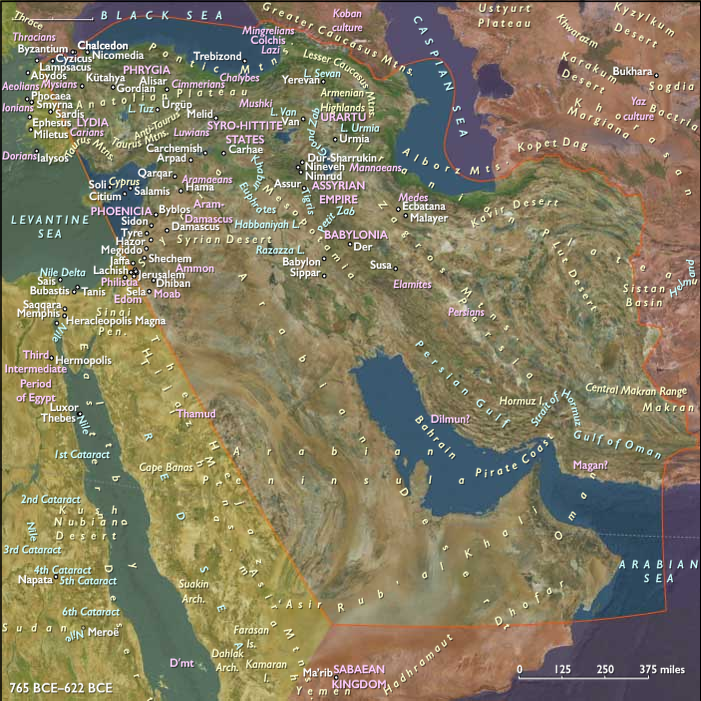
The Assyrians’ perception of the total eclipse of the sun on June 15, 763, as an evil omen serves to drive the already plague-ridden country, threatened with expansion by Urartu, deeper into chaos.
A revolt breaks out in 763 and lasts until another plague hits the land four years later.
Locations
People
Groups
Topics
Subjects
Regions
Subregions
Related Events
Filter results
Showing 10 events out of 66527 total
Maritime East Asia (765–622 BCE): Cultural Prosperity Amid Political Fragmentation
Between 765 BCE and 622 BCE, Maritime East Asia—comprising lower Primorsky Krai, the Korean Peninsula, the Japanese Archipelago below northern Hokkaido, Taiwan, and southern, central, and northeastern China—experiences a paradoxical age marked by political disunity and extraordinary cultural and economic advancements. Known historically as the early Spring and Autumn Period, this era sets the stage for significant cultural and technological growth despite ongoing regional conflicts and decentralized rule.
Emergence of Political Competition and Fragmentation
As central authority under the Eastern Zhou Dynasty further weakens, regional lords become increasingly independent and compete fiercely to strengthen their domains. This intense rivalry necessitates robust military capabilities, effective governance, and economic innovation. The frequent conferences among feudal lords, characteristic of the previous age, evolve into competitive rather than cooperative interactions, intensifying internal strife and decentralization.
Economic Innovations and Technological Advancements
This age witnesses substantial economic growth, driven by increased commerce and critical technological advancements. Coinage is introduced, significantly facilitating trade and economic interaction across regions. The widespread adoption of iron metallurgy revolutionizes both agriculture and warfare, with iron weapons and farm implements enhancing military efficiency and agricultural productivity.
Large-scale infrastructure projects emerge, including sophisticated flood control systems, irrigation networks, and canal construction, reflecting regional lords' ambition to improve productivity and sustain population growth. Additionally, enormous fortification projects, including expansive city walls and frontier barriers along the northern boundary, underscore the strategic importance of defense in this period of persistent regional rivalry.
Intellectual and Cultural Flourishing
The era from 765 to 622 BCE marks the beginning of a remarkable intellectual and cultural flowering in China, often referred to as the age of the Hundred Schools of Thought. Although formal education remains limited to the aristocracy, the demand for knowledgeable, literate administrators leads to significant intellectual developments. Various philosophical traditions begin to emerge, laying critical foundations for later influential Chinese philosophies.
Historiography also sees considerable advancements. Early historical texts such as the Classic of History and the annalistic chronicle Spring and Autumn Annals, traditionally attributed to Confucius, appear during this era. These works reflect a growing conviction in China that historical understanding constitutes a vital source of wisdom for governance and societal harmony.
Ritual and Cultural Continuity
Despite political fragmentation, established cultural practices such as ritual ancestor worship and divination continue to thrive. The cryptic oracle text known as the I Ching (Book of Changes), dating back to the early first millennium BCE, gains prominence as a foundational text of Chinese culture. Additionally, the pentatonic musical scale, symbolic of cosmic harmony and extensively used in ritual ceremonies, becomes the dominant musical form throughout the region.
Legacy of the Age: Foundations for China's Golden Age
Thus, the age from 765 to 622 BCE in Maritime East Asia represents a paradoxical yet profoundly influential period. Amid ongoing political fragmentation and military competition, unprecedented cultural, economic, and intellectual developments set crucial precedents for the vibrant and diverse cultural landscape that will characterize subsequent periods, including the flourishing of classical Chinese civilization.

The Spring and Autumn and Warring States periods, though marked by disunity and civil strife, witnesses an unprecedented era of cultural prosperity—the "golden age" of China.
The atmosphere of reform and new ideas is attributed to the struggle for survival among warring regional lords who compete in building strong and loyal armies and in increasing economic production to ensure a broader base for tax collection.
To effect these economic, military, and cultural developments, the regional lords need ever-increasing numbers of skilled, literate officials and teachers, the recruitment of whom is based on merit.
Also during this time, commerce is stimulated through the introduction of coinage and technological improvements.
Iron comes into general use, making possible not only the forging of weapons of war but also the manufacture of farm implements.
Public works on a grand scale—such as flood control, irrigation projects, and canal digging—are executed.
Enormous walls are built around cities and along the broad stretches of the northern frontier.
China is ruled by a feudal system during the Spring and Autumn Period in Chinese history, which roughly corresponds to the first half of the Eastern Zhou dynasty.
The so-called Hundred Schools of Thought reportedly emerge after 770 BCE from the courts of the various Chinese kingdoms, which form the centers of cultural leadership.
Formal education is available only to rulers and nobles.
Chinese historiography, based on the conviction that human historical experience constitutes the main repository of human wisdom, has its beginnings under the Zhou dynasty.
The Classic of History, one of the Five Classics of Chinese classic texts is one of the earliest narratives of China.
The Spring and Autumn Annals, the official chronicle of the State of Lu covering the period from 722 BCE to 481 BCE, is among the earliest surviving Chinese historical texts to be arranged on annalistic principles.
It is believed to have been compiled by Confucius.
The pentatonic scale, a musical scale with five pitches per octave as compared to the major scale of seven distinct notes, is the prevalent musical form in the Far East.
The five notes represent the four cardinal directions and the center.
The cryptic nuclear text of the oracle known as the "I Ching,” or "Book of Changes" is written at the beginning of the first millennium BCE.
The Yanghai Tombs, a vast ancient cemetery (fifty-four thousand square miles) situated in the Turpan district of the Xinjiang Uyghur Autonomous Region of the People's Republic of China, have revealed the twenty-seven hundred-year-old grave of a shaman.
He is thought to have belonged to the Gushi culture recorded in the area centuries later in the Hanshu, Chapter 96B.
Near the head and foot of the shaman was a large leather basket and wooden bowl filled with seven hundred and eighty-nine gram of cannabis, superbly preserved by climatic and burial conditions.
An international team demonstrated that this material contained tetrahydrocannabinol, the psychoactive component of cannabis.
The cannabis was presumably employed by this culture as a medicinal or psychoactive agent, or an aid to divination.
This is the oldest documentation of cannabis as a pharmacologically active agent.
The cache of cannabis is about twenty-seven hundred years old and was clearly "cultivated for psychoactive purposes," rather than as fiber for clothing or as food, says a research paper in the Journal of Experimental Botany.
The seven hundred and eighty-nine grams of dried cannabis was buried alongside a light-haired, blue-eyed Caucasian man, likely a shaman of the Gushi culture, near Turpan in northwestern China.
The extremely dry conditions and alkaline soil acted as preservatives, allowing a team of scientists to carefully analyze the stash, which still looked green though it had lost its distinctive odor.
This shaman was Caucasoid, and was well over six feet tall.
He may belong to, or was related to the Yuezhi people or Tocharians known to have lived in the region.
Central Asia (765–622 BCE): Expansion of Scythian Power and Early Urban Flourishing
Between 765 and 622 BCE, Central Asia experienced significant shifts, defined primarily by the strengthening and expansion of Scythian-related nomadic societies across the Eurasian steppe, alongside the emergence and prosperity of early urban centers in Bactria, Sogdiana, and Margiana. This era marked the maturation of nomadic cultures, increasing regional trade, technological advancement, and the deepening integration between pastoralist and settled populations.
Dominance of Scythian Nomadic Societies
During this era, Scythian nomads increasingly dominated the vast steppes of modern Kazakhstan and Kyrgyzstan, extending their influence to the fringes of settled oases in modern-day Uzbekistan, Turkmenistan, and Tajikistan.
-
The Scythians, distinguished by their highly developed horse culture and exceptional skills in metalworking, expanded their territorial reach, establishing extensive networks of trade, cultural exchange, and political alliances with sedentary communities.
-
Burial sites featuring prominent kurgan mounds—characterized by elaborate grave goods, including intricate gold and bronze jewelry, weaponry, and horse harnesses—illustrate their growing wealth, social hierarchy, and cultural sophistication.
Urban Growth and Oasis Civilization
Alongside nomadic developments, the fertile oasis cities of Central Asia, particularly in Bactria (modern Uzbekistan and Tajikistan) and Margiana (modern Turkmenistan), experienced urban expansion, bolstered by advanced irrigation techniques and vibrant local economies.
-
Centers such as Balkh (ancient Bactra), Samarkand, and Merv emerged as significant urban settlements, serving as hubs for agricultural production, artisanal manufacturing, and interregional trade networks.
-
Agriculture thrived, supported by sophisticated irrigation systems, allowing the intensive cultivation of cereals, fruits, and vegetables, thereby sustaining growing urban populations and enabling specialized craftsmanship in pottery, metallurgy, and textiles.
Economic Integration and Regional Trade
The expanding Scythian presence and flourishing oasis cities fostered an increasingly interconnected regional economy.
-
Nomadic groups exchanged livestock products, metals, furs, and horses with settled populations for grain, manufactured goods, textiles, and luxury items.
-
Trade routes began crystallizing into more established pathways, laying the foundations for the later Silk Roads. Settlements like Samarkand and Balkh became central nodes facilitating interactions between steppe pastoralists, oasis farmers, and distant civilizations, including Achaemenid Persia in the southwest and emerging Chinese states in the east.
Technological and Metallurgical Advancements
Technological innovations accelerated during this period, significantly enhancing economic productivity and military effectiveness.
-
Ironworking spread extensively across both steppe and oasis societies, dramatically improving tools, weaponry, and agricultural implements. Iron's accessibility facilitated greater economic specialization and societal stratification.
-
Metallurgical expertise, especially in bronze and gold crafting, became exceptionally refined, exemplified by intricate jewelry, decorative weapons, and ceremonial artifacts found at Scythian sites and urban centers.
Cultural and Religious Developments
The synthesis of nomadic and settled cultures led to diverse cultural and religious practices across Central Asia:
-
Iranian-speaking populations further developed religious practices that later evolved into early forms of Zoroastrianism, with fire altars and dualistic cosmological beliefs becoming more widespread, particularly in Bactria and Margiana.
-
Nomadic groups maintained distinctive spiritual beliefs centered around shamanistic practices, ancestral reverence, animal symbolism, and elaborate funerary rites, evidenced by burial traditions and grave goods.
Long-Term Significance and Legacy
The period from 765 to 622 BCE significantly influenced Central Asia’s historical trajectory:
-
The expansion of Scythian nomadic power profoundly shaped regional demographics, politics, and economies, establishing patterns of pastoralist dominance that would characterize much of Central Asia’s later history.
-
Urban growth in Bactria, Sogdiana, and Margiana laid critical groundwork for enduring Central Asian civilizations, establishing economic and cultural hubs central to future trade routes and imperial dynamics.
-
Increasing regional integration fostered by trade and cultural exchange set foundational conditions for the subsequent formation of the Silk Roads, significantly influencing Central Asia’s role as a critical crossroads of Eurasian civilization.
By 622 BCE, Central Asia stood as an increasingly interconnected and dynamic region, characterized by vibrant cultural synthesis, advanced urban development, and the sustained prominence of Scythian nomadic societies, all of which would decisively shape the centuries that followed.
These nomads, who speak Iranian dialects, settle in Central Asia and begin to build an extensive irrigation system along the rivers of the region.
Cities such as Bukhara and ...