
Ashurbanipal does not accede to the kingship …
Years: 669BCE - 658BCE
Ashurbanipal does not accede to the kingship of Assyria until late in the year.
His grandmother Zakutu Naqi'a required all to support his sole claim to the throne and to report acts of treason from now on to him and herself, which shows how influential the old lady was at the beginning of Ashurbanipal's reign.
The official ceremonies of coronation come in the second month of the new year, and within the same year (668 BCE), Ashurbanipal installs his brother as King of Babylon.
The transition is smooth, and the dual monarchy of the youthful brothers begins.
Texts describe their relationship as if they were twins.
It is clear, however, that Ashurbanipal, as king of Assyria, like his fathers before him, is also called "king of the universe".
Not having been expected to become heir to the throne, Ashurbanipal was trained in scholarly pursuits as well as the usual horsemanship, hunting, chariotry, soldierliness, craftsmanship, and royal decorum.
In a unique autobiographical statement, Ashurbanipal specified his youthful scholarly pursuits as having included oil divination, mathematics, and reading and writing.
According to legend, Ashurbanipal was the only Assyrian king who learned how to read and write.
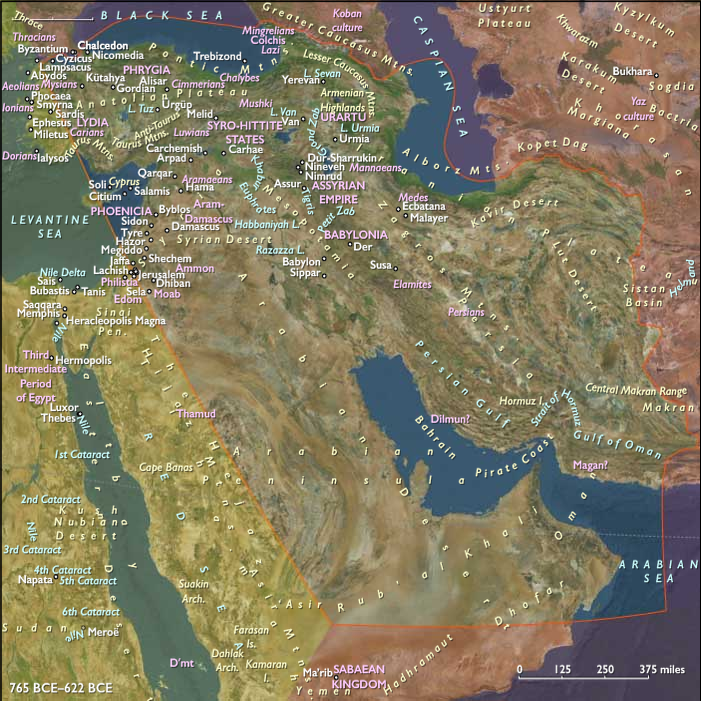
Assyria retains control and subjugation of Media, Persia, Aramaea, Phoenicia, Israel, Judah, Asia Minor, northern Arabia, the Syro-Hittites and Cyprus with few problems.
Urartu is defeated and contained, and the Nubians have been expelled from Egypt and a native puppet regime installed.
For the time being, the dual monarchy in Mesopotamia goes well, with no problems from the junior partner Babylon, and its Assyrian king.
An Assyrian royal inscription informs us of the Lydian king Gyges receiving dreams from the Assyrian god Ashur, telling him that when he submitted to Ashurbanipal he would conquer his foes.
After he sends his ambassadors to do so he is indeed able to defeat his Cimmerian enemies around 660.
This alliance effectively extends Assyrian influence across Anatolia to the Aegean Sea.
Locations
People
Groups
- Mesopotamia
- Nubians
- Lydia, Kingdom of
- Babylon, Kingdom of
- Egypt (Ancient), Third Intermediate Period of
- Cimmerians
- Assyrian people
- Urartu, Kingdom of
- Assyria, (New) Kingdom of (Neo-Assyrian Empire)
Topics
- Younger Subboreal Period
- Iron Age, Near and Middle East
- Iron Age Cold Epoch
- Classical antiquity
- Assyrian Wars of c. 745-609 BCE
Commodoties
Subjects
Regions
Subregions
Years: 669BCE - 658BCE
Locations
People
Groups
- Mesopotamia
- Nubians
- Lydia, Kingdom of
- Babylon, Kingdom of
- Egypt (Ancient), Third Intermediate Period of
- Cimmerians
- Assyrian people
- Urartu, Kingdom of
- Assyria, (New) Kingdom of (Neo-Assyrian Empire)
Topics
- Younger Subboreal Period
- Iron Age, Near and Middle East
- Iron Age Cold Epoch
- Classical antiquity
- Assyrian Wars of c. 745-609 BCE
Commodoties
Subjects
Regions
Subregions