
Ashikaga shogun Yoshimitsu, who has developed a …
Years: 1419 - 1419
Ashikaga shogun Yoshimitsu, who has developed a passion for collecting Chinese paintings and art objects, indulges in elaborate ceremonial displays of his collection.
The painters of the Ashikaga mortuary temple, the Shokokuji in Kyoto, have come to form a virtual academy with a variety of functions, including the procuring of paintings for the shogun's collection.
Japanese priest-painter Josetsu, his pupil Shubun, and their associates formulate a national style based on Chinese styles of the Southern Song painting academy.
Josetsu, expert in the Southern Song styles of Ma Yuan and Liang K'ai, is a master of suibokuga, or Chinese-style ink painting.
A colophon to Josetsu's Catching a Catfish with a Gourd refers to its being in a "new style," presumably a reference to the incorporation of a Southern Song-type landscape setting into an illustration of a Zen allegory.
Shubun frequently executes formalized, Chinese-style mountain landscapes on narrow, vertical hanging scrolls to provide pictorial accompaniment to Chinese poetry inscribed on the scrolls by Zen priests.
His Studio of the Three Worthies—pine, bamboo, and plum, executed in 1418 exemplifies this style, as does 1419’s Koten En'i.
(Although approximately forty extant paintings that have been associated with Shubun, none of them can definitely be assigned to his hand.)
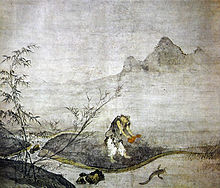
Josetsu: Catching cat-fish with a gourd (Hyōnen-zu) c. 1413. (Myōshin-ji temple, Taizō-in (Kyoto, Japan))
Locations
People
Groups
Subjects
Regions

Subregions
Years: 1419 - 1419
Josetsu: Catching cat-fish with a gourd (Hyōnen-zu) c. 1413. (Myōshin-ji temple, Taizō-in (Kyoto, Japan))
Locations
People
Groups
Subjects
Regions
Subregions