
The Dalmatian city states, having gradually lost …
Years: 1108 - 1108
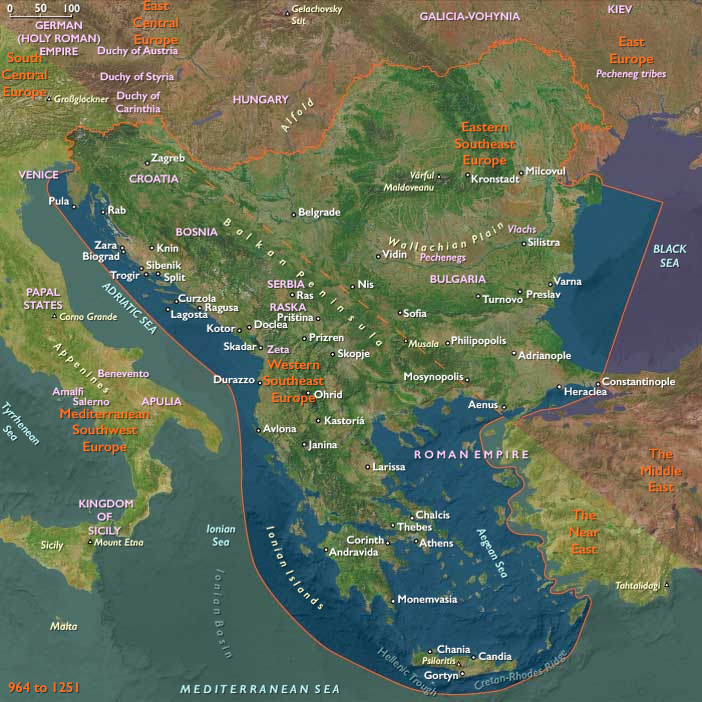
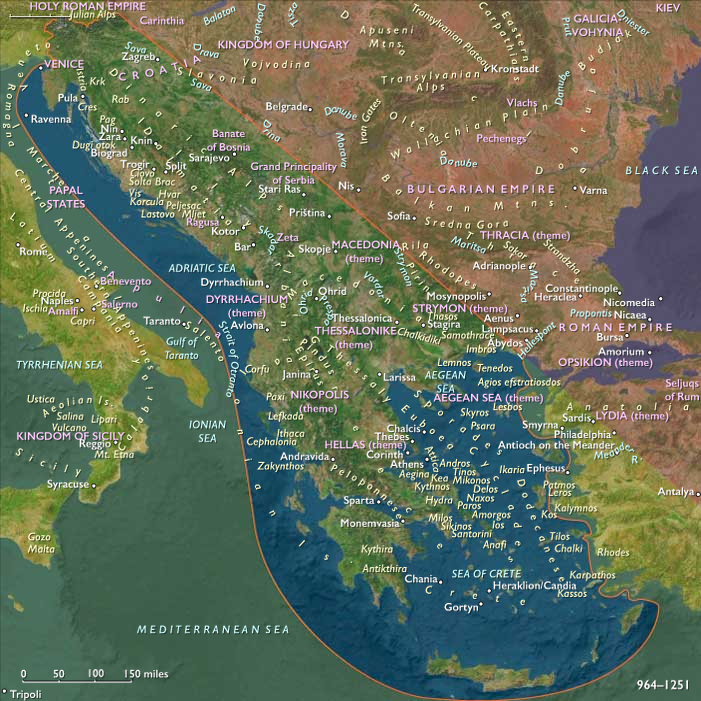
The Dalmatian city states, having gradually lost all protection by Constantinople and being unable to unite in a defensive league hindered by internal dissension, had had to turn to either Venice or Hungary for support.
Each of the two political factions had had support within the Dalmatian city states, based mostly on economic reasons.
The Venetians, to whom the Dalmatians are already bound by language and culture, could afford to concede liberal terms as their main goal is to prevent the development of any dangerous political or commercial competitor on the eastern Adriatic.
The seafaring community in Dalmatia looks to Venice as mistress of the Adriatic.
In return for protection, the cities have often furnished a contingent to the army or navy of their suzerain, and sometimes paid tribute either in money or in kind.
Arbe (Rab), for example, annually paid ten pounds of silk or five pounds of gold to Venice.
Hungary, on the other hand, had defeated the last Croat king in 1097 and forced Croatian noblemen into a personal union with the treaty of 1102.
King Coloman in 1102–1105 had proceeded to conquer Dalmatia, and in 1108 control passes to Hungary.
The farmers and the merchants who trade in the interior favor Hungary as their most powerful neighbor on land that affirms their municipal privileges.
Subject to the royal assent they might elect their own chief magistrate, bishop and judges.
Their Roman law remains valid.
They are even permitted to conclude separate alliances.
No alien, not even a Hungarian, can reside in a city where he is unwelcome; and the man who dislikes Hungarian dominion can emigrate with all his household and property.
In lieu of tribute, the revenue from customs is in some cases shared equally by the king, chief magistrate, bishop and municipality. (As the age progresses, these rights and the analogous privileges granted by Venice will, however, too frequently be infringed. Hungarian garrisons will be quartered on unwilling towns, while Venice will interfere with trade, the appointment of bishops, or the tenure of communal domains. Consequently, the Dalmatians are to remain loyal only while it suits their interests, and insurrections will occur frequently.)
Locations
People
Groups
- Hungarian people
- Slavs, South
- Venice, Duchy of
- Croats (South Slavs)
- Hungary, Kingdom of
- Christians, Roman Catholic
- Dalmatia region
- Croatia, Kingdom of
Topics
Commodoties
Subjects
Regions
Subregions
Years: 1108 - 1108
Locations
People
Groups
- Hungarian people
- Slavs, South
- Venice, Duchy of
- Croats (South Slavs)
- Hungary, Kingdom of
- Christians, Roman Catholic
- Dalmatia region
- Croatia, Kingdom of
Topics
Commodoties
Subjects
Regions
Subregions