
Domitian as Emperor quickly dispenses with the …
Years: 82 - 82
Domitian as Emperor quickly dispenses with the republican facade his father and brother had maintained during their reign.
By moving the center of government (more or less formally) to the imperial court, Domitian openly renders the Senate's powers obsolete.
In his view, the Roman Empire is to be governed as a divine monarchy with himself as the benevolent despot at its head.
In addition to exercising absolute political power, Domitian believes the Emperor's role encompasses every aspect of daily life, guiding the Roman people as a cultural and moral authority.
To usher in the new era, he embarks on ambitious economic, military and cultural programs with the intention of restoring the Empire to the splendor it had seen under the Emperor Augustus.
Despite these grand designs, Domitian is determined to govern the Empire conscientiously and scrupulously.
He becomes personally involved in all branches of the administration: edicts are issued governing the smallest details of everyday life and law, while taxation and public morals are rigidly enforced.
According to Suetonius, the imperial bureaucracy never ran more efficiently than under Domitian, whose exacting standards and suspicious nature maintained historically low corruption among provincial governors and elected officials.
Although he makes no pretense regarding the significance of the Senate under his absolute rule, those senators he deems unworthy are expelled from the Senate, and in the distribution of public offices he rarely favors family members; a policy which stands in contrast to the nepotism practiced by Vespasian and Titus.
Above all, however, Domitian values loyalty and malleability in those he assigns to strategic posts, qualities he finds more often in men of the equestrian order than in members of the Senate or his own family, whom he regards with suspicion, and promptly removes from office if they disagree with imperial policy.
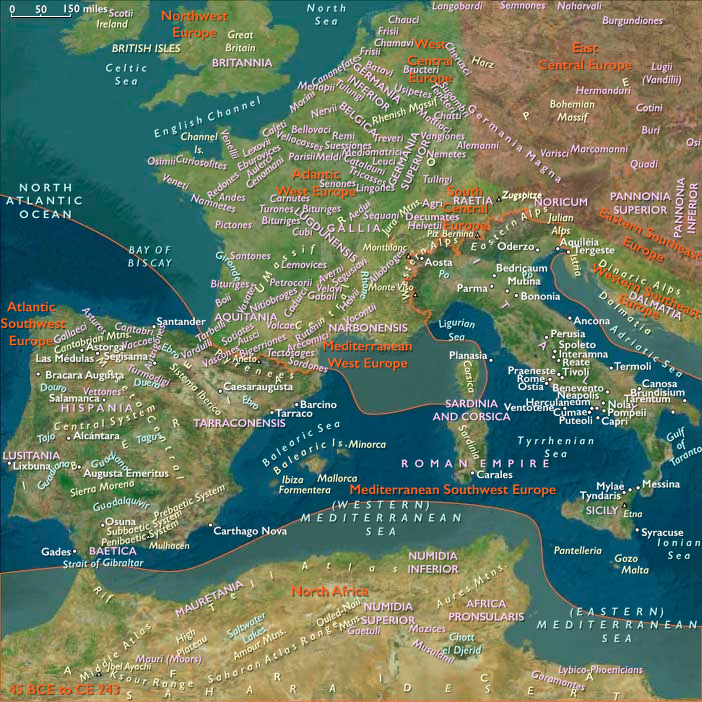
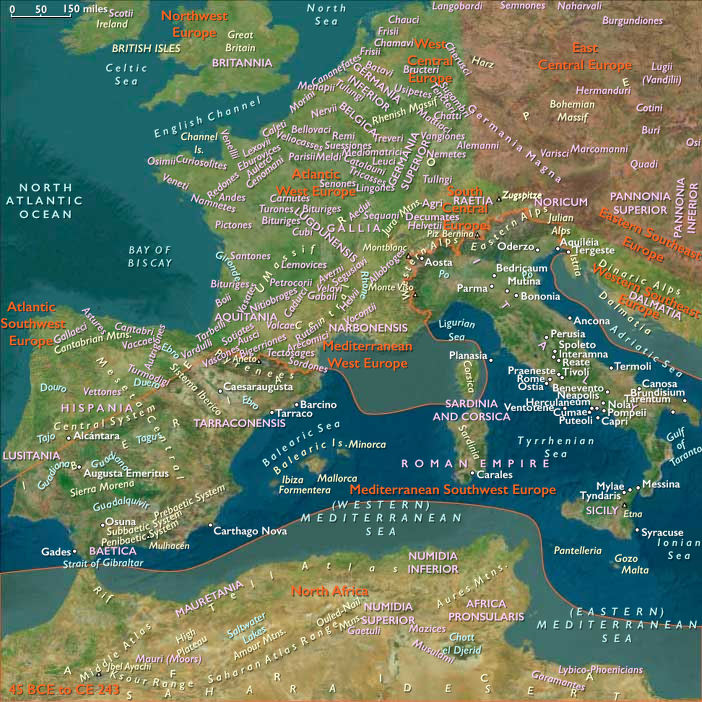
The conquest of Britain continues under the command of Gnaeus Julius Agricola, who expands the Roman Empire as far as Caledonia, or modern day Scotland.
Domitian also founds a new legion in 82, the Legio I Minervia, to fight against the Chatti.
Domitian commissions the elaborate triumphal Arch of Titus, a graphic glorification of Rome’s victories in the Judean War.
In rebuilding the destroyed Capitoline Hill temple, he adds gilded tiles and gold-plated doors to a richly decorated marble structure.
Locations
People
Groups
Topics
Commodoties
Subjects
- Commerce
- Architecture
- Environment
- Labor and Service
- Decorative arts
- Conflict
- Games and Sports
- Faith
- Government
- Technology
- Catastrophe
- Economics
Regions
Subregions
Related Events
Showing 10 events out of 61506 total
Years: 82 - 82
Locations
People
Groups
Topics
Commodoties
Subjects
- Commerce
- Architecture
- Environment
- Labor and Service
- Decorative arts
- Conflict
- Games and Sports
- Faith
- Government
- Technology
- Catastrophe
- Economics
Regions
Subregions