
Greek cities under Carthaginian control rebel as …
Years: 398BCE - 398BCE
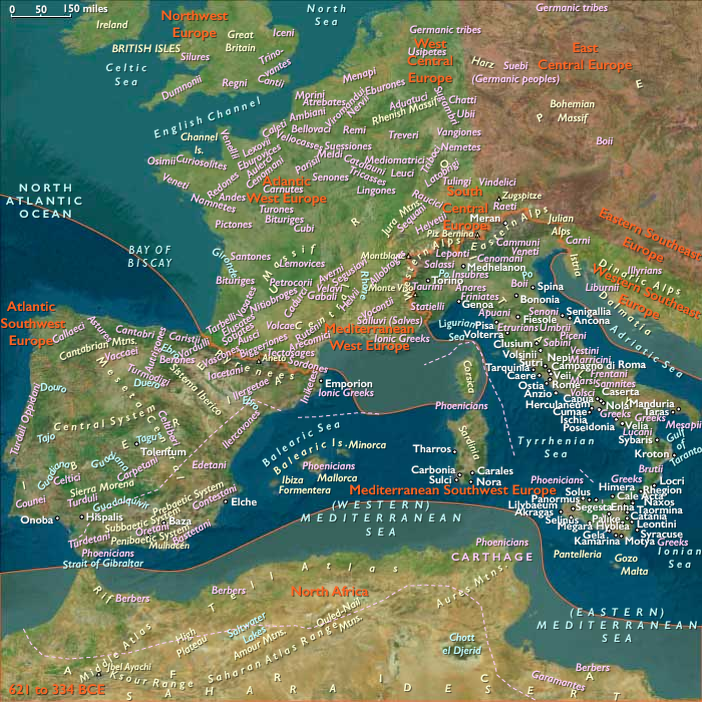
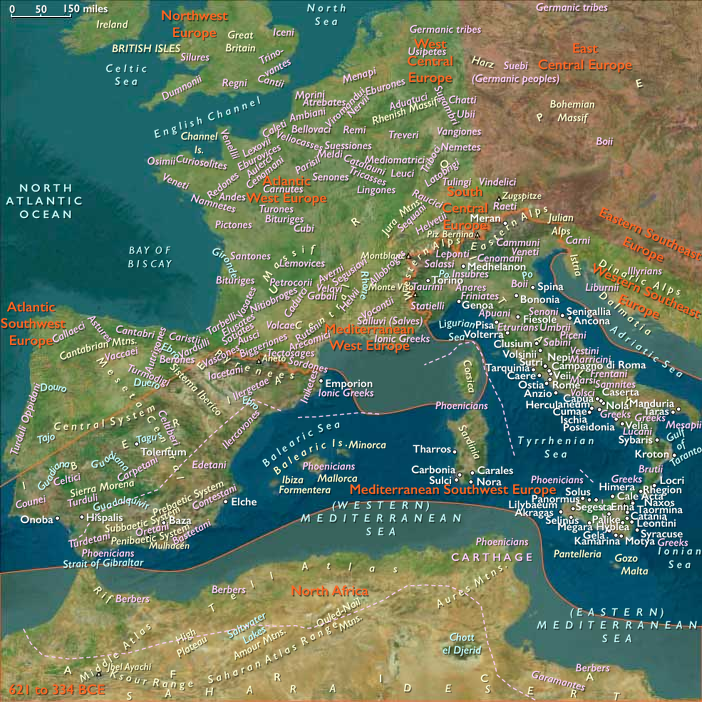
Greek cities under Carthaginian control rebel as Dionysius and his army march west along the southern coast of Sicily.
The Greeks kill Carthaginians living in their cities, loot their property, and send soldiers to join Dionysius.
Sicels, Sikans and the city of Messene also send contingents so that by the time Dionysius reaches Motya, his army has swelled to eighty thousand infantry and three thousand cavalry.
Dionysius sends his navy under his brother Leptines to blockade Motya, and himself moves with the army to Eryx, which surrenders to him.
Even the city of Threame declares for him, leaving only the cities of Panormus, Solus, Ancyrae, Segesta and Entella loyal to Carthage in Sicily.
Dionysius raids the surrounding areas near the first three, then places Segesta and Entella under siege.
After these cities had repulsed several assaults, Dionysius himself returns to Motya to oversee the progress of the siege, assuming that the cities would surrender once Motya was captured.
Little is known of the activities of Carthage during 405 -397 BCE except that a plague had swept through Africa, which had been carried by the returning army in 405 BCE, weakening Carthage.
Himilco is again given the task of responding to the threat.
While raising a mercenary army (Carthage does not maintain a standing army) Himilco sends ten triremes to raid Syracuse itself.
The raiders enter the Great Harbor of Syracuse and destroy all the ships they can find.
Himilco next mans one hundred triremes with picked crews and sails to Selinus, arriving at night.
From there, the Punic navy sails to Motya the following day and falls on the transports beached near Lilybaeum, destroying all that lay at anchor.
Then the Carthaginian fleet moves into the area between Motya and the peninsula to the west of the lagoon, trapping the beached Greek fleet on the northern shallows of the lagoon.
It is unknown why Himilco chose to go after the transports instead of attacking the beached Greek warships to the north of Motya.
The loss of the war fleet would have forced Dionysius to lift the siege, giving Himilco a chance to carry the war to Syracuse.
Dionysius in response launches his ships with a great number of archers and slingers and supports them with his land-based catapults.
The first nontorsion artillery (i.e., artillery using mechanical means to winch back, by means of a ratchet, a bow of unusual solidity but of a basically conventional conception) is attested from the Sicily of this period.
While these duel with the archers and slingers on board the Carthaginian triremes, taking a heavy toll and preventing Himilco from reaching the beached ships, Dionysius has his men construct a road of wooden planks on the northern isthmus, on which eighty triremes are then hauled to the open sea to the north of the isthmus.
Once properly manned, these ships sail south along the peninsula.
The Carthaginian fleet now facing encirclement, Himilco chooses not to fight a two-front battle against superior numbers, and sails away to Carthage, having accomplished little except making a sizable dent in Syracusan shipping.
Locations
People
Groups
- Sicani
- Sicels
- Ionians
- Dorians
- Elymians
- Greece, classical
- Sicily, classical
- Italy, classical
- Carthage, Kingdom of
- Segesta, (Elymian-Ionian Greek) city-state of
- Magna Graecia
- Syracuse, Corinthian city-state of
- Selinus, (Dorian Greek) city-state of
- Etruria
- Peloponnesian League (Spartan Alliance)
- Athenian Empire (Delian League)
Topics
- Iron Age Europe
- Iron Age Cold Epoch
- Classical antiquity
- Sicilian Wars, or Carthaginian-Syracusan Wars
- Sicilian War, Second, or Second Carthaginian-Syracusan War
- Motya, Siege of
- Dionysius War, First
Commodoties
Subjects
Regions
Subregions
Related Events
Showing 10 events out of 64960 total
Years: 398BCE - 398BCE
Locations
People
Groups
- Sicani
- Sicels
- Ionians
- Dorians
- Elymians
- Greece, classical
- Sicily, classical
- Italy, classical
- Carthage, Kingdom of
- Segesta, (Elymian-Ionian Greek) city-state of
- Magna Graecia
- Syracuse, Corinthian city-state of
- Selinus, (Dorian Greek) city-state of
- Etruria
- Peloponnesian League (Spartan Alliance)
- Athenian Empire (Delian League)
Topics
- Iron Age Europe
- Iron Age Cold Epoch
- Classical antiquity
- Sicilian Wars, or Carthaginian-Syracusan Wars
- Sicilian War, Second, or Second Carthaginian-Syracusan War
- Motya, Siege of
- Dionysius War, First
Commodoties
Subjects
Regions
Subregions