
Many of the disgruntled Aztec subjects flock …
Years: 1519 - 1519
November
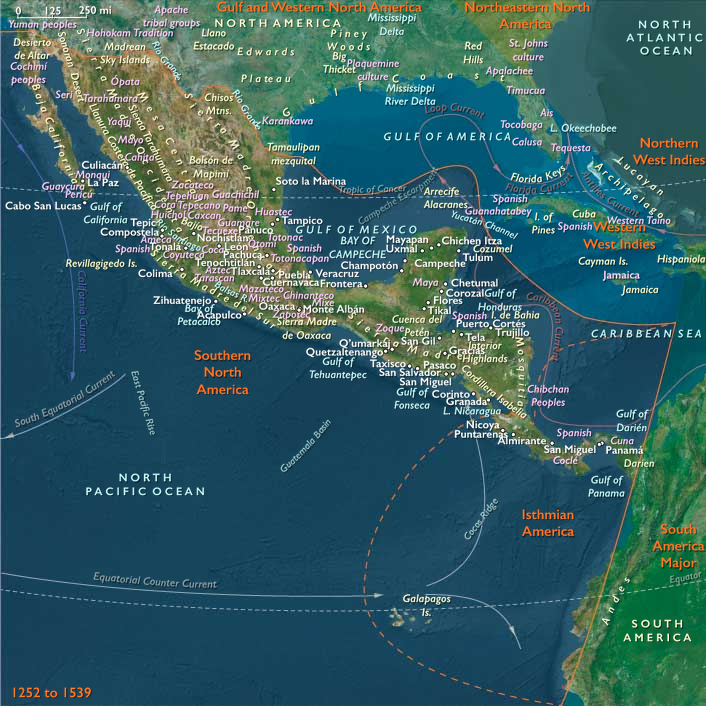
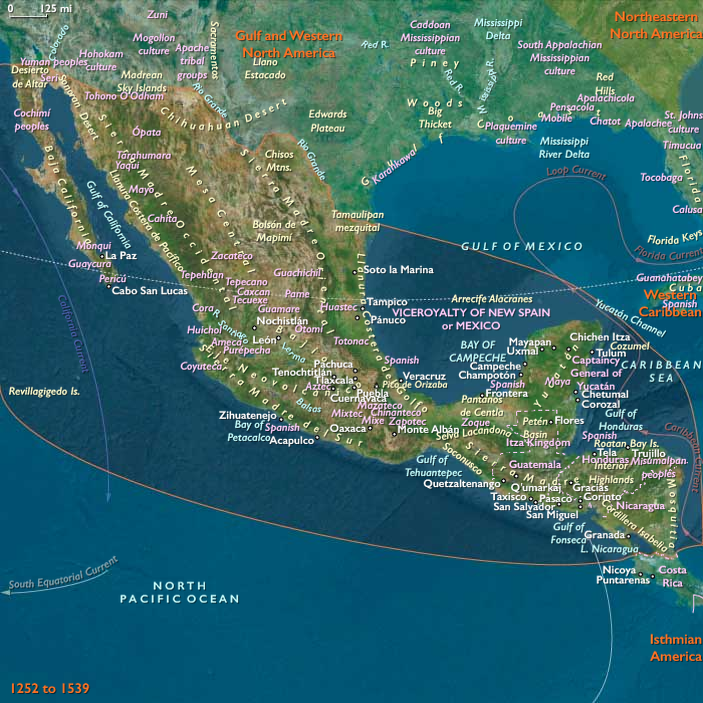
Many of the disgruntled Aztec subjects flock to Cortés’ side as he marches inland with his army of about four hundred Spaniards and six thousand native Cemoalan and Tlaxcalan auxiliaries.
Cortés’ invasion force according to the Aztec calendar had landed in Mexico on the day One Reed, the calendar day of the hero-god Quetzalcoatl's birth.
Quetzalcoatl, a title taken by several historical rulers and heroes since the driving out of King Topiltzin Quetzalcoatl from the city of Tula in the twelfth century, has become central to mythological stories about the deification of the god-man and his promise to return and claim his earthly kingdom.
This still-current prophecy has apparently caused Moctezuma to regard Cortés as a deity, perhaps Quetzalcoatl himself.
The Spaniards reach the Aztec’s island capital of Tenochtitlan in November 1519, and, after a study of omens and prophecies persuades Motecuhzoma that the invaders are gods, he concludes that he is doomed.
He chooses not to fight the Europeans but to deter them by trickery, magic, and gift offerings.
Failing in this, Moctezuma permits Cortés and his men to enter Tenochtitlán unopposed by the formidable imperial armies.
Locations
People
- Bernal Díaz del Castillo
- Bernardino de Sahagún
- Gerónimo de Aguilar
- Hernán Cortés
- Juan Velázquez de León
- La Malinche (Malinali)
- Maxixcatl
- Moctezuma II
- Pedro de Alvarado
- Qualpopoca
- Xicotencatl I
- Xicotencatl II
Groups
- Totonac people
- Otomi, or Hñähñu, people (Amerind tribe)
- Mexica
- Christians, Roman Catholic
- Franciscans, or Order of St. Francis
- Tlaxcala (Nahua state)
- Tlaxcaltec
- Aztec Triple Alliance
- Santo Domingo, Captaincy General of
- Spain, Habsburg Kingdom of
Topics
- Age of Discovery
- Flower wars
- Colonization of the Americas, Spanish
- Aztec Empire, Spanish conquest of the
Commodoties
- Weapons
- Gem materials
- Domestic animals
- Textiles
- Strategic metals
- Salt
- Slaves
- Sweeteners
- Land
- Tobacco
Subjects
- Origins
- Commerce
- Language
- Labor and Service
- Conflict
- Exploration
- Faith
- Government
- Custom and Law
- Technology
- Finance
- Cartography
Regions
Subregions
Related Events
Showing 10 events out of 38849 total
Years: 1519 - 1519
November
Locations
People
- Bernal Díaz del Castillo
- Bernardino de Sahagún
- Gerónimo de Aguilar
- Hernán Cortés
- Juan Velázquez de León
- La Malinche (Malinali)
- Maxixcatl
- Moctezuma II
- Pedro de Alvarado
- Qualpopoca
- Xicotencatl I
- Xicotencatl II
Groups
- Totonac people
- Otomi, or Hñähñu, people (Amerind tribe)
- Mexica
- Christians, Roman Catholic
- Franciscans, or Order of St. Francis
- Tlaxcala (Nahua state)
- Tlaxcaltec
- Aztec Triple Alliance
- Santo Domingo, Captaincy General of
- Spain, Habsburg Kingdom of
Topics
- Age of Discovery
- Flower wars
- Colonization of the Americas, Spanish
- Aztec Empire, Spanish conquest of the
Commodoties
- Weapons
- Gem materials
- Domestic animals
- Textiles
- Strategic metals
- Salt
- Slaves
- Sweeteners
- Land
- Tobacco
Subjects
- Origins
- Commerce
- Language
- Labor and Service
- Conflict
- Exploration
- Faith
- Government
- Custom and Law
- Technology
- Finance
- Cartography
Regions
Subregions