Caliph Harun al-Rashid has ordered the rebuilding …
Years: 787 - 787
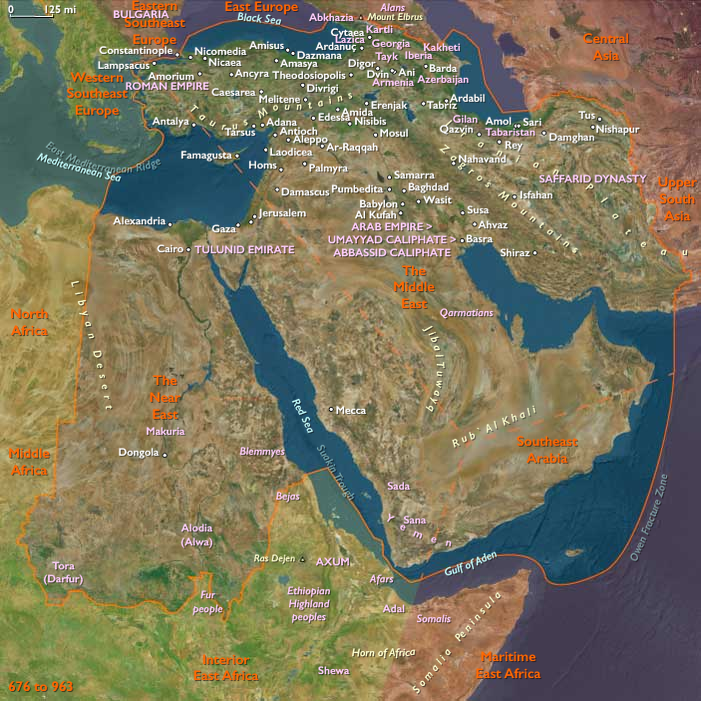
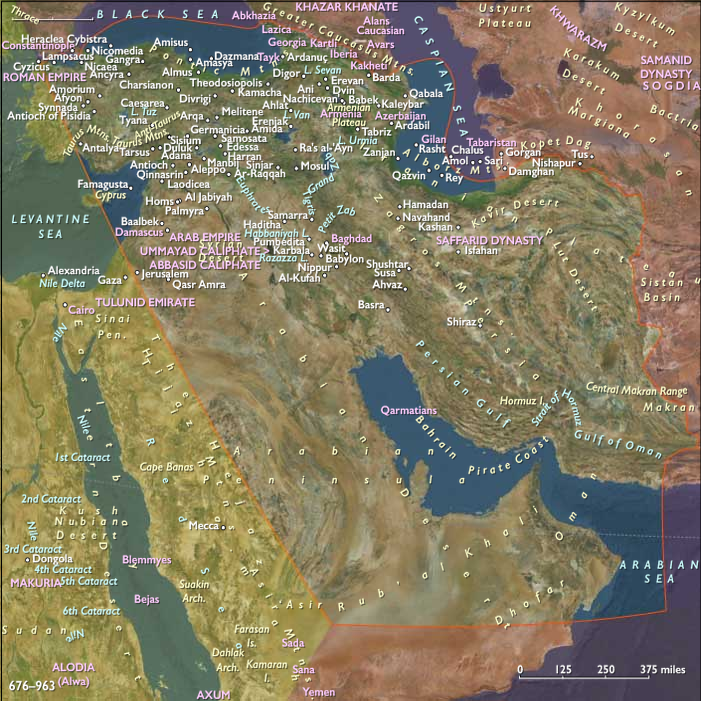
Caliph Harun al-Rashid has ordered the rebuilding and fortification of Tarsus, an imperial city destroyed by Arabs more than a century before, and establishes a fort at nearby Hadath in preparation for an invasion of the Eastern Roman Empire.
Locations
People
Groups
- Arab people
- Greeks, Medieval (Byzantines)
- Roman Empire, Eastern: Isaurian dynasty
- Abbasid Caliphate (Baghdad)
Topics
Commodoties
Subjects
Regions
Subregions
Related Events
Filter results
Showing 10 events out of 54996 total
Charles conquers Bavaria in 787-88, absorbing the duchy in 788.
Harun had made Yahya his vizier when he became caliph.
Under Yahya's influence, the Caliph invites to Baghdad many scholars and masters from India, especially Buddhists.
A catalogue of both Muslim and non-Muslim texts prepared at this time, Kitab al-Fihrist, includes a list of Buddhist works.
Among them is an Arabic version of the account of Buddha’s previous lives, Kitab al-Budd.
The ecumenical council is again summoned to meet, this time in Nicaea, since Constantinople is still distrusted.
The Second Council of Nicaea (the seventh ecumenical council of the Christian church) assembles on September 24, 787 at the church of Hagia Sophia.
It numbers about three hundred and fifty members; three hundred and eight bishops or their representatives sign.
Tarasius presides, and seven sessions are held in Nicaea.
At Irene’s urging, and with the support of Pope Adrian and Constantine VI’s representative, Nikephoros, the council declares that whereas the veneration of images is legitimate and the intercession of saints efficacious, their veneration must be carefully distinguished from the worship due God alone; this ruling effectively ends the Greek church’s policy of iconoclasm.
The papal legates voice their approval of the restoration of the veneration of icons in no uncertain terms, and the patriarch sends a full account of the proceedings of the council to Pope Adrian I, who has it translated.
The marshes and moraines near Bremen, a port in northwestern Germany on the banks of the Weser River about forty-three miles (seventy kilometers) from the North Sea, have been settled since about 12,000 BCE.
Burial places and settlements in Bremen-Mahndorf and Bremen-Osterholz date back to the seventh century CE.
Since the age of Renaissance, some scientists have believed that the entry Fabiranum or Phabiranon in Ptolemy's Fourth Map of Europe, written in CE 150, refers to Bremen, but Ptolemy gives geographic coordinates, and by these dates Phabiranon is situated northeast of the mouth of river Visurgis (Weser).
At that time the Chauci lived in the area now called northwestern Germany or Lower Saxony.
By the end of the third century, they had merged with the Saxons.
During the Saxon Wars (772–804) the Saxons, led by Widukind, fight against the West Germanic Franks, the founders of the Carolingian Empire, and lose the war.
Charlemagne, the King of the Franks, makes a new law, the Lex Saxonum, which states that Saxons are not allowed to worship Odin (the god of the Saxons), but rather that they had to convert to Christianity on pain of death.
This period is called the Christianization.
Willehad of Bremen becomes, in 787, the first Bishop of Bremen.
Constantine, as he approaches maturity, has grown increasingly resentful of his mother's controlling influence in the empire.
The Empress crushes his attempt to seize power, demanding in 788 that the military oath of fidelity should recognize her as senior ruler.
The raids launched in the two years since Harun al-Rashid's accession in 786 have been relatively minor affairs; the first great invasion of the new reign occurs in 788, when a large expeditionary force crosses the Cilician Gates into the Anatolic Theme.
The raid is not mentioned in Arabic sources, but its description by the Byzantine chronicler Theophanes the Confessor points to a major invasion, as it is confronted by the forces of the two most powerful imperial thematic armies, those of the Anatolic Theme itself and of the Opsician Theme.
The site of the battle is called "Kopidnadon" in Theophanes, a name otherwise unattested.
Modern scholars, beginning with Henri Grégoire in 1932, have identified it with the town of Podandos, on the western exit of the Cilician Gates.
According to the brief account of Theophanes, the battle ended in a bloody defeat for the Byzantines, who lost many men and officers, including members of the tagma of the Scholai who had been banished to the provinces by Irene in 786 for their continued support of Iconoclasm.
Theophanes also singles out the loss of the capable officer Diogenes, a tourmarches (division commander) of the Anatolics.
The immediate impact of the imperial defeat seems to have been negligible; losses were heavy but not unbearable, and the level of devastation of the region seems to have been minimal.
In material terms, there is therefore little to distinguish the defeat at Kopidnadon from the "typical" Arab raid.
It marks, however, a recommencement of large-scale border warfare after the relative lull since 782, which will continue unabated until Harun's death in 809 and the subsequent Abbasid civil war.

The date of Abd al-Rahman's death is disputed, but is generally accepted to be sometime around 785 through 788.
Abd al-Rahman dies in his adopted city of Córdoba, and is supposedly buried under the site of the Mezquita.
Abd al-Rahman's alleged favorite son is his choice for successor, and will later be known as Hisham I, who, at the beginning of his reign, in 788, faces rebellions from his older brothers, Suleiman and 'Abd Allah.
Abd ar-Rahman's progeny will continue to rule al-Andalus in the name of the house of Umayyad for several generations, with the zenith of their power coming during the reign of Abd al-Rahman III.
Al-Hakam, the current Umayyad emir, is the target of an unsuccessful conspiracy to overthrow him.
He responds with repressive measures and increased taxation.
The Short Reign of King Bermudo I of Asturias (788–791 CE)
After the death of Mauregatus in 788 CE, the palatine nobility—the aristocracy of the royal court—elects Bermudo Ias his successor.
Since Mauregatus had seized power in a coup d'état in 783 with regional support, and Bermudo’s succession occurs without opposition, it is likely that Mauregatus had reshaped the court nobility to favor a candidate who, like himself, would block the rightful succession of Alfonso II, the son and heir of Fruela I.
Bermudo’s Possible Clerical Background
The Chronicle of Alfonso III, in both its extant versions, describes Bermudo as a deacon at the time of his succession. If true, this detail further suggests that his election was a deliberate political move to prevent Alfonso II from ascending the throne.
Regardless of the circumstances of his rise to power, Bermudo’s reign is short-lived, lasting only a few years before he is forced to abdicate in 791 CE.
Kanmu's armies are meanwhile pushing back the boundaries of his empire.
This leads to an uprising, and in 789 a substantial defeat for Kanmu's troops.
Also in 789 there is a severe drought and famine—the streets of the capital are clogged with the sick, and with people avoiding conscription into the military or as forced labor.
Many disguise themselves as Buddhist priests for the same reason.
Charles organizes campaigns against the Veleti, and their fellow Slavic tribe of the Linonen, because of their constant hatred and hostility toward the Franks.
With the aid of Frisian, Obodrite, Saxon and Sorbian, reinforcements, Charles manages to cross the Elbe River, advancing toward the Havel River into Veleti territory.
Outnumbered, Dragovit, in 789, is forced to pledge loyalty to the Franks and surrender hostages.
Among others, Dragovit is also forced to pay a tribute and accept the influence of Christian missionaries among his people.
His capital is a fortification known as civitas Dragowiti (City of Dragovit).
Its location is hypothesized to be either at Brandenburg an der Havel or …
Years: 787 - 787
Locations
People
Groups
- Arab people
- Greeks, Medieval (Byzantines)
- Roman Empire, Eastern: Isaurian dynasty
- Abbasid Caliphate (Baghdad)