
Filters:
The Establishment of Artois as a Principality …
Years: 1180 - 1180
The Establishment of Artois as a Principality (1180 CE)
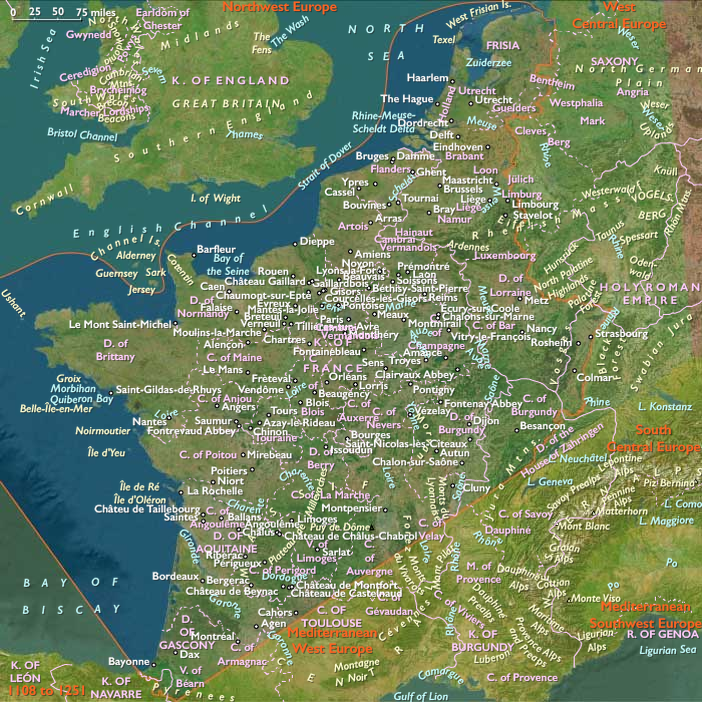
Artois, originally a Carolingian lordship (comitatus) in West Francia, has a long and complex history, shaped by Roman, Germanic, and medieval feudal influences.
Early History of Artois
- In Roman times, Artois was part of the provinces of Belgica and Germania Inferior, inhabited by Celtic tribes until Germanic groups settled in the region as the Roman Empire declined.
- By the 9th century, it was an established Carolingian lordship, ruled by Counts Odalric and Ecfrid of Artois.
- In 898, Count Baldwin II of Flanders began integrating Artois into his domain, a process completed under his successor, Count Arnulf I, making it a permanent part of the County of Flanders.
The Creation of Artois as a Separate Principality (1180)
- In 1180, Philip of Alsace, Count of Flanders, granted Artois as a dowry to his niece, Isabelle of Hainaut, when she married King Philip II of France.
- This division of Flanders effectively created a new territorial principality of Artois, now under Capetian control.
- The marriage significantly strengthened Capetian influence in northern France, challenging Flemish authority in the region.
Significance of the 1180 Division
- Artois became a Capetian possession, marking the first major French territorial gain in the Low Countries.
- It weakened Flanders, ensuring that the Capetian monarchy could challenge Flemish dominance.
- The division set the stage for future French expansion into Flanders, playing a key role in Capetian-Plantagenet and Franco-Flemish conflicts.
The creation of Artois as an independent principality in 1180 marked a pivotal moment in medieval French history, as the region transitioned from Flemish control to Capetian rule, reshaping the balance of power in northern France.
Locations
People
Groups
- Flemish people
- Flanders, County of
- French people (Latins)
- France, (Capetian) Kingdom of
- Hainaut, County of
Topics
Commodoties
Subjects
Regions

Subregions
Years: 1180 - 1180
Locations
People
Groups
- Flemish people
- Flanders, County of
- French people (Latins)
- France, (Capetian) Kingdom of
- Hainaut, County of
Topics
Commodoties
Subjects
Regions
Subregions