
Arthur Conan Doyle's first significant piece of …
Years: 1886 - 1886
December
Arthur Conan Doyle's first significant piece of writing, A Study in Scarlet, is taken by Ward Lock & Co. on November 20, 1886, giving Doyle twenty-five pounds for all rights to the story.
The piece appears later this year in the Beeton's Christmas Annual and receives good reviews in The Scotsman and the Glasgow Herald.
The story features the first appearance of Watson and Sherlock Holmes, partially modeled after his former university teacher Joseph Bell.
Conan Doyle wrote to him, "It is most certainly to you that I owe Sherlock Holmes... [R]ound the centre of deduction and inference and observation which I have heard you inculcate I have tried to build up a man." (Independent, 7 August 2006.)
Robert Louis Stevenson was able, even in faraway Samoa, to recognise the strong similarity between Joseph Bell and Sherlock Holmes: "[M]y compliments on your very ingenious and very interesting adventures of Sherlock Holmes. ... [C]an this be my old friend Joe Bell?" (Letter from R L Stevenson to Conan Doyle 5 April 1893 The Letters of Robert Louis Stevenson Volume 2/Chapter XII.)
Other authors sometimes suggest additional influences—for instance, the famous Edgar Allan Poe character C. Auguste Dupin.
Arthur Conan Doyle was born on May 22, 1859 at 11 Picardy Place, Edinburgh, Scotland.
His father, Charles Altamont Doyle, was English of Irish descent, and his mother, born Mary Foley, was Irish.
They married in 1855.
In 1864, the family had dispersed due to Charles's growing alcoholism and the children were temporarily housed across Edinburgh.
In 1867, the family had reunited and lived in the squalid tenement flats at 3 Sciennes Place.
Although he is now referred to as "Conan Doyle", the origin of this compound surname is uncertain.
The entry in which his baptism is recorded in the register of St. Mary's Cathedral in Edinburgh gives "Arthur Ignatius Conan" as his Christian name, and simply "Doyle" as his surname.
It also names Michael Conan as his godfather.
Supported by wealthy uncles, Conan Doyle had been sent to the Roman Catholic Jesuit preparatory school Hodder Place, Stonyhurst, at the age of nine (1868-1870), and had then gone on to Stonyhurst College until 1875.
From 1875 to 1876, he was educated at the Jesuit school Stella Matutina in Feldkirch, Austria.
From 1876 to 1881, he had studied medicine at the University of Edinburgh, including a period working in the town of Aston (now a district of Birmingham) and in Sheffield, as well as in Shropshire at Ruyton-XI-Towns.
While studying, Conan Doyle began writing short stories.
His earliest extant fiction, "The Haunted Grange of Goresthorpe", was unsuccessfully submitted to Blackwood's Magazine.
His first published piece, "The Mystery of Sasassa Valley", a story set in South Africa, had been printed in Chambers's Edinburgh Journal on September 6, 1879.
Later that month, on September 20, he published his first nonfictional article, "Gelsemium as a Poison" in the British Medical Journal.
Following his term at university, he had been employed as a doctor on the Greenland whaler Hope of Peterhead in 1880 and, after his graduation, as a ship's surgeon on the SS Mayumba during a voyage to the West African coast in 1881.
He had completed his doctorate on the subject of tabes dorsalis in 1885.
In 1882, he had joined former classmate George Turnavine Budd as his partner at a medical practice in Plymouth, but their relationship proved difficult, and Conan Doyle soon left to set up an independent practice.
Arriving in Portsmouth in June of that year with less than ten pounds (seven hundred pounds today) to his name, he set up a medical practice at 1 Bush Villas in Elm Grove, Southsea.
The practice was initially not very successful.
While waiting for patients, Conan Doyle had again begun writing stories and composed his first novels, The Mystery of Cloomber, not published until 1888, and the unfinished Narrative of John Smith, which will go unpublished until 2011.
He has amassed a portfolio of short stories including "The Captain of the Pole-Star" and "J. Habakuk Jephson's Statement", both inspired by Doyle's time at sea.
Doyle has struggled to find a publisher for his work.
Locations
People
Groups
Topics
Commodoties
Subjects
Regions
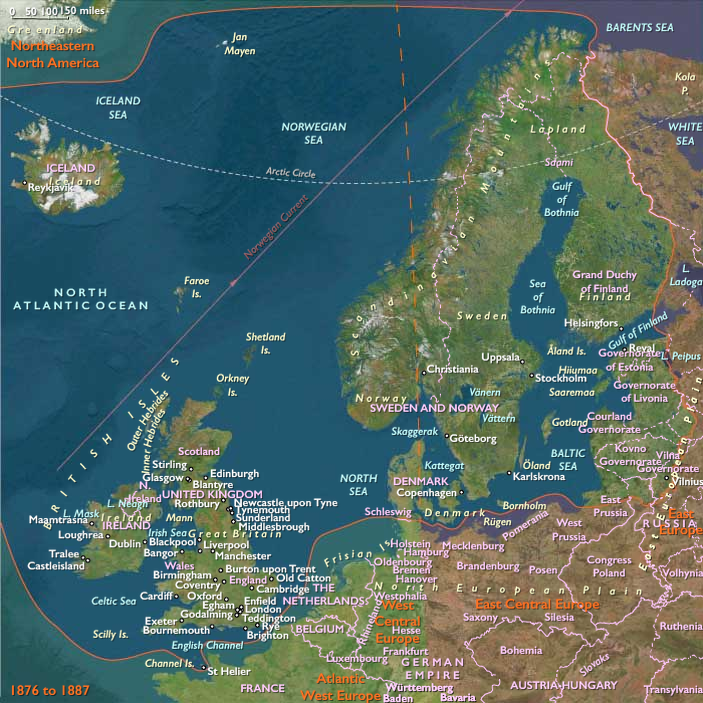
Subregions
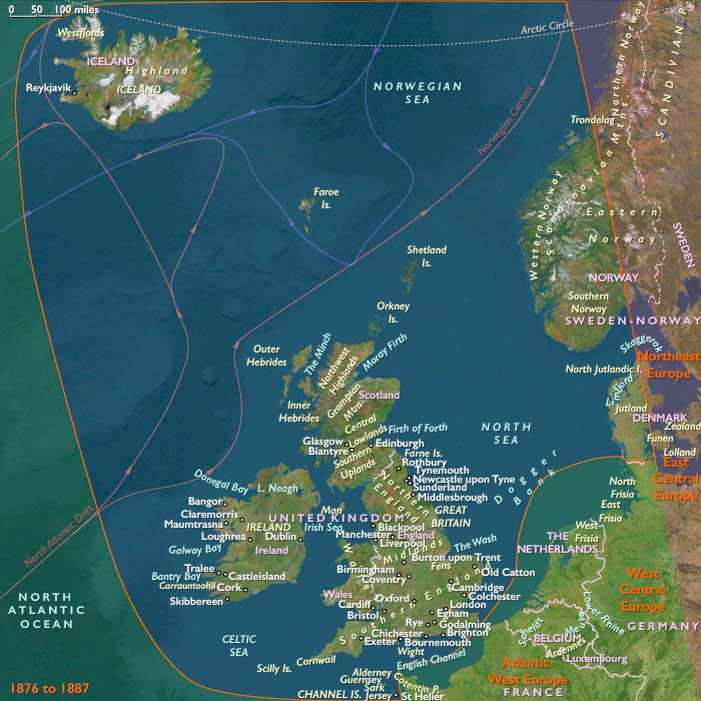
Years: 1886 - 1886
December
Locations
People
Groups
Topics
Commodoties
Subjects
Regions
Subregions