Arpinum, a city of Latium dated at …
Years: 188BCE - 188BCE
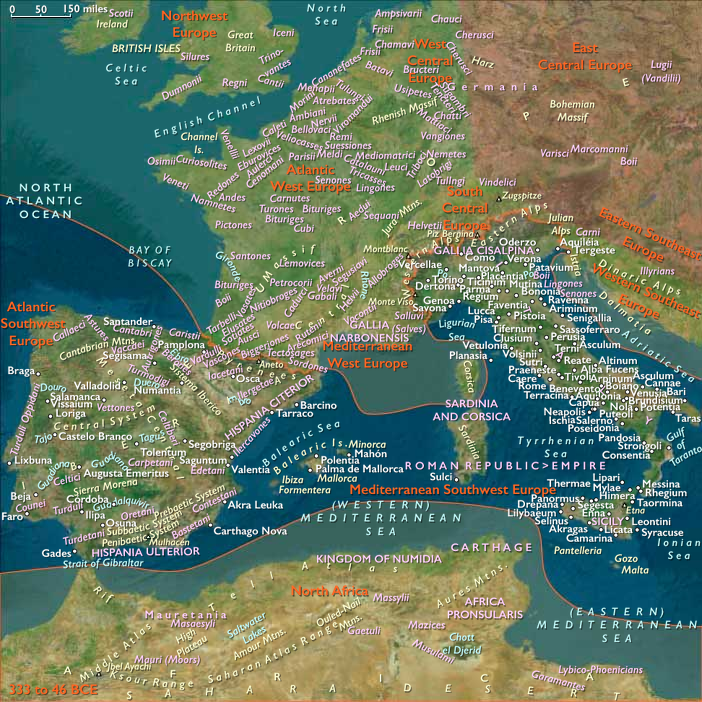
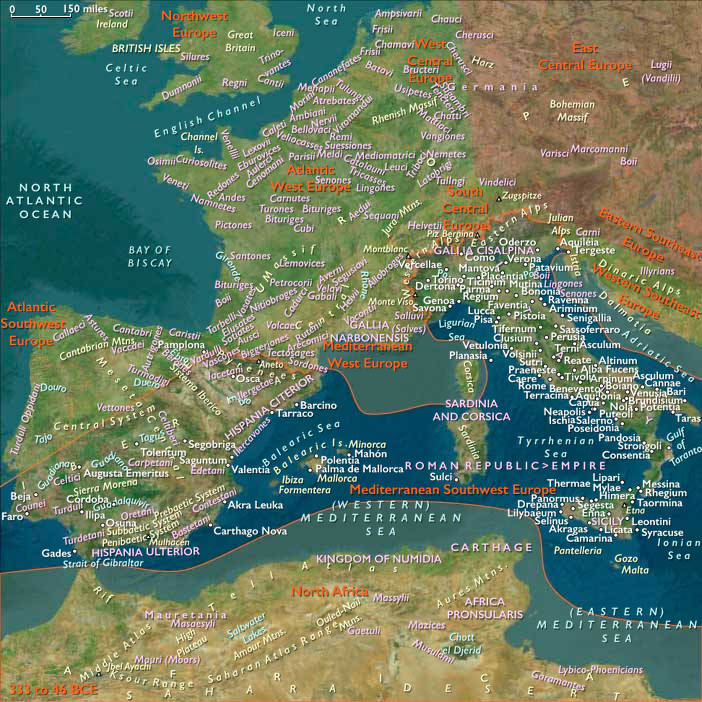
Arpinum, a city of Latium dated at least from the seventh century BCE and connected with the Pelasgi, the Volscian and Samnite people, had been captured by the Romans and made a civitas sine suffragio in 305 BCE.
The city gains Roman suffrage in 188 BCE.
Locations
Groups
Topics
Subjects
Regions
Subregions
Related Events
Filter results
Showing 10 events out of 63360 total
The Romans have no desire to actually administer territory in Hellenistic Anatolia but want to see a strong, friendly state in the region as a buffer zone against any possible Seleucid expansion in the future.
Following the peace of Apamea that ended the Syrian-Roman War, the Romans reward Eumenes by giving him control over the Thracian Chersonese (modern Gallipoli peninsula in European Turkey) and over most of the former Seleucid possessions in Asia Minor.
Seleucid king Antiochus III renounces all claim to his conquests in Europe and in Asia Minor west of the Taurus at the peace treaty of Apamea, signed with Rome in 188.
According to the humiliating terms of the peace agreement, he also is obliged to pay a huge indemnity of fifteen thousand talents over a period of twelve years, surrender his elephants—a great asset in battle— surrender the entire Syrian fleet except ten warships, and furnish hostages, including his son (the future Antiochos IV).
He is also made to give up his coastal territories and leave the whole of Anatolia as a Roman sphere of influence, most of it under the control of Eumenes II of Pergamon.
He can continue his war in the eastern provinces, but his kingdom is now reduced to Mesopotamia, western Iran, and Syria.
Antiochus has failed in his attempt to challenge Roman ascendancy in Europe and Asia Minor, but has rebuilt the Seleucid empire in the East and reformed the empire administratively by reducing the provinces in size.
He has also established a ruler cult (with himself and his late consort Laodice as divine), and improved relations with neighboring countries by giving his daughters in marriage to their princes.
One such is Demetrius, son of Euthydemus of Bactria, who thus preserves his political prestige.
Ariarathes IV of Cappadocia, who had assisted his father-in-law Antiochus in his war against the Romans, sues for peace in 188 BCE after the defeat of Antiochus by the Romans in 190-189 BCE.
Ariarathes obtains favorable terms, as his daughter, Stratonice, is at about this time betrothed to Roman ally Eumenes II, king of Pergamon, whom she will later actually marry.
Artaxias and Zariadres unite their efforts to enlarge their domains at the expense of neighboring areas; they are considered the creators of historical Armenia.
The Greek geographer Strabo names the capital of Sophene as Carcathiocerta, identified as the now abandoned town-site of Egil on the Tigris river north of Diyarbakir.
However, its largest settlement and only true city is Arsamosata, located further to the north and founded in the third century BCE.
(Much of the site, which is not to be confused with Samosata, now lies submerged under the waters of the Keban dam.
Though the kingdom's rulers are Armenian, the ethnicity of the kingdom is mixed, having a population of Armenian descent and a population of Semitic descent, infiltrating from the South, a situation that will still exist at the time of the Crusades.
The original Attalid territory around Pergamon (Mysia) is by 188 BCE greatly expanded with the addition of Lydia (excluding most Greek coastal cities), part of Phrygia, Lycaonia, and Pisidia (from 183), all former Seleucid territories.
Eumenes, realizing that his power rests on Roman might despite this enlargement of his domain, therefore cultivates friendship with the Romans, securing their intervention in his struggles against the kings of Bithynia and Pontus in northern Anatolia.
Philopoemen had taken advantage of the Aetolian treachery towards Sparta and had entered the city with his Achaean army.
Now in full control of Sparta, Philopoemen has forced Sparta to become a member state of the Achaean League.
Sparta's entry to the League had raised the problem of how to deal with the all the Spartans exiled by the social-revolutionary regimes that had dominated Sparta for a number of years.
Philopoemen had wanted to restore only those Spartans who were willing to support the League.
This meant that he has adopted an uncompromising hostility to traditional Spartan concerns.
When an infringement of the Achaean League’s promise to Sparta prompts the Spartans to secede from the confederation in 188, Philopoemen enters northern Laconia with his army and a group of Spartan exiles.
Capturing between eighty and three hundred and fifty members of the Spartan secessionist movement, he executes them after a show trial.
His army demolishes the wall that the former tyrant of Sparta, Nabis, had built around the city, and mandates the exile of all mercenaries, anti-Achaeans, and enfranchised helots.
Philopoemen now restores Spartan citizenship to the exiles and abolishes Spartan law and its education system, introducing Achaean law and institutions in their place.
Sparta's role as a major power in Greece ends, while the Achaean League becomes the dominant power throughout the Peloponnese.

The Roman Senate hears complaints from the Spartans, but takes no immediate action against the Achaeans.
The continuing quarrels among the Greek cities and leagues increases the conviction in Rome that there will be no peace in Greece until Rome takes full control.
Antiochus, faced with rebellion in the east, is without resources to suppress them.
Mounting a fresh expedition in 187 to the east of his kingdom in Luristan, in the upstart kingdom of Elymais, the king, now fifty-four, is murdered in a Baal temple near Susa, where he is exacting tribute in order to obtain much-needed revenue.