
Arnulf, besieged by frequent raids by the …
Years: 912 - 912
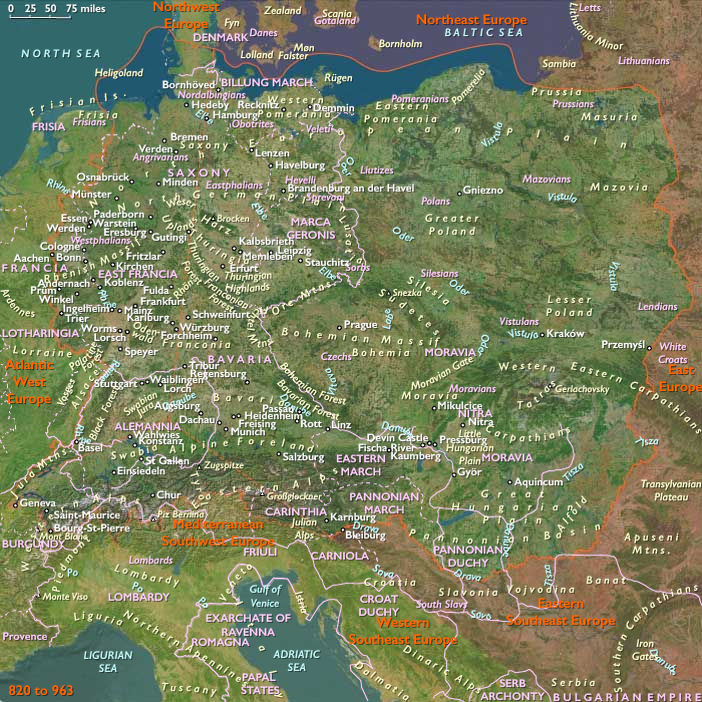
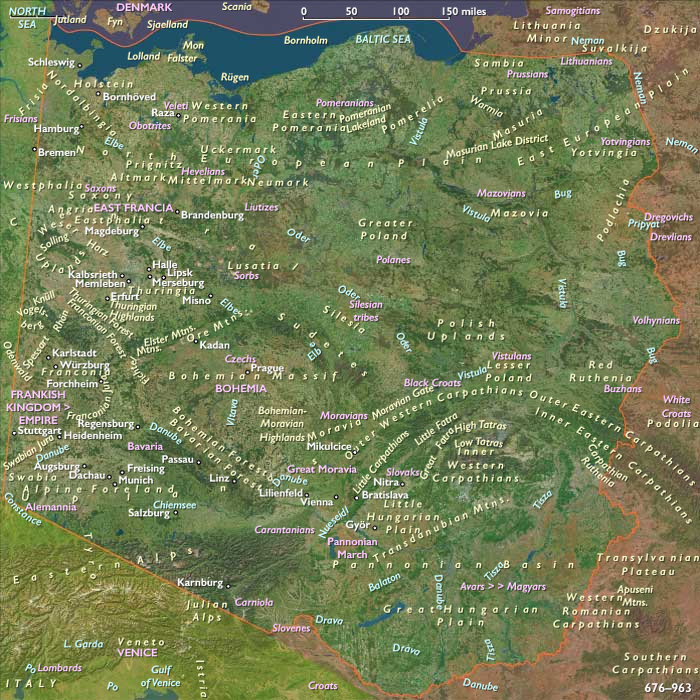
Arnulf, besieged by frequent raids by the Hungarians and desperate to raise funds to finance a defense, strengthens his power through confiscation of church lands and property, which earns him the nickname "the Bad".
He reestablishes the stem duchy of Bavaria and eventually negotiates a truce with the Hungarians, who hereafter largely pass through Bavaria on their raids into other German territories.
Locations
People
Groups
- Franks
- Hungarian people
- Saxony, Duchy of
- Francia Orientalis (East Francia), Kingdom of
- Hungary, Principality of
- Bavaria, Luitpolding Duchy of
Topics
Commodoties
Subjects
Regions
Subregions
Related Events
Filter results
Showing 10 events out of 53420 total
Igor, supposedly the son of legendary Varangian adventurer Rurik of Novgorod (who died around 879), rules Kiev (according the Russian Primary Chronicle) at the death of Rurik’s successor, Oleg.
Constantine Zuckerman, drastically revising the chronology of the Primary Chronicle, argues that Igor actually reigned for three years, between summer 941 and his death in early 945.
He explains the epic thirty-three-year span of his reign in the chronicle by its author's faulty interpretation of Byzantine sources.
Indeed, the chronicle records none of Igor's activities prior to 941.
Alexander, the brother of Leo VI, crowned co-emperor by his father Basil I in about the year 879, succeeds his brother on May 11, 912, as senior emperor alongside Leo's young son Constantine VII.
He is the first of Constantinople’s emperors to use the term "autocrator" on coinage to celebrate the ending of his thirty-three years as co-emperor.
Alexander promptly dismisses most of Leo's advisers and appointees, including the admiral Himerios, the patriarch Euthymios, and the Empress Zoe Karbonopsina, the mother of Constantine VII whom he locks up in a nunnery.
The patriarchate is again conferred on Nicholas Mystikos, who had been removed from this position because he had opposed Leo's fourth marriage.
Ahmad's Turkic general Simjur al-Dawati receives the surrender of Zaranj from al-Mu'addal.
The conquest of the Saffarids complete by 911, Ahmad appoints his cousin Mansur ibn Ishaq as governor of Sistan in the following year.
The Samanids also capture the Caliphal rebel, Sebük-eri, and send him to Baghdad.
Death ends the half-century reign of Western Ganga-Pallava king Kovijiya Kampavarman in about 912, at which point the kingdom of the Western Gangas, weakened by two centuries of more-or-less constant hostilities with the Chalukyas, collapses.
Leo of Tripoli defeats the naval expedition of 911-912, led by general Romanos and Admiral Himerios.
Orso Participazio is kidnapped in the Adriatic by a Serb prince of Zachlumia by the name of Mihailo Višević while returning with the Doge's son from an official visit to Constantinople in 912.
Bulgaria is at war with Constantinople, the sovereign of Venice, so the coastal prince dispatches him to Emperor Simeon of Bulgaria, hoping he will push off Petar Gojniković's domination in the area.
As Orso II, he becomes the eighteenth doge of the Republic of Venice, by tradition (historically, he is the sixteenth), elected by the popular assembly.
It seems that he is not related to the Participazio family that had already given many dogi to the city.
(There was a prior Orso II Participazio who vied for Dogeship in about 887 but appears to have been entirely unrelated.)
As soon as elected, he sends his son Pietro to Constantinople in order to reestablish the relationships with the emperor, which his predecessors had neglected; Pietro is named protospatario.
The Adriatic is still plagued with Dalmatian, Saracen, and Narentine pirates, but the Doge takes no action.
He is proclaimed Baduario in Constantinople; his family takes this title and modifies it, over time, to Badoer (pronounced “Badoèr”), which becomes a prominent name among successive generations of Veneziana nobility.
Al-Mahdi establishes the town of Mahdiah in 912 in coastal eastern Tunisia.
The Christian Reconquest of Coimbra and the Role of Count Hermenegildo (878 CE)
The Moors occupied Coimbra around 711 CE, transforming it into a major commercial hub between the Christian north and Muslim south. However, in the late 9th century, Christian forces reclaim the city for the third time in less than thirty years—this time holding it for nearly a century before it falls again to Almanzor in 987 CE.
Count Hermenegildo and the Reconquest of Northern Portugal
Count Hermenegildo, son of Count Gutierre and Elvira, is a prominent noble and one of the most loyal vassals of King Alfonso III of Asturias. He appears in medieval records from 869 CE, settling disputes between the Asturian king and Bishop Mauro, until his last documented act in May 912, when he confirms a donation made by his son-in-law, King Ordoño II, to the Cathedral of Santiago de Compostela.
As a reward for his service to the crown, Alfonso III appoints Hermenegildo as majordomo and grants him extensive properties and tenencias.
Military Campaigns and Repopulation Efforts
Hermenegildo plays a crucial role in military operations during the Reconquista. In 878 CE, he successfully defeats Muslim forces that had attacked Oporto and Coimbra, reclaiming both cities. Following this victory, he spearheads the repopulation of Coimbra, Braga, Viseu, and Lamego, settling these areas with Galician settlers after expelling the Moors.
The County of Coimbra and Later Muslim Reconquest
The lands Hermenegildo secures pass to his descendants, forming what becomes known as the County of Coimbra. However, in 987 CE, the city falls once again to Almanzor, the powerful military leader of Al-Andalus.
Coimbra remains under Muslim control until 1064, when it is permanently reconquered by the Christian forces of Ferdinand I of León, securing its place as an important center in medieval Portugal.
The Formation of Normandy and the Establishment of Rouen as its Capital (912)
By 912, Normandy emerges as a distinct political entity, formed from territories settled by various Viking groups—Danish, Norwegian, Hiberno-Norse, Orkney Vikings, and Anglo-Danish raiders—who had invaded and colonized West Francia throughout the 9th century.
Origins of Normandy
- The region had been subjected to repeated Viking invasions, leading to permanent Norse settlements along the lower Seine River.
- Normandy forms out of the following territories:
- Rouen County, where the Vikings, under Rollo, had concentrated their power.
- Pays de Caux, a fertile plateau along the coast that became heavily colonized by Norse settlers.
- Talou in Dieppe County, another coastal stronghold of Viking activity.
The Treaty of Saint-Clair-sur-Epte (911) and the Establishment of Rouen
- Following the Frankish victory at the Battle of Chartres in 911, King Charles the Simple negotiates a treaty with Rollo, leader of the Vikings.
- Under the Treaty of Saint-Clair-sur-Epte, Charles grants Rollo land along the Seine River, giving him control over Rouen and its surrounding territories.
- In 912, Rouen is officially established as the capital of Normandy, marking the beginning of organized Norman rule.
The Transformation of Normandy
- The Norse settlers begin adopting Frankish customs, including language, Christianity, and feudal governance.
- Normandy quickly becomes one of the most powerful feudal duchies in medieval France, with Rouen as its political and economic center.
- The region’s Scandinavian roots will shape its distinct cultural and military identity, influencing later European history, particularly through the Norman Conquest of England in 1066.
Conclusion: The Birth of Normandy as a Feudal State
The establishment of Rouen as the capital of Normandy in 912 marks the formal creation of the Norman state, blending Viking military traditions with Frankish feudal structures. This new power center will play a critical role in medieval European politics, with Normandy emerging as one of the dominant regions of France and later England.
Rollo’s Conversion and the Establishment of the Duchy of Normandy (912)
Following the Treaty of Saint-Clair-sur-Epte (911), Rollo and his Viking followers accept baptism and convert to Christianity in 912. This marks the beginning of Normandy as a Christian, yet still militaristic, Norse-Frankish state.
Rollo’s Baptism and the Title of Duke
- Rollo is baptized as Robert, taking a Christian name as part of his agreement with King Charles the Simple.
- He becomes the first Duke of Normandy, although contemporary sources often describe him as a Count rather than a Duke.
- Despite conversion, Rollo and his followers retain their Viking identity, maintaining their warrior traditions and expansionist mindset.
Norman Raiding Continues
- Even after their formal settlement in Normandy, Rollo’s forces continue Viking raids into neighboring Flanders.
- These raids reflect the Normans’ desire for expansion and wealth, rather than mere plunder, as they seek to consolidate their new territory.
- Northern France remains vulnerable, as Viking raiding culture persists alongside their gradual integration into Frankish society.
The Significance of Rollo’s Conversion
- Strengthens ties with the Frankish elite, as Christian rulers are more willing to recognize Rollo as a legitimate vassal.
- Encourages assimilation, as Norse settlers begin to adopt the French language, customs, and feudal governance.
- Establishes Normandy as a powerful feudal duchy, which will later play a crucial role in French and English history, particularly with the Norman Conquest of England in 1066.
Conclusion: The Birth of Christian Normandy
Though baptized and integrated into the Carolingian feudal system, Rollo and his followers remain true to their Viking origins, using their military prowess to expand Norman influence. The Duchy of Normandy thus begins as a hybrid Norse-Frankish state, blending Scandinavian warrior traditions with Christian feudal governance, shaping medieval European history for centuries.
Years: 912 - 912
Locations
People
Groups
- Franks
- Hungarian people
- Saxony, Duchy of
- Francia Orientalis (East Francia), Kingdom of
- Hungary, Principality of
- Bavaria, Luitpolding Duchy of
