
Arnulf, according to the Annals of Fulda, …
Years: 894 - 894
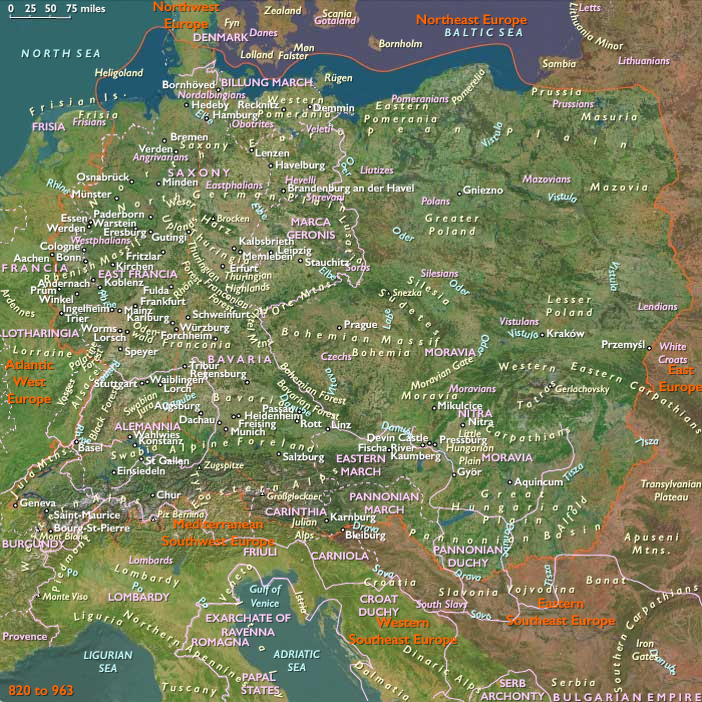
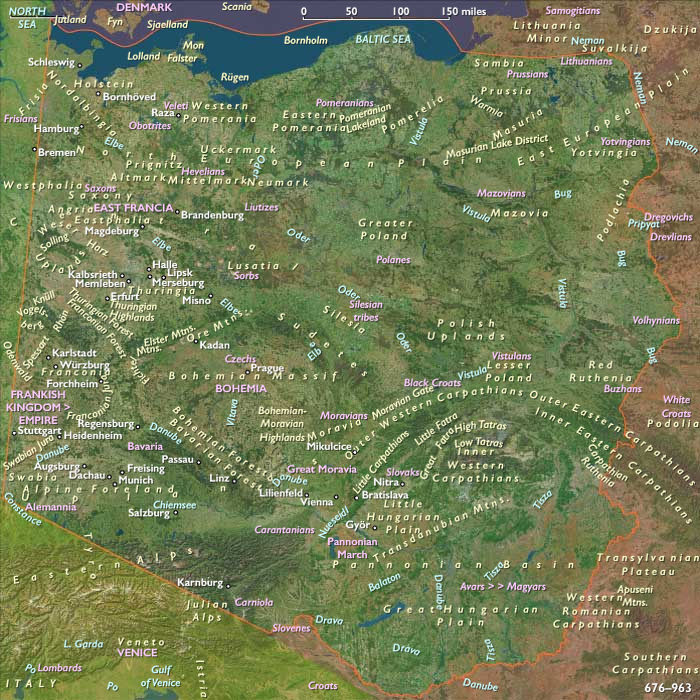
Arnulf, according to the Annals of Fulda, had sent an embassy led by margrave Arbo to Moravia sometime during 891 in order to renew the peace between Moravia and Eastern Francia.
A letter written by the margrave had soon announced that the legates were returning from Svatopluk and the Moravians who had agreed "to give themselves in friendship".
Svatopluk, however, had broken his pledges; thus, Arnulf decided to invade Moravia in 891.
First the king met with Braslav, the Slavic dux on the river Sava, next raised an army of Franconians, Bavarians and Alamanni, and also recruited Hungarians to join his campaign.
Because of his desire to bring down Moravia, Arnulf will be accused by Ottonian authors in the late tenth century of unleashing the Hungarians on Europe.
Arnulf's invasion of Moravia had started in July 892, but he had failed to defeat Svatopluk, who has brought the Moravian kingdom to its greatest height.
The war against Moravia seems to have continued until 894, the year of Svatopluk's "most unlucky death" according to the Annals of Fulda, which implies that he met his end in some kind of mishap, the sort that occurs in war.
The exact circumstances of Svatopluk's death, however, are unknown.
Zwentibald, the dux of the Moravians and the source of all treachery, who had disturbed all the lands around him with tricks and cunning and circled around thirsting for human blood, made an unhappy end, exhorting his men at the last that they should not be lovers of peace but rather continue in enmity with their neighbors.-- Annals of Fulda (year 894).
Arnulf ends Moravian assaults by treaty in 894.
People
Groups
- Franks
- Alamannia
- Wends, or Sorbs (West Slavs)
- Bavaria, Carolingian Duchy of
- Hungarians, Realm of the (Etelköz)
- Moravia, Great, Kingdom of
- Francia Orientalis (East Francia), Kingdom of
Topics
Commodoties
Subjects
Regions
Subregions
Related Events
Filter results
Showing 10 events out of 49 total
Broad Overview of High Medieval Atlantic West Europe (1108–1251 CE): Northern & Western France and the Low Countries
From 1108 to 1251, Atlantic West Europe—which includes northern and western France as well as the Low Countries (modern Netherlands, Belgium, and Luxembourg)—underwent profound transformations in political power, economic expansion, military conflicts, and cultural development.
This period saw:
- The consolidation of Capetian power in France, particularly under Philip II Augustus (r. 1180–1223) and Louis IX (r. 1226–1270).
- The decline of Plantagenet (Angevin) control in western France, culminating in the loss of Normandy, Anjou, and Poitou to the French Crown (1204–1259).
- The economic rise of the Low Countries, especially in Flanders, Brabant, and Holland, as centers of textile production and trade.
- The growing power of Burgundy, Champagne, and Lorraine, balancing between French royal authority and the Holy Roman Empire.
1. Political and Military Developments
The Capetian Expansion and the Decline of the Angevin Empire
- Philip II Augustus (r. 1180–1223) decisively defeated John of England, reclaiming Normandy, Anjou, Maine, and Poitou (1204).
- The Battle of Bouvines (1214), where Philip defeated an English-Flemish-Imperial coalition, solidified French dominance in the north.
- The Battle of Taillebourg (1242) further weakened English influence in Gascony and Poitou.
- Despite these victories, Gascony remained under English control, leading to ongoing Franco-English tensions.
The Low Countries: A Political and Economic Powerhouse
- Flanders and Brabant became crucial economic hubs, balancing alliances between France, England, and the Holy Roman Empire.
- The War of the Succession of Flanders (1185–1206) saw French intervention, culminating in Philip II’s victory over Count Baldwin IX of Flanders.
- Burgundy, Champagne, and Lorraine remained contested borderlands between France and the Empire, with frequent feudal conflicts.
- The Stedinger Crusade (1232–1234) in northwestern Germany saw the suppression of Frisian settlers resisting noble authority.
2. Economic and Urban Expansion
The Low Countries: The Rise of a Commercial Power
- Flanders, Brabant, and Holland became leading trade and textile centers, with major cities such as:
- Bruges and Ghent (Flanders) – Textile production and trade hubs.
- Brussels and Antwerp (Brabant) – Growing financial centers.
- Dordrecht and Haarlem (Holland) – Maritime and fishing economies.
- The Hanseatic League began expanding into Dutch and Flemish waters, increasing Baltic-North Sea trade links.
France: Regional Economic Growth
- Champagne Fairs (held in cities like Troyes and Provins) became key international trade markets, connecting merchants from Italy, Spain, and the Low Countries.
- Bordeaux and La Rochelle emerged as maritime trade centers, linking France to England and the Mediterranean.
- Wine production flourished in Gascony and Burgundy, fueling export economies.
3. Religious and Cultural Developments
Gothic Architecture and the High Middle Ages Cultural Boom
- Major cathedrals were constructed across the region, marking the height of French High Gothic and Rayonnant styles:
- Notre-Dame de Paris (begun 1163, completed c. 1240s)
- Reims Cathedral (begun 1211) – Coronation site of French kings.
- Amiens Cathedral (begun 1220) – Tallest of the High Gothic cathedrals.
- Sainte-Chapelle (1246–1248) – Built by Louis IX to house relics from Constantinople, showcasing the height of Rayonnant Gothic.
The Inquisition and Religious Tensions
- The Albigensian Crusade (1209–1229) led to the fall of the Cathar heresy in Languedoc, strengthening Capetian control over southern France.
- Pope Gregory IX formally established the Papal Inquisition in 1231, appointing Robert le Bougre ("Hammer of Heretics") as an inquisitor in Burgundy.
- In 1242, Christian zealots burned 24 cartloads of Talmud manuscripts in Paris, marking a period of increasing institutionalized anti-Jewish policies.
The Rise of Universities and Intellectual Thought
- The University of Paris became a leading center of Scholasticism, with thinkers like:
- Alexander of Hales, who introduced Aristotelian logic into theology.
- William of Auvergne, who worked to reconcile Augustine with Aristotle.
- The University of Orléans emerged around 1230, as a center of legal studies, focusing on Roman and canon law.
- Johannes de Sacrobosco’s Tractatus de Sphaera (c. 1230) became the leading astronomical text of the era.
4. The Strengthening of Monarchical Authority
France: The Rise of a Centralized State
- Philip II Augustus expanded royal justice, limiting noble autonomy.
- Louis IX (Saint Louis) sent enquêteurs (royal commissioners) in 1247 to investigate local governance, ensuring administrative accountability.
- The French monarchy increased control over taxation and trade, strengthening its financial power.
Burgundy, Champagne, and Lorraine: Balancing Between France and the Empire
- Burgundy remained a semi-independent duchy, balancing feudal allegiances between France and the Holy Roman Empire.
- The War of the Succession of Champagne (1216–1222) highlighted tensions between French royal influence and regional autonomy.
- In Lorraine, Theobald I’s rebellion against Frederick II (1218) led to a brief imperial occupation and restructuring of local power.
The Low Countries: Increasing Autonomy
- The Counts of Flanders and Holland navigated a delicate balance between England and France, using their economic power to resist complete subjugation.
- Haarlem (1245) and Delft (1246) received city rights, reflecting the increasing urban autonomy and self-governance of Dutch cities.
Conclusion: The Transformation of Atlantic West Europe by 1251
By 1251, northern and western France and the Low Countries had undergone profound transformations:
- Capetian France had become the dominant power, solidifying control over Normandy, Anjou, and Poitou while increasing royal administration.
- England had lost most of its continental holdings, retaining only Gascony, leading to a shift in its focus toward maritime power and internal governance.
- The Low Countries had risen as economic centers, with cities like Bruges, Ghent, and Antwerp becoming major trading hubs.
- Burgundy, Champagne, and Lorraine remained contested border regions, balancing imperial and French influences.
- Religious, architectural, and intellectual advancements flourished, positioning the region at the heart of medieval European culture and governance.
These changes set the stage for the Late Middle Ages, shaping the Hundred Years’ War, the continued growth of urban economies, and the increasing centralization of power in France and the Low Countries.
The Reign of Louis VI and the Capetian Expansion (1108–1137)
With the accession of Louis VI in 1108, the Capetian dynasty consolidated its hold over the Île-de-France, while extending its influence into the broader Frankish realm. Unlike his predecessors, who struggled to assert control over the powerful feudal lords, Louis VI actively engaged in campaigns to subdue rebellious vassals, particularly in regions bordering Atlantic West Europe, such as Normandy, Anjou, and Aquitaine. His reign marked a gradual strengthening of royal authority, often in alliance with the Church, which saw the king as a protector against unruly barons.
One of Louis VI's most significant conflicts was with Henry I of England, whose control over Normandy placed French royal interests in direct opposition to the Anglo-Norman realm. The battle for dominance in Normandy became a recurring struggle between the Capetians and the Angevin rulers of England, setting the stage for centuries of conflict. Although the French monarchy remained weaker than its Anglo-Norman rival, Louis VI laid the groundwork for Capetian resilience, particularly through the use of strategic marriages and alliances.
His son, Louis VII, inherited the throne in 1137, bringing with him a union that would momentarily strengthen Capetian claims—his marriage to Eleanor of Aquitaine, the most powerful noblewoman in France.
Philip II and the Collapse of the Angevin Empire (1180–1223)
The ascension of Philip II Augustus in 1180 marked a turning point in the balance of power. Unlike his predecessors, Philip II aggressively pursued policies aimed at dismantling Angevin dominance. Through careful diplomacy and military campaigns, he exploited the internal divisions among Henry II's heirs, particularly after Richard I’s death in 1199 and the succession crisis involving John of England.
Philip’s decisive victory at the Battle of Bouvines in 1214 crushed Anglo-Angevin ambitions in Normandy, permanently integrating it into the French crown. The subsequent loss of Anjou, Maine, and Touraine weakened English influence on the continent, leaving Aquitaine as the last major English holding in Atlantic West Europe.
Philip's reign also saw the expansion of royal institutions, including the bailliage system, which increased the crown’s control over provincial administration, laying the foundation for a centralized French monarchy.
The Angevin Empire and the Capetian Rivalry (1137–1189)
The marriage of Louis VII and Eleanor of Aquitaine initially seemed to bolster Capetian influence in Atlantic West Europe, as the vast territories of Aquitaine, Poitou, and Gascony fell under the French crown. However, the union was fraught with tensions, as Eleanor’s independent nature and close ties to her homeland clashed with Louis' pious and restrained character. Their marriage ended in annulment in 1152, allowing Eleanor to marry Henry Plantagenet, the soon-to-be Henry II of England. This union created the Angevin Empire, a vast territorial network spanning from England to Normandy, Anjou, and Aquitaine, posing a direct threat to Capetian authority.
Under Henry II (r. 1154–1189), the Angevin Empire became the dominant power in Western Europe. His legal reforms, administrative restructuring, and military campaigns reinforced his control over Atlantic West Europe, particularly in Brittany, Maine, and Poitou. However, Henry's ambitions clashed with both his sons and the Papacy. The assassination of Thomas Becket, Archbishop of Canterbury, in 1170 weakened Henry's standing with the Church, while internal rebellions among his sons—Richard the Lionheart, John Lackland, and Geoffrey of Brittany—destabilized the realm.
Despite these struggles, the Angevin presence in Atlantic West Europe remained formidable, setting the stage for continued conflict with the Capetians.
Atlantic West Europe (1108–1119): Consolidation, Expansion, and Cultural Renewal
Between 1108 and 1119, Atlantic West Europe—which includes the Low Countries, Brittany, Normandy, Aquitaine, Burgundy, central France, Alsace, and Franche-Comté—underwent significant political stabilization, territorial consolidation, and early cultural renaissance. This era marked the strengthening of feudal structures, the expansion of royal and ducal authority, and flourishing monastic and intellectual activity.
Political and Military Developments
-
France: Royal Consolidation under Louis VI
-
King Louis VI "the Fat" (r. 1108–1137) significantly expanded Capetian royal authority, subduing rebellious nobles in the Île-de-France and strengthening royal influence over central France.
-
Louis VI utilized diplomacy and military action to consolidate power, particularly asserting dominance over rebellious barons and castellans.
-
-
Normandy: English and French Rivalries
-
Henry I of England (r. 1100–1135), also Duke of Normandy, secured control over the duchy following internal struggles, reinforcing the Anglo-Norman connection and stabilizing the region through administrative reforms.
-
-
Aquitaine and Poitou: Ducal Power
-
William IX, Duke of Aquitaine (r. 1086–1127), one of the first troubadours, maintained strong regional control, navigating between asserting ducal autonomy and managing feudal obligations to the French crown.
-
-
Brittany and the Loire Valley: Regional Autonomy
-
Brittany remained largely independent, with Duke Alan IV (r. 1084–1112) and Conan III (r. 1112–1148) solidifying local governance and defending against external pressures.
-
-
Low Countries: Emerging Urban Autonomy
-
Cities in Flanders, such as Bruges and Ghent, experienced economic prosperity, enhancing their political influence and autonomy from feudal lords.
-
-
Burgundy and Alsace: Feudal Stability
-
The Duchy of Burgundy maintained semi-autonomous stability under Duke Hugh II (r. 1103–1143), balancing regional power dynamics through alliances and feudal management.
-
Economic and Social Developments
-
Agricultural Expansion and Economic Growth
-
Improved agricultural methods and the expansion of arable land led to demographic growth and economic stability, supporting the rise of regional trade networks.
-
Increased production sustained burgeoning urban markets and long-distance trade routes, especially in wine, wool, and textiles.
-
-
Urbanization and Trade Networks
-
The rise of trade fairs and market towns, particularly in Champagne, facilitated extensive trade across Atlantic West Europe, enhancing urban economic power and integration.
-
Cultural and Intellectual Developments
-
Monastic Reform and Intellectual Revival
-
The spread of Cluniac and Cistercian monastic reform movements revitalized spiritual life, boosted agricultural productivity, and encouraged intellectual activity.
-
Notable monasteries such as Cluny and Cîteaux gained prominence, influencing religious practice, culture, and politics.
-
-
The Rise of Troubadour Culture
-
The court of William IX of Aquitaine became a hub for troubadour poetry, significantly influencing European literary culture and courtly tradition.
-
Religious Developments
-
Church Reform and Centralization
-
Continued efforts toward church reform and papal authority, initiated in the previous century, gained momentum, shaping ecclesiastical governance and relations with secular powers.
-
Tensions between church authority and local secular rulers occasionally arose, shaping the broader social and political landscape.
-
Legacy and Significance
The period 1108–1119 established crucial foundations in Atlantic West Europe, reinforcing royal authority, regional stability, and economic prosperity. Cultural and intellectual advancements, driven by monastic reforms and the troubadour tradition, laid the groundwork for the vibrant intellectual and cultural life that characterized the high medieval period.
The Rise of Louis VI and the Struggle for Royal Authority (c. 1100 CE)
By 1100 CE, Louis, the nineteen-year-old son of King Philip I of France, began to assume military leadership of the monarchy, stepping in for his aging and increasingly ineffective father. His early leadership foreshadowed the central theme of his reign: the struggle to assert royal authority over rebellious nobles and fortify the power of the Capetian monarchy.
A Fragmented Kingdom and the Weakness of Royal Power
At the dawn of the 12th century, the Kingdom of France was a patchwork of semi-independent principalities, where the authority of the Capetian kings was nominal at best outside their personal domain. Unlike the well-organized Anglo-Norman realm across the Channel, the Capetian crown was hemmed in by powerful feudal princes, including the Dukes of Normandy, Aquitaine, and Burgundy.
Even within the royal demesne, centered on the Île-de-France, the monarchy faced severe challenges:
- The region was infested with unruly castellans—petty warlords who controlled fortresses, terrorized the peasantry, and plundered churches and trade routes.
- The princely vassals of France—many more powerful than the king himself—paid little more than lip service to Capetian authority.
- Banditry and lawlessness disrupted transportation and commerce, weakening the economic base of the monarchy.
With Philip I increasingly inactive and disinterested, it fell to his son Louis to restore order and begin the process of strengthening Capetian rule.
Louis’s Early Campaigns Against the Castellans
Louis, later known as Louis VI ("Louis the Fat"), quickly gained a reputation as a militant and energetic leader. His first priority was to curb the power of the robber lords within the royal demesne:
- Siege Warfare and Castles – Louis launched a series of military campaigns against lawless castellans, capturing fortified strongholds and destroying castles used as bases for raiding.
- Church Support – He secured the backing of the Church, which viewed his efforts as a moral crusade against feudal lawlessness.
- Defending Royal Roads and Trade – By pacifying the Île-de-France, Louis laid the groundwork for the restoration of commerce and safe travel, essential for the kingdom’s economy.
Although Louis's early battles were confined to the royal domain, they represented the first step in the slow consolidation of Capetian power, setting the stage for later expansion and centralization.
Legacy and Significance
The early leadership of Louis VI marked a turning point in Capetian rule. By militarily asserting the king’s authority within the Île-de-France, he began transforming the French monarchy from a weak feudal overlord into a growing centralized force. His efforts to curb feudal anarchy, secure Church support, and defend the royal domain would pave the way for the gradual expansion of royal power under his successors, culminating in the later dominance of the Capetian dynasty.
The Death of Philip I and the Contested Succession of Louis VI (1108 CE)
On July 28 or 29, 1108, Philip I of France died at the age of 56 in the castle of Melun, bringing an end to his forty-eight-year reign, one of the longest in early Capetian history. Unlike his royal predecessors, Philip was not buried in Saint-Denis alongside his forefathers but, per his request, at the monastery of Saint-Benoît-sur-Loire, reflecting his fraught relationship with the Church.
Philip’s reign had been marked by controversy and discord with ecclesiastical authorities, owing to his bigamous marriage, his resistance to Church reforms, and his notoriously indulgent lifestyle. His long rule, however, had preserved Capetian control over the Île-de-France, setting the stage for his son, Louis VI, to further consolidate royal authority.
The Rise of Louis VI: Early Struggles and Coronation
Louis, the great-great-grandson of Hugh Capet, was born in Paris to Philip I and Bertha of Holland. Even before his accession, he had gradually taken control of the French government from 1100 onward, assuming military leadership while his father remained increasingly inactive.
In his youth, Louis had:
- Fought the Duke of Normandy, Robert Curthose, asserting Capetian influence against the Anglo-Norman rulers.
- Struggled against rebellious lords in the Île-de-France, seeking to pacify the castellans who terrorized the royal domain.
- Gained the support of Abbot Suger of Saint-Denis, a key political adviser who would later shape his reign.
Despite his position as heir, Louis's succession was not uncontested. His half-brother, the son of Philip I and Bertrade de Montfort, sought to block his path to Rheims, the traditional site of royal coronations.
- Unable to reach Reims, Louis was instead crowned on August 3, 1108, in the cathedral of Orléans by Daimbert, Archbishop of Sens.
- The Archbishop of Reims, Ralph the Green, opposed the legitimacy of the coronation and sent envoys to challenge its validity, but their efforts failed to prevent Louis's recognition as king.
A New Era for the Capetians
With his coronation secured, Louis VI ascended the throne at a critical juncture in Capetian history. Unlike his father, he was energetic, militarily capable, and determined to expand royal authority beyond the Île-de-France. His early reign would be dominated by campaigns against feudal lawlessness, marking the beginning of a more assertive and centralized Capetian monarchy.
The Growing Threat to Normandy and the Conflict Between Louis VI and Henry I (1108–1109 CE)
Following the accession of Louis VI of France in 1108, the Duchy of Normandy faced increased pressure from a coalition of France, Anjou, and Flanders, as the new king sought to reassert royal authority over his vassals. Unlike his father, Philip I, whose influence had been limited to the Île-de-France, Louis VI pursued a more aggressive policy against the Anglo-Norman realm, directly challenging the authority of Henry I of England, Duke of Normandy.
Louis VI’s Demands and Henry I’s Defiance
Soon after taking the throne, Louis VI asserted his overlordship by demanding that Henry I pay homage for Normandy. Additionally, he insisted that two disputed castles along the Normandy border be placed under the control of neutral castellans, effectively reducing Henry’s control over these contested frontier strongholds.
Henry I, who had consolidated power in England and Normandy following his victory over Robert Curthose at the Battle of Tinchebray (1106), refused to acknowledge Louis’s authority in such matters. His response was outright defiance, rejecting both the homage and the demand to relinquish control of the castles.
Military Posturing and Diplomatic Stalemate
In response, Louis VI mobilized an army, preparing for a potential military campaign against Normandy. However, despite the show of force, neither side was eager to engage in open conflict at this stage. After heated negotiations, the two kings reached a truce, agreeing to withdraw without battle, yet leaving the core disputes unresolved.
This diplomatic impasse marked the beginning of a long-standing rivalry between the Capetian and Norman-Angevin realms. Though open war was avoided in 1109, tensions between Louis VI and Henry I would continue to escalate in the following years, culminating in further confrontations over Normandy’s borders, feudal allegiances, and the balance of power in Western France
Fulk V of Anjou and the Renewal of Angevin Power (1109 CE)
In 1109, Fulk V assumed control of Anjou, embarking on a campaign to rebuild Angevin authority and assert independence from Norman and English domination. His succession marked the beginning of a more assertive and ambitious Angevin policy, directly challenging Henry I of England, Duke of Normandy and King of England.
The Control of Maine and the Alliance with France
Along with Anjou, Fulk V inherited the County of Maine, a strategically vital territory contested by both Normandy and Anjou. Instead of recognizing Henry I as his feudal overlord, as his predecessors had done, Fulk chose to ally with King Louis VI of France, reinforcing Capetian efforts to counterbalance Norman power.
This move represented a direct rejection of Norman influence and strengthened the anti-Norman coalition, as both Louis VI and Fulk V sought to weaken Henry’s control over northern and western France.
Rising Tensions Between Anjou and Normandy
- Fulk’s refusal to pay homage to Henry I heightened tensions along the Normandy-Anjou frontier, exacerbating long-standing rivalries.
- His alliance with Louis VI provided the Capetians with a key ally, while positioning Anjou as a central player in the struggle for dominance in France.
- Henry I, preoccupied with securing Normandy’s borders and dealing with Flemish and Breton threats, sought to contain Fulk’s ambitions but refrained from immediate military action.
Fulk V’s defiance of Henry I and alignment with Capetian France set the stage for further Norman-Angevin conflicts, shaping the shifting balance of power in Atlantic West Europe over the next several decades.
Louis VI and the Struggle for Normandy (1109–1113 CE)
Upon ascending the throne in 1108, Louis VI ("the Fat") embarked on a lifelong campaign against the Norman kings of England, seeking to challenge their hold over Normandy and extend Capetian influence. Though, like his predecessors, he ruled only the Île-de-France and a few adjacent lands, Louis was determined to contest English power on the continent and position himself as the rightful overlord of Norman and Angevin territories.
A Lifelong Ambition for the English Throne
Even before becoming king, Louis VI had actively opposed the Anglo-Norman rulers:
- He had supported rebellion in Normandy, encouraging Duke Robert Curthose and his sons to resist the rule of Henry I of England.
- He had mentored Robert II of Normandy, fostering instability within the duchy and challenging Henry I’s authority.
- As king, he continued to claim feudal suzerainty over Normandy, insisting that Henry I owed him homage as Duke of Normandy.
However, rather than making direct claims to the English throne, Louis's ambitions were focused on undermining Anglo-Norman control in France, particularly in Normandy and the Vexin.
The Vexin and the War Against Henry I (1109–1113)
The Vexin, a valuable and contested region between Normandy and the Île-de-France, became the primary battleground in Louis VI’s war with Henry I. The territory was politically divided:
- Part of the region was controlled by Henry I, who had captured Duke Robert Curthose and consolidated power in Normandy.
- The other portion was aligned with Louis VI, who sought to exploit divisions among the Norman nobility to weaken Henry’s hold.
By 1109, Henry I launched an invasion of Capetian France, initiating a four-year war (1109–1113) marked by:
- Sporadic French raids into Normandy, aiming to disrupt Henry’s control.
- Counter-invasions by the English, devastating the lands of rebellious Norman barons loyal to Louis.
- Repeated truces, none of which resolved the underlying conflict.
Despite military setbacks, Louis VI solidified his authority in France, emerging as one of the strongest Capetian rulers since the division of the Carolingian Empire. His struggles with Henry I would set the stage for later Capetian-Plantagenet conflicts, defining the political landscape of Atlantic West Europe for generations to come.
Years: 894 - 894
People
Groups
- Franks
- Alamannia
- Wends, or Sorbs (West Slavs)
- Bavaria, Carolingian Duchy of
- Hungarians, Realm of the (Etelköz)
- Moravia, Great, Kingdom of
- Francia Orientalis (East Francia), Kingdom of
