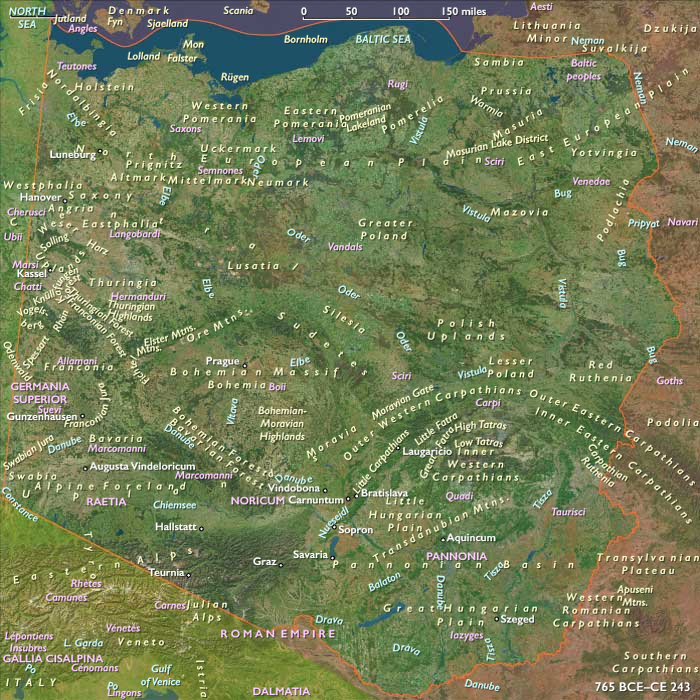
…Arnsburg—Inheiden—Schierenhof—Gunzenhausen—…
Years: 96 - 96
…Arnsburg—Inheiden—Schierenhof—Gunzenhausen—…
Locations
People
Groups
Topics
Commodoties
Subjects
Regions
Subregions
Related Events
Filter results
Showing 10 events out of 16 total
…Shanxi provinces.
The war drags on.
During and the Yellow Turban Rebellion and its aftermath, many people from other provinces, in order to ward off pillaging by Yellow Turbans or governmental forces, also organize into military organizations, and a good number resist government forces, and even after the Yellow Turbans are defeated, the central government's control of the provinces will no longer be what it once was.
…Shanxi provinces, although they have been severely weakened by the effort.
Yuan Shao had maintained good relations with the Wuhuan beyond the imperial borders during his campaign against rival warlord Gongsun Zan, their common enemy, in the 190s.
Yuan Shao had given the chieftains of his Wuhuan allies seals and insignia as chanyu after the final destruction of Gongsun Zan in the Battle of Yijing in 199, and has reinforced the alliance by marrying the daughters of his subordinates to the Wuhuan leaders, pretending as though the daughters were his own.
The Wuhuan war leader Tadun was especially powerful and was thus very well-treated by Yuan Shao.
The Wuhuan have continued to support the Yuan clan after Yuan Shao's defeat at the Battle of Guandu against Cao Cao.
Subsequently, Yuan Shao's oldest and youngest son, Yuan Tan and Yuan Shang respectively, fought among themselves in a succession feud, which Cao Cao had exploited for himself.
Soon Yuan Tan was killed in a battle against Cao Cao and Yuan Shang had to flee to his second brother, Yuan Xi, in You Province.
The Yuan brothers in You Province had then been the targets of a mutiny against them, and had fled further north to seek protection from the Wuhuan, who have been united under the military leadership of Tadun, whose apparent strength prompts rumurs that he is seeking to emulate Modu Chanyu of the Xiongnu and Tanshihuai of the Xianbei in creating a hegemony over the northern nomadic tribes.
With the arrival of the Yuan brothers, accompanied by a considerable number of their followers, Tadun has gained command of a combined Wuhuan and Chinese force that is said to have numbered up to three hundred thousand.
In the name of helping Yuan Shang regain his territories, the Wuhuan make several raids across the imperial border, and are said to have kidnapped over one hundred thousand Chinese families.
Posed with such danger in the north, Cao Cao contemplates the elimination of the Wuhuan threat.
The defeat of the Former Qin in the Battle of Fei and the subsequent uprisings split its territory into two noncontiguous pieces after the death of Fu Jian: one located at present day Taiyuan, Shanxi, is soon overwhelmed in 386 by the Xianbei under the Later Yan and the Gaoche, or Dingling.
The other portion, occupying greatly reduced territories around the border of present day Shaanxi and Gansu, struggles for survival.
Yuan Huangtou of Ye, the son of the deposed Yuan Lang, the briefly reigning Emperor of Northern Wei, has been permitted to inherit his father’s title of Prince of Anding.
Northern Wei's branch successor state Eastern Wei having ended in 550 and been replaced by Northern Qi, its first emperor, Emperor Wenxuan of Northern Qi, carries out a major slaughter of Northern Wei's imperial Yuan clan in 559.
Several prisoners of Emperor Wenxuan, including Yuan Huangtou, are forced to launch themselves from a tower attached to a kite, as an experiment.
Yuan Huangtou is the sole survivor, successfully gliding over the city walls.
One Yuan Huangtou is imprisoned and starves to death, but it is not known for sure whether that Yuan Huangtou was Yuan Lang's son.
The Liang Dynasty ends in 557 as Chen Baxian, a distinguished general, becomes, as Emperor Wu, the first emperor of Southern China’s Chen Dynasty.
Chen Qian, age thirty-seven, succeeds his uncle Emperor Wu of Chen.
During his reign, he will consolidate the state against the rebellious warlords.
Taiyuan, the secondary capital of Northern Qi, is rebuilt in 562; it will become a center of Buddhism.
Li Yuan had served three terms as provincial governor during the reign of Emperor Wen of Sui.
Early in the reign of Emperor Wen's son Emperor Yang, Li Yuan had served as prefecture governor (as Emperor Yang converted provinces into prefectures), but had later been recalled to serve as a junior minister within Emperor Yang's administration.
When Emperor Yang carried out his second campaign against Goguryeo in 613, Li Yuan was in charge of part of the logistics operation.
When the general Yang Xuangan rebelled near the eastern capital Luoyang, Emperor Yang had commissioned Li Yuan as a general and placed in charge of the operations west of the Tong Pass, although Yang Xuangan's rebellion eventually did not involve that region.
Li Yuan took the opportunity to recruit talented people to his staff.
Later that year, when Emperor Yang summoned him to his presence, he had declined, citing ill health—an excuse that Emperor Yang did not believe, as he questioned Li Yuan's niece, a Consort Wang (Emperor Yang's concubine), "Will he die?".
In fear, Li Yuan took up drinking and receiving bribes to try to show Emperor Yang that he did not have great ambitions.
In 615, Emperor Yang had placed him in charge of the operations against agrarian rebels in the Hedong region (roughly modern Shanxi), but recalls him in 616.
Later this year, Emperor Yang puts him in charge of the key city of Taiyuan (in modern Taiyuan, Shanxi).
Li Yuan begins to gather forces from the region, claiming that they are necessary to defend against the Turks, which draws suspicions from his deputies Wang Wei and Gao Junya.
Li Yuan, afraid that Wang and Gao will act against him first, then uses a Turkish attack as an excuse to falsely claim that Wang and Gao are working in concert with the Turkish khagan, Shibi Khan (Ashina Duojishi), and has them executed.
He sends secret messengers to Hedong to recall his sons Li Jiancheng, Li Yuanji (both by Duchess Dou) and Li Zhiyun (by his concubine Lady Wan), whom he had left there to watch over his household, and the capital Chang'an to recall his daughter (the future Princess Pingyang) and her husband Chai Shao.
Li Jiancheng and Li Yuanji, leaving Li Zhiyun at Hedong, soon meet with Chai, and they arrive together at Taiyuan.
Li Yuan's daughter, believing it would be difficult for her to flee with Chai, chooses to hide instead.
Once Li Jiancheng, Li Yuanji, and Chai arrive at Taiyuan, Li Yuan formally declares his rebellion, but maintains the guise of a Sui loyalist and declares that his intention is simply to install on the throne Emperor Yang's grandson Yang You, the Prince of Dai, who is at this time at Chang'an, and honor Emperor Yang as Taishang Huang (retired emperor).
Li Yuan first secures his northern flank by contacting Shibi Khan, offering tribute, and receives men and horses in exchange.
He puts Li Jiancheng and Li Shimin in charge of his army and, leaving Li Yuanji in charge at Taiyuan, advances south.
Meanwhile, the Sui officials at Hedong arrest Li Zhiyun and deliver him to Chang'an, where he is executed.
His daughter Pingyang sells her possessions to raise an army for him.
She persuades several other leaders to fight under her banner.
They take several towns and her army swells until she has seventy thousand troops under her command.

Tang is meanwhile facing another serious threat—Liu Wuzhou, now determined to march south against Tang.
Emperor Gaozu sends Pei Ji against Liu's advancing army, but Pei is defeated by Liu, who then puts Taiyuan under siege.
Li Yuanji flees back to Chang'an, and much of modern Shanxi is seized by Liu.
Emperor Gaozu then sends Li Shimin against Liu, and by summer 620, Li Shimin has defeated Liu, forcing him to flee to the Eastern Turks.
Liu's territory is incorporated into Tang.
Around the same time, however, Dou Jiande the Prince of Xia makes a major offensive against the cities that had submitted to Tang in modern Hebei and Henan, north of the Yellow River, seizing nearly all of them and taking captive Emperor Gaozu's cousin Li Shentong the Prince of Huai'an, Emperor Gaozu's sister the Princess Tong'an, and Li Shiji's father Li Gai.
With Li Gai in Dou's custody, Li Shiji surrenders to Dou as well.
In 620, Li Shiji, in association with another Tang general who had surrendered to Dou, Li Shanghu, plots to ambush Dou, but the plot is discovered; Li Shanghu is killed, and Li Shiji flees back to Tang.