
The Seljuks win control of most of …
Years: 964 - 1107
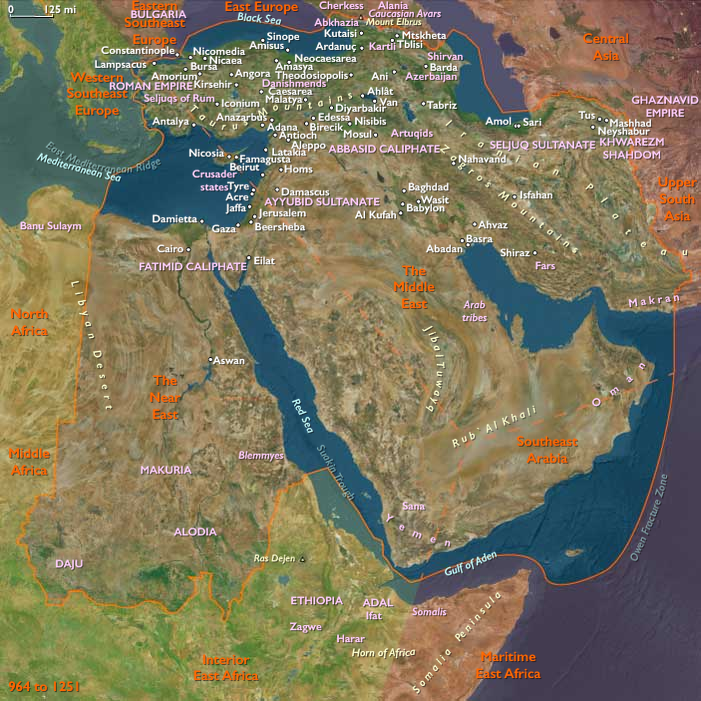
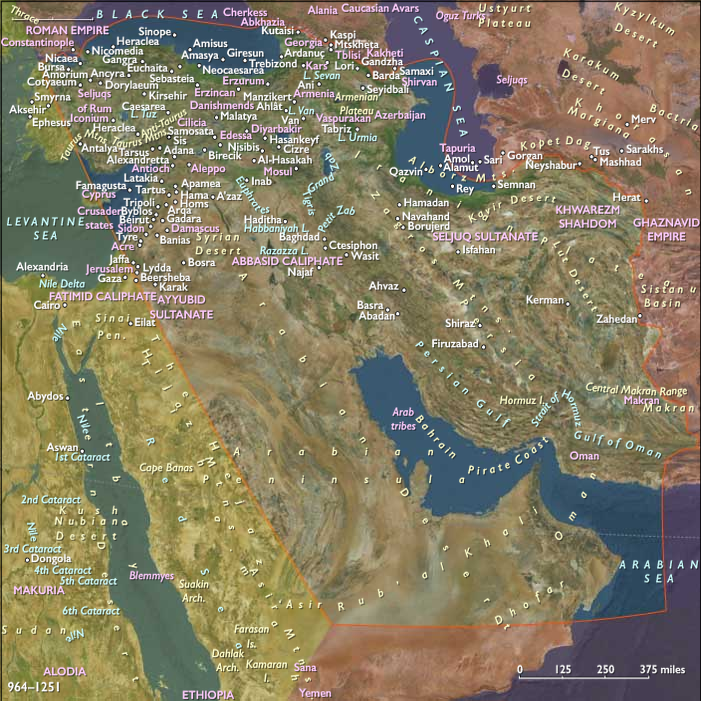
The Seljuks win control of most of Anatolia within ten years of the Battle of Manzikert.
The Seljuk sultanate in Baghdad, although successful in the west, reels under attacks from the Mongols in the east and is unable—indeed unwilling—to exert its authority directly in Anatolia.
The ghazis carve out a number of states here, under the nominal suzerainty of Baghdad, states that are continually reinforced by further Turkish immigration.
The strongest of these states to emerge is the Seljuk sultanate of Rum ("Rome," i.e., Byzantine Empire), which has its capital at Konya (Iconium).
Rum becomes dominant over the other Turkish states during the twelfth and thirteenth centuries.
The society and economy of the Anatolian countryside are unchanged by the Seljuks, who have simply replaced Greek Christian officials with a new elite that is Turkish and Muslim.
Conversion to Islam and the imposition of the language, mores, and customs of the Turks progresses steadily in the countryside, facilitated by intermarriage.
The cleavage widens, however, between the unruly ghazi warriors and the state-building bureaucracy in Konya.
Locations
People
Groups
- Armenian people
- Christianity, Chalcedonian
- Oghuz Turks
- Greeks, Medieval (Byzantines)
- Muslims, Sunni
- Muslims, Shi'a
- Turkmen, Iraqi
- Abbasid Caliphate (Baghdad)
- Seljuq Empire (Neyshabur)
- Seljuq Empire (Rayy)
- Seljuq Empire (Isfahan)
- Rum, Sultanate of
Topics
- Islamic Golden Age
- Byzantine-Seljuq Turk War of 1048-49
- Byzantine-Seljuq Turk Wars of 1064-81
- Manzikert, Battle of
Subjects
Regions
Subregions
Years: 964 - 1107
Locations
People
Groups
- Armenian people
- Christianity, Chalcedonian
- Oghuz Turks
- Greeks, Medieval (Byzantines)
- Muslims, Sunni
- Muslims, Shi'a
- Turkmen, Iraqi
- Abbasid Caliphate (Baghdad)
- Seljuq Empire (Neyshabur)
- Seljuq Empire (Rayy)
- Seljuq Empire (Isfahan)
- Rum, Sultanate of
Topics
- Islamic Golden Age
- Byzantine-Seljuq Turk War of 1048-49
- Byzantine-Seljuq Turk Wars of 1064-81
- Manzikert, Battle of
Subjects
Regions
Subregions