
Armenia fights off an invasion by Turkmens …
Years: 1276 - 1276
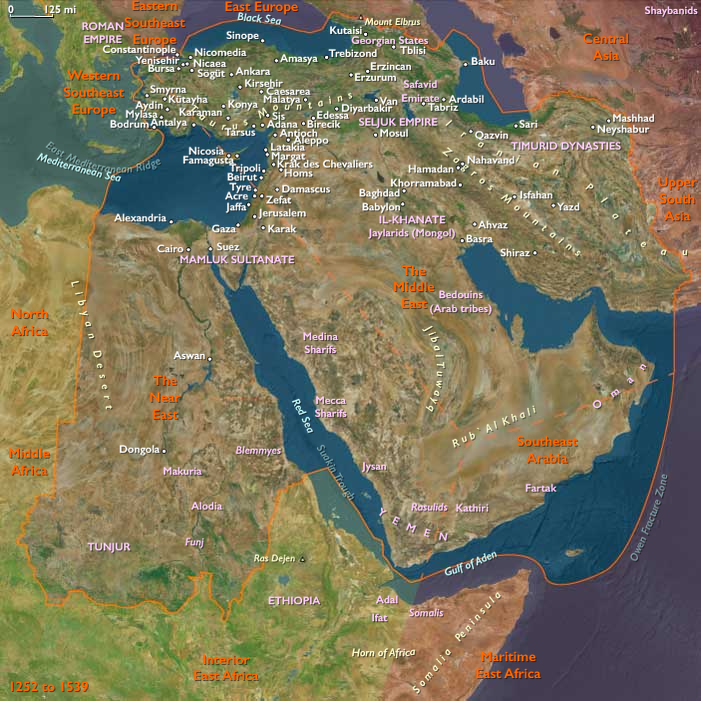
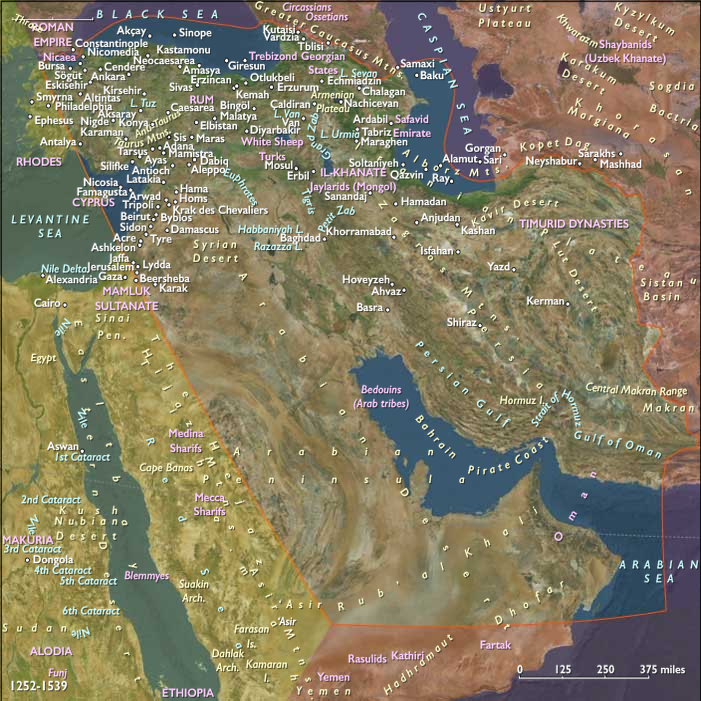
Armenia fights off an invasion by Turkmens in 1276, but the Constable Sempad, King Leo's uncle, is killed in combat.
Locations
People
Groups
- Armenian people
- Christians, Armenian Apostolic Orthodox
- Oghuz Turks
- Muslims, Sunni
- Turkmen people
- Rûm, Sultanate of
- Mongols
- Armenian Kingdom of Cilicia, or Little Armenia
- Mongol Empire
- Egypt and Syria, Mamluk Bahri Sultanate of
- Il-khanate
Topics
Commodoties
Subjects
Regions
Subregions
Related Events
Filter results
Showing 10 events out of 45657 total
Kublai Khan, the conqueror of China, founder of the Yuan Dynasty and the Great Khan of the Mongol Empire, in 1277 and 1283 invades the Pagan Kingdom of Burma.
The Mongol invasions of Japan of 1274 and 1281 are major military operations undertaken by Kublai Khan to invade the Japanese islands after conquering Korea.
Despite their ultimate failure, the invasion attempts are of macro-historical importance, setting a limit on Mongol expansion, and ranking as nation-defining events in Japanese history.
Rabban Bar Sauma: Kublai Khan’s Emissary to Christian Europe
Rabban Bar Sauma, a Nestorian Christian of Turkic origin, embarked on a remarkable diplomatic mission to Europe in the late 13th century, serving as an emissary of the Ilkhanate, a Mongol state established in Persia under Hülegü Khan, a grandson of Genghis Khan. His journey was part of a broader Mongol effort to forge alliances with Christian monarchs against the Muslim rulers of the Holy Land, particularly the Mamluks of Egypt, who posed a significant threat to both Mongol and Christian interests.
Originally a monk from China, Bar Sauma had risen to prominence within the Nestorian Church before being entrusted with this diplomatic endeavor by Ilkhan Arghun (r. 1284–1291). His travels took him to the courts of Pope Nicholas IV, King Philip IV of France, and King Edward I of England, where he relayed Mongol proposals for a coordinated military campaign. Although well received, his mission ultimately failed to secure a formal alliance, as Europe remained preoccupied with its own political conflicts and internal struggles.
Despite its diplomatic shortcomings, Bar Sauma’s journey remains historically significant as a rare instance of east-to-west travel and diplomacy, providing a fascinating counterpoint to the more widely known expeditions of Marco Polo. His detailed account of European customs, courtly life, and religious practices stands as an invaluable record of late 13th-century cross-cultural exchange.
Kublai Khan, who founds the Yüan Dynasty, also sends Mongolian and Chinese officials (along with colonists) to serve as judges in the Kyrgyz and Tuva regions.
East Europe (1276–1287 CE): Muscovite Expansion and Mongol Consolidation
Political and Military Developments
Continued Mongol Authority
Between 1276 and 1287 CE, the Golden Horde further cemented its dominance over East European territories, refining its tribute and vassalage system. The Mongol rulers maintained control through local princes who managed regional affairs under Mongol oversight.
Growing Power of Moscow
During this period, the Principality of Moscow steadily expanded its territory and political influence by effectively cooperating with the Golden Horde. Moscow's princes notably increased their authority, laying a stronger foundation for future autonomy and regional control.
Economic and Technological Developments
Enhanced Eurasian Commerce
Trade networks connecting East Europe with Asia and the Middle East continued to thrive, with increased volumes of silk, spices, precious metals, and other luxury goods enriching urban centers. Moscow, Novgorod, and other cities significantly benefited from these expanded economic activities.
Further Adoption of Military Technology
Local principalities continued to integrate Mongol military tactics, further developing their cavalry, siege warfare, and defensive infrastructure. These adaptations provided East European territories with improved defense and military capability.
Cultural and Artistic Developments
Deepening Cultural Exchange
Artistic and cultural exchanges intensified, further merging Rus' and Mongol aesthetics. Distinctive styles emerged, evident in architecture, decorative arts, and religious iconography, reflecting the complex intercultural dynamics of the period.
Literary and Intellectual Growth
Rus' literary traditions flourished, as chronicles and religious texts continued to be diligently produced. Intellectual activity aimed at preserving cultural identity and historical memory amidst Mongol oversight.
Settlement Patterns and Urban Development
Urban Consolidation and Expansion
Urban centers, especially Moscow, experienced continued growth, both economically and demographically. This urban consolidation reflected stable governance, strategic economic planning, and successful integration within Mongol-administered systems.
Expansion of Defensive Measures
The strengthening of fortifications and defensive infrastructure remained critical, as urban centers reinforced their protective measures to mitigate ongoing regional tensions and ensure stability.
Social and Religious Developments
Strengthening of Aristocratic Power
Local aristocratic families entrenched their roles and power further within the Mongol governance system. These families increasingly influenced political, economic, and social dynamics, consolidating their regional power.
Orthodox Church and Social Stability
The Orthodox Church maintained its pivotal role in societal cohesion, education, and cultural continuity. Its influence extended beyond spiritual matters into areas of governance and community leadership.
Long-Term Consequences and Historical Significance
The era from 1276 to 1287 CE marked significant political and economic developments, particularly through Moscow's territorial and political expansion under Mongol authority. These years laid vital groundwork for future political autonomy and regional unity in East Europe.
Northeast Europe (1276–1287 CE): Crusader Consolidation, Renewed Baltic Resistance, and Expanding Influence
Introduction
Between 1276 and 1287 CE, Northeast Europe experienced further stabilization and expansion of crusader states, renewed resistance from Baltic tribes, and increasingly complex geopolitical dynamics. German, Danish, and Swedish territorial authorities strengthened their economic and political hold, while the Baltic tribes, notably the Lithuanians, persisted in formidable opposition, reshaping regional tensions.
Crusader State Consolidation
Danish-controlled Estonia, with its administrative and military center at Reval (Tallinn), solidified governance, enhancing infrastructure and fortifications. The fortress of Castrum Danorum continued as a vital symbol of Danish rule, anchoring further economic and urban growth.
In the Livonian Confederation, German authorities, centralized at Riga, deepened their political and ecclesiastical influence. Likewise, the Teutonic Knights solidified their grip over Prussia, effectively reinforcing their military and administrative structures through an extensive network of castles, notably strengthening Königsberg as a critical regional power center.
Resurgence of Baltic Resistance and Lithuanian Strength
Renewed resistance by Baltic peoples characterized this period. The Lithuanians, in particular, emerged as a powerful regional opponent, actively resisting crusader incursions and initiating frequent raids into Livonian and Prussian territories. Their organized military strength posed a significant ongoing challenge to crusader ambitions, forcing a continual defensive posture.
Other Baltic tribes, including the Curonians, Semigallians, and remaining Prussian elements, periodically engaged in guerrilla resistance, demonstrating their resilience despite overwhelming military pressure.
Continued Swedish Expansion in Finland
Swedish influence in southern Finland deepened further, solidifying its political and cultural integration with Sweden. Expanded fortifications, settlements, and ecclesiastical institutions marked sustained Swedish investment, reinforcing Finland's distinct path toward a Scandinavian alignment.
Economic Prosperity and Urban Expansion
Cities within crusader-controlled territories flourished significantly during this era. Reval (Tallinn), Riga, and Königsberg further developed as vibrant centers of trade, governance, and cultural exchange. Visby on Gotland retained its status as a vital maritime hub, strongly connecting Northeast Europe with wider European trade routes.
Ecclesiastical Influence and Cultural Integration
The ecclesiastical hierarchy, especially under the Teutonic Order, maintained its central role in governance, education, and cultural assimilation throughout the region. Monastic institutions and bishops effectively promoted Latin Christendom, further embedding Christian norms and practices deeply within the local populations.
Geopolitical Complexity and Emerging Conflicts
This era witnessed escalating geopolitical complexities. Crusader states encountered heightened tensions along their borders, particularly with the growing power of Lithuania and various Russian principalities. The militarization of borders intensified, signaling impending future conflicts and shifting alliances that would define subsequent decades.
Legacy of the Era
The period from 1276 to 1287 CE profoundly shaped Northeast Europe's future trajectory. Continued crusader consolidation, robust Baltic resistance—especially Lithuanian opposition—and sustained Swedish expansion into Finland created lasting patterns of political, cultural, and economic interaction. These developments laid essential foundations for the region's ongoing evolution, defining the historical dynamics that persisted into subsequent centuries.
East Central Europe (1276–1287 CE): Fall of Ottokar II, Rise of the Habsburgs, Continued Hungarian Turmoil, Polish Duchies' Independence, and Strengthening Thuringian and Saxon Influence
Between 1276 and 1287 CE, East Central Europe experienced transformative shifts following the dramatic fall of Bohemia's powerful ruler, Ottokar II Přemysl, the consequent rise of the Habsburg dynasty in Austria, continued fragmentation in Poland, persistent internal instability in Hungary, and strengthened regional influence of Saxon and Thuringian principalities. This period redefined political alignments, setting critical foundations for subsequent medieval geopolitical and cultural developments.
Political and Military Developments
Ottokar II’s Fall and the Habsburg Rise
-
In 1278, at the decisive Battle on the Marchfeld, Ottokar II Přemysl of Bohemia was defeated and killed by Rudolf I of Habsburg. This battle dramatically shifted regional dominance, ending Přemyslid authority over Austria, Styria, and Carinthia.
-
The victory secured Austria for the emerging Habsburg dynasty, establishing a territorial foundation crucial for their subsequent centuries-long dominance in Central European politics.
Instability and Succession Conflicts in Bohemia
-
Ottokar's son, Wenceslaus II (r. 1278–1305), ascended as a minor, triggering internal instability and noble infighting within Bohemia. Royal authority significantly weakened, necessitating regency councils and external diplomatic interventions.
Hungarian Continued Aristocratic Fragmentation
-
Hungary remained troubled by aristocratic factionalism and regional conflicts following the brief reigns of Stephen V (r. 1270–1272) and his son Ladislaus IV "the Cuman" (r. 1272–1290). Royal authority struggled against powerful nobles, significantly weakening Hungary’s ability to assert regional influence.
Polish Duchies and Continued Fragmentation
-
Polish territories remained fragmented into multiple independent Piast duchies, notably in Silesia, Greater Poland, and Mazovia. Despite political division, economic prosperity continued, driven by growing urbanization, Hanseatic trade, and local autonomy.
Thuringian Consolidation and Wettin Influence
-
Following their triumph in the Thuringian Succession War (ending 1264), the Wettin family solidified their authority over Thuringia, expanding their regional influence. Thuringia's stability allowed it to exert political and cultural influence within the eastern German sphere.
Saxon Territories and Emerging Dynastic Influence
-
The Saxon duchies and principalities, especially the Wettin-controlled territories and the emerging power of Saxe-Wittenberg, increasingly asserted influence within East Central Europe, fostering economic growth, urban expansion, and political stability.
Brandenburg Expansion and Consolidation
-
Under the House of Ascania, Brandenburg continued territorial consolidation eastward into former Slavic lands. Their settlements strengthened economic and demographic integration into broader Central European networks.
Economic and Technological Developments
Urban and Commercial Growth
-
Economic prosperity continued across East Central Europe, driven by robust Hanseatic League trade, connecting Baltic markets to broader European economies. Cities such as Lübeck, Rostock, Toruń, Kraków, and Wrocławflourished economically, becoming vibrant urban centers.
Agricultural Productivity Enhancements
-
Improved agricultural techniques and tools, including more efficient plows and extensive use of the three-field rotation system, increased productivity and regional population growth, fueling urban development.
Cultural and Artistic Developments
Bohemian Cultural Continuity Despite Political Instability
-
Although politically weakened, Bohemia maintained a thriving cultural life centered on Prague. Gothic architecture, manuscript illumination, and literature continued flourishing, influenced by earlier Přemyslid patronage.
Regional Artistic Flourishing in Polish Duchies and Hungary
-
Silesian and Polish duchies retained cultural dynamism, evident in ecclesiastical architecture, monasteries, and manuscript production, notably in Wrocław and Kraków.
-
Despite political turmoil, Hungarian ecclesiastical institutions continued fostering cultural and artistic patronage, maintaining religious and intellectual continuity.
Settlement and Urban Development
Continued Urban Expansion and Fortification
-
Urban growth and fortifications expanded significantly throughout Austria, Bohemia, Poland, and Saxon territories, bolstering regional economic prosperity, political influence, and demographic stability.
Intensified Germanic Settlement (Ostsiedlung)
-
Ongoing Germanic colonization in Brandenburg, Mecklenburg, Silesia, and Lusatia profoundly influenced demographic patterns, urban development, and agricultural innovation, reshaping local economies and identities.
Social and Religious Developments
Increased Ecclesiastical Influence
-
Ecclesiastical institutions, notably the Archbishopric of Salzburg and bishoprics of Bamberg, Passau, and Regensburg, expanded their social and cultural influence, promoting education, religious life, and artistic patronage.
Aristocratic Autonomy and Feudal Structures
-
Aristocratic and noble autonomy strengthened significantly, especially in Hungary, Bohemia, and Polish duchies. Local noble authority increasingly dominated political and economic governance, setting firm foundations for regional identities and power structures.
Long-Term Consequences and Historical Significance
The era 1276–1287 CE profoundly reshaped East Central Europe. The fall of Ottokar II and rise of the Habsburgs fundamentally altered regional power dynamics, setting the stage for long-term Austrian dominance. Continued Hungarian aristocratic factionalism weakened royal centralization, while Polish fragmentation deepened local autonomy. Wettin-controlled Thuringia and Saxon territories expanded their regional influence, significantly shaping future political developments. Economically, intensified trade, urbanization, and agricultural innovation brought lasting prosperity and cultural flourishing. Collectively, these transformations firmly established the geopolitical and cultural framework for subsequent medieval developments throughout East Central Europe.
The Mamluk Sultanate of Egypt opens a dialogue with the revived Greek empire of Constantinople: the Greek sovereign orders the restoration of the ancient mosque and permits the Egyptian merchants and ambassadors to sail through the Hellespont and Bosporus.
The network of diplomacy laid by Michael VII Palaiologos covers the Il-Khanid Mongols of Iran and of the Golden Horde in Russia, as well as the Mamluks of Egypt.
Michael has fostered communication among the Hohenstaufen supporters in Sicily, the republic of Genoa, and finally and most important, King Peter III of Aragon, the son-in-law of the late Hohenstaufen King Manfred of Sicily, with whom the Greek emperor has formed a secret alliance against Charles d’Anjou, the expansionist monarch of Sicily and Naples.
The vast network of alliances erected by Charles to conquer the Greek East includes factions in Sicily, parts of Italy, Greek Laskarid dissidents, various Slavs of the Balkans, Philip of Courtenay of the former Latin Empire, France, and Venice, and the papacy.
Eastern Southeast Europe (1276–1287 CE): Byzantine Diplomacy and Bulgarian Struggles
Settlement and Migration Patterns
Continued Byzantine Stabilization
The Byzantine Empire under Emperor Michael VIII Palaiologos and his successor Andronikos II Palaiologos (from 1282) continued consolidating control over urban and rural areas, stabilizing populations primarily around Constantinople, Adrianople, and Thrace. Byzantine authorities fortified strategic locations, maintaining stable demographic conditions in established settlements.
Bulgarian Fragmentation and Population Shifts
Internal strife and political divisions within the Second Bulgarian Empire intensified, causing minor population movements and settlement realignments. The struggle between regional boyars (nobility) undermined centralized authority, promoting a decentralized pattern of settlement, particularly in areas around Turnovo and northern Bulgaria.
Political Dynamics and Regional Rivalries
Byzantine Diplomatic Efforts
Under Emperor Michael VIII and subsequently Andronikos II, Byzantine diplomacy actively pursued strategic alliances, notably with the Italian maritime republic of Genoa, to counterbalance Venetian economic dominance. Diplomatic marriages and treaties with Western European powers continued to shape regional politics.
Increasing Bulgarian Political Turmoil
Bulgarian authority further declined due to internal power struggles following the death of Tsar Constantine Tikh (r. 1257–1277). The resulting fragmentation left Bulgaria vulnerable to external pressures, weakening its ability to resist Byzantine and Mongol influences.
Economic and Technological Developments
Byzantine Economic Consolidation
The Byzantine economy maintained steady growth and stability, supported by strategic trade alliances with Genoa, especially in the Black Sea trade, reinforcing the economic vitality of major cities such as Constantinople and Adrianople.
Regionalized Bulgarian Economy
Economic activity in Bulgaria continued to fragment, with regional lords independently managing trade relationships, particularly with Genoese and Venetian merchants. Turnovo remained economically significant but increasingly isolated economically due to internal strife.
Cultural and Artistic Developments
Byzantine Cultural Renaissance
Byzantine artistic and cultural activity flourished under the Palaiologan emperors, reflecting a renewed sense of imperial dignity and Orthodox spirituality. Monumental religious art, illuminated manuscripts, and renewed architectural projects highlighted a sustained cultural revival.
Bulgarian Cultural Endurance
Despite political instability, Bulgarian culture persisted robustly, particularly around Turnovo, preserving religious, literary, and artistic traditions. Cultural resilience continued despite diminished political cohesion, sustaining Bulgaria's distinct national identity.
Social and Religious Developments
Strengthened Orthodox Church Institutions
Orthodox Christianity remained central in Byzantine and Bulgarian social structures, with ecclesiastical authorities providing stability and coherence. The Byzantine patriarchate retained significant influence, while the Bulgarian patriarchate in Turnovo helped maintain social cohesion amid political divisions.
Religious Diplomacy and Tensions
Byzantium actively managed religious diplomacy, notably addressing tensions with Western Catholic authorities and the lingering impact of the Union of Lyons (1274), a short-lived attempt at reconciliation between Eastern Orthodoxy and the Roman Catholic Church.
Long-Term Consequences and Historical Significance
The era from 1276 to 1287 CE in Eastern Southeast Europe marked continued Byzantine diplomatic stabilization, economic consolidation, and cultural flourishing, contrasted by ongoing Bulgarian political fragmentation and internal challenges. These dynamics profoundly shaped regional stability and influenced subsequent historical developments in the Balkans, paving the way for future struggles and transformations.
The Middle East: 1276–1287 CE
Mongol Consolidation and Fragmentation
During 1276–1287 CE, the Mongol Il-Khanate further consolidates its control over the Middle East, solidifying governance structures throughout Persia, Iraq, and Anatolia. Despite their militaristic origins, Mongol rulers begin adopting aspects of local governance, significantly relying on Persian administrators and embracing Islam to enhance political legitimacy among the predominantly Muslim populations.
Cultural Exchange and Scholarship: Gregory Bar Hebraeus
A prominent figure during this period is the Syrian scholar Gregory Bar Hebraeus, noted for his extensive scholarship in science, philosophy, and literature. His numerous travels to libraries throughout Syria and Armenia foster significant intellectual exchange and dialogue between the Christian and Muslim worlds. Through his encyclopedic works, Gregory Bar Hebraeus enriches Syriac literature with Arabic cultural elements, thus significantly enhancing intercultural communication and understanding.
Continued Seljuq Fragmentation in Anatolia
The weakening of the Seljuq Sultanate of Rûm accelerates, with local Turkish beyliks increasingly asserting independence and forming distinct political entities. Anatolia becomes characterized by fragmented governance, setting the stage for the later rise of prominent powers such as the Ottoman beylik. This fragmentation creates a politically fluid environment marked by frequent alliances and rivalries among local Turkish and Mongol factions.
Crusader Fortifications and Military Dynamics
The Knights Hospitaller maintain their defensive strongholds in the Levant, particularly the Krak des Chevaliers, which remains a crucial bulwark against regional threats. However, increasing Mongol and Muslim pressures around this period challenge Crusader dominance, intensifying the strategic importance of these fortifications.
Cultural Resilience and Intellectual Continuity
Despite ongoing political instability, cultural and intellectual traditions in the region persist. The works of figures like Gregory Bar Hebraeus and Persian scholars maintain scholarly continuity, fostering intellectual growth amidst political uncertainty. This era, thus, witnesses both the persistent Mongol political presence and vibrant intercultural exchanges across diverse religious and ethnic communities.
Years: 1276 - 1276
Locations
People
Groups
- Armenian people
- Christians, Armenian Apostolic Orthodox
- Oghuz Turks
- Muslims, Sunni
- Turkmen people
- Rûm, Sultanate of
- Mongols
- Armenian Kingdom of Cilicia, or Little Armenia
- Mongol Empire
- Egypt and Syria, Mamluk Bahri Sultanate of
- Il-khanate
Topics
Commodoties
Subjects
Regions
Subregions