
Filters:
Denmark becomes officially Lutheran on October 30, …
Years: 1396 - 1539
Denmark becomes officially Lutheran on October 30, 1536, by decree of King Christian III, and in 1537 the reconstituted State Council approves the Lutheran Ordinances, which is worked out by Danish theologians and Johannes Bugenhagen, based on the Augsburg Confession and Luther's Little Catechism.
The government establishes the Danish National Church (Danish: Folkekirken) as the state church.
All of Denmark's Catholic bishops go to prison until such time as they convert to Luther's reform.
The authorities release them when they promise to marry and to support the reforms.
If they agree, they receive property and will spend the rest of their lives as wealthy landowners.
If they refuse conversion, they will die in prison.
The State confiscates Church lands to pay for the armies that had enforced Christian III's election.
Priests swear allegiance to Lutheranism or find new employment.
The new owners turn monks out of their monasteries and abbeys.
Nuns in a few places gain permission to live out their lives in nunneries, though without governmental financial support.
The Crown closes churches, abbeys, priories and cathedrals, giving their property to local nobles or selling it.
The King appoints Danish superintendents (later bishops) to oversee Lutheran orthodoxy in the church.
Denmark becomes part of a Lutheran heartland extending through Scandinavia and northern Germany.
The Catholic Church everywhere in Scandinavia has sealed its fate by supporting hopeless causes: Christian II and the emperor Charles V in Denmark, Norwegian independence in that country, and in Sweden the Kalmar Union.
Geographical distance also prevents them from receiving anything more than a sympathetic ear from Rome.
The government establishes the Danish National Church (Danish: Folkekirken) as the state church.
All of Denmark's Catholic bishops go to prison until such time as they convert to Luther's reform.
The authorities release them when they promise to marry and to support the reforms.
If they agree, they receive property and will spend the rest of their lives as wealthy landowners.
If they refuse conversion, they will die in prison.
The State confiscates Church lands to pay for the armies that had enforced Christian III's election.
Priests swear allegiance to Lutheranism or find new employment.
The new owners turn monks out of their monasteries and abbeys.
Nuns in a few places gain permission to live out their lives in nunneries, though without governmental financial support.
The Crown closes churches, abbeys, priories and cathedrals, giving their property to local nobles or selling it.
The King appoints Danish superintendents (later bishops) to oversee Lutheran orthodoxy in the church.
Denmark becomes part of a Lutheran heartland extending through Scandinavia and northern Germany.
The Catholic Church everywhere in Scandinavia has sealed its fate by supporting hopeless causes: Christian II and the emperor Charles V in Denmark, Norwegian independence in that country, and in Sweden the Kalmar Union.
Geographical distance also prevents them from receiving anything more than a sympathetic ear from Rome.
People
Groups
- Danes (North Germanic tribe)
- Icelanders (Scandinavians)
- Greenland, Norwegian Crown Colony of
- Christians, Roman Catholic
- Norwegians (Scandinavians)
- Swedes (Scandinavians)
- Iceland (Danish dependency)
- Lutheranism
- Protestantism
- Sweden, (second) Kingdom of
- Denmark-Norway, Kingdom of
Topics
Subjects
Regions
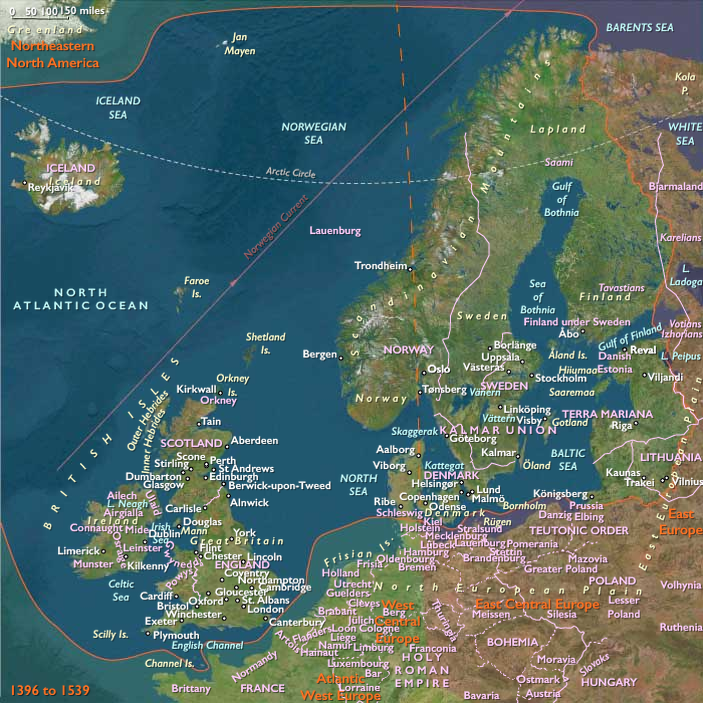
Subregions
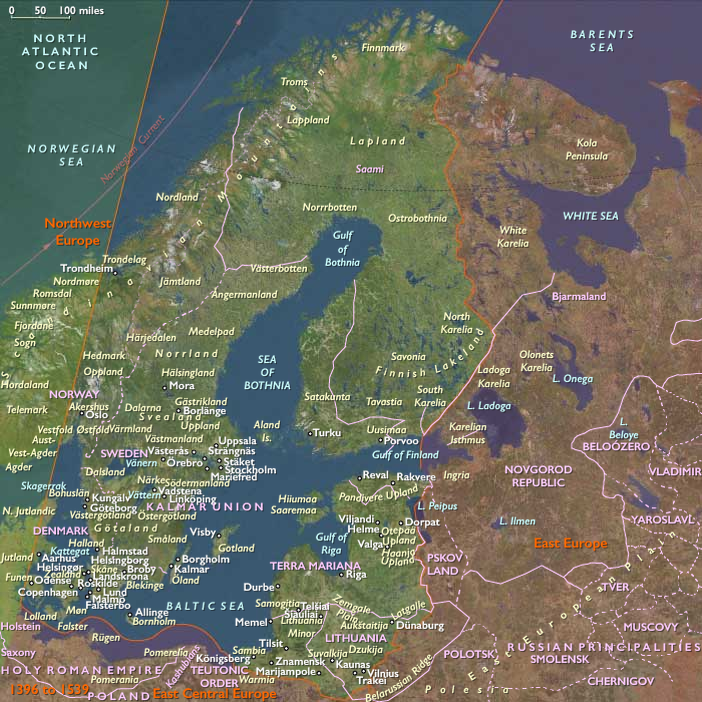

Years: 1396 - 1539
People
Groups
- Danes (North Germanic tribe)
- Icelanders (Scandinavians)
- Greenland, Norwegian Crown Colony of
- Christians, Roman Catholic
- Norwegians (Scandinavians)
- Swedes (Scandinavians)
- Iceland (Danish dependency)
- Lutheranism
- Protestantism
- Sweden, (second) Kingdom of
- Denmark-Norway, Kingdom of
Topics
Subjects
Regions
Subregions