Aristides is ostracized and banned from Athens …
Years: 482BCE - 482BCE
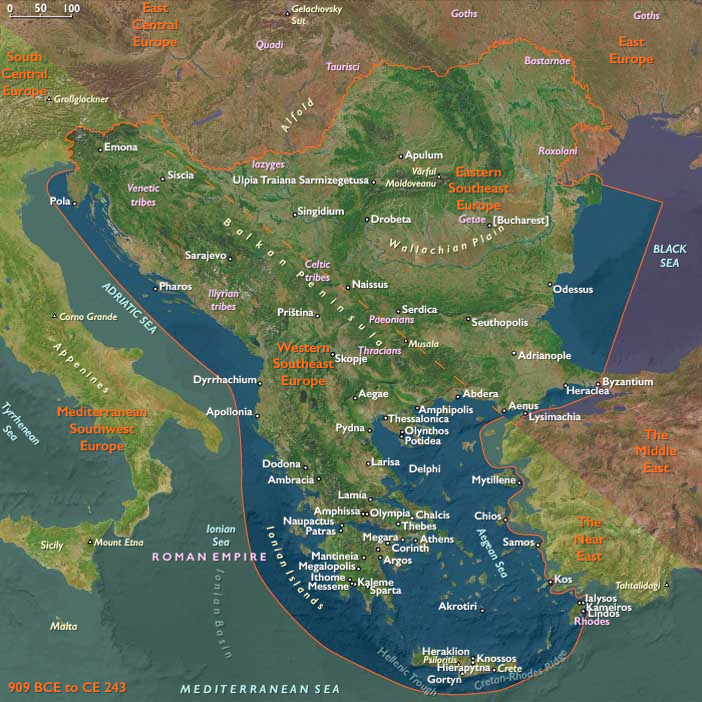
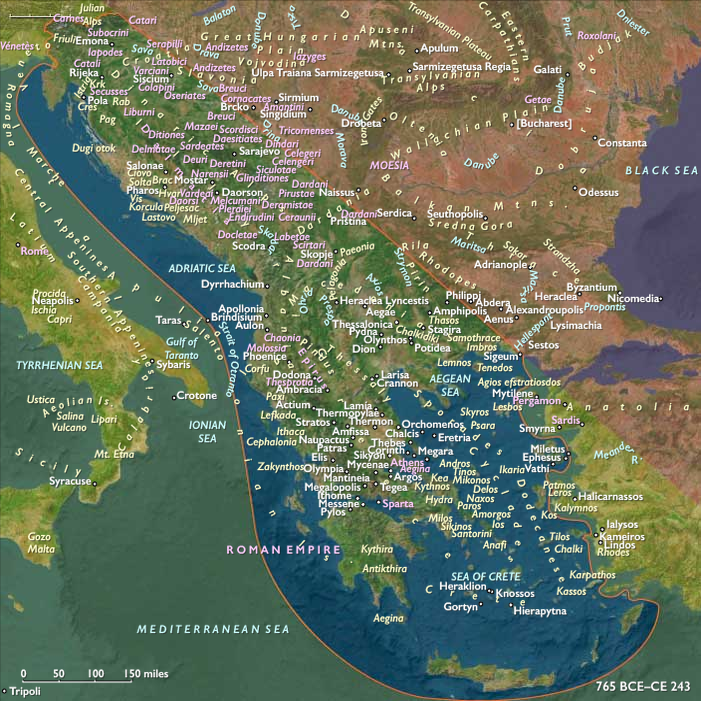
Aristides is ostracized and banned from Athens in 482 BCE, probably because he opposes Themistocles' plan to finance the building of a large fleet by using the silver from the new vein.
Locations
People
Groups
Topics
Commodoties
Subjects
Regions
Subregions
Related Events
Filter results
Showing 10 events out of 65593 total
Xerxes had outraged the Babylonians in 484 BCE by violently confiscating and melting down the golden statue of Bel (Marduk, Merodach), the hands of which the rightful king of Babylon had to clasp each New Year's Day.
This sacrilege had led the Babylonians to rebel in 484 and 482 BCE, so that in contemporary Babylonian documents, Xerxes refuses his father's title of King of Babylon, being named rather as King of Persia and Media, Great King, King of Kings (Shahanshah) and King of Nations (i.e.
of the world).
Xerxes deals with the revolt by razing the walls and plundering the city.
Darius’ death has left to his son the task of punishing the Athenians, Naxians, and Eretrians for their interference in the Ionian Revolt, the burning of Sardis and their victory over the Persians at Marathon.
From 483 BCE, Xerxes had begun preparing his expedition: A channel is dug through the isthmus of the peninsula of Mount Athos, provisions are stored in the stations on the road through Thrace, two pontoon bridges later known as Xerxes' Pontoon Bridges are built across the Hellespont.
Soldiers of many nationalities serve in the armies of Xerxes, including the Assyrians, Phoenicians, Babylonians, Egyptians and Judahites.
Among the Phoenician naval contingents of the Persian fleet are the sailors of Sidon.
Xerxes concludes an alliance with Carthage, and thus deprives Greece of the support of the powerful monarchs of Syracuse and Akragas.
Many smaller Greek states, moreover, take the side of the Persians, especially Thessaly, Thebes and Argos.
The Second Persian War is a very different proposition from the first.
Xerxes in 481 BCE uses a bridge of boats to cross the Hellespont at Abydos with a huge fleet and an army of over one hundred thousand troops. (Herodotus estimates the Persian army to number in the millions, but modern scholars tend to doubt his figures, replacing them with far lower ones.)
The unprecedented size of Xerxes' forces makes their progress quite slow, giving the Greeks plenty of time to prepare their defense.
The natural isolation and character of the Thessalians have kept them aloof from the main currents of Greek life.
Politically unstable because of tribal rivalries, they have never long sustained a concerted action.
The Greeks soon abandon an initial plan to defend Thessaly, and the Aleuads of Larissa ally their country with the Persians.
The Greeks instead fall back on a zone at the northeastern end of Euboea, where they hope to defend Thermopylae by land and Artemisium by sea; the two holding operations close enough for each set of defenders to know what is happening to the other.
Xerxes' forces advance slowly toward the Greeks, suffering losses from the weather.
A military coalition of Greek city-states led by Sparta and known as the Peloponnesian League, also called the Spartan Alliance, is a major force in Greek affairs, forming the nucleus of resistance to the Persian invasions.
League policy, usually decisions on questions of war, peace, or alliance, is determined by federal congresses, summoned by the Spartans when they think fit; each member state has one vote.
A general Greek league against Persia is formed in 481.
Quarrels like that between Athens and Aegina must be set aside and help sought from distant or colonial Greeks such as the Cretans, Syracusans, and Corcyrans, whose extraordinarily large fleet of sixty ships (possibly developed against Adriatic piracy but also—surely—against Corinth) will be a prime asset.
Corcyra, however, waits on events, and Crete stays out altogether, while Syracuse and Sicily, now under the tyranny of Gelo, generally have barbarian enemies of their own to cope with, the Carthaginians.
Command of the army is given to Sparta, …
…that of the navy to Athens.
The combined Greek fleet, which, even without western Greek help, numbers about three hundred and fifty vessels, is thus only about one-third the size of the Persian fleet.
Greek unity, though impressive, is not complete; …
…conspicuous among the “Medizers” is Thebes, whose hostility to Athens over mutual interest in the Plataea district leads to Theban collaboration with Persia, while …
…the neutrality maintained by Argos amounts, in Herodotus's view at least, to Medism.
The mainland Greeks send an embassy to Gelo requesting aid against Xerxes.
Gelo at first complains that the Greeks had spurned his request of aid against the Carthaginians in the past, but he offers to sent twenty-four thousand foot, four thousand horse and two hundred warships in addition to fully provisioning the combined Greek force in Greece if he were to be made the supreme commander.
The Spartans object to this, and Gelo then asks to be the commander of either the land or naval forces in exchange for his help.
The Athenian envoy then objects, and the Greeks are dismissed.
Gelo also hedges his bets, sending three ships under Cadmus of Kos to Delphi, with instructions to offer his submission to Xerxes in case of a Persian victory.
The Ligurians called themselves Ambrones, according to Plutarch, but this does not necessarily indicate a relationship with the Ambrones of northern Europe.
Classical references and toponomastics suggest that the Ligurian sphere once extended further than the present boundary of Liguria.
Ligurian toponyms have been found in Sicily, the Rhône valley, Corsica and Sardinia.
Aeschylus represents Hercules as contending with the Ligures on the stony plains near the mouths of the Rhone, and Herodotus speaks of Ligures inhabiting the country above Massilia (modern Marseilles, founded by the Greeks).
Thucydides also speaks of the Ligures having expelled the Sicanians, an Iberian tribe, from the banks of the river Sicanus, in Iberia.
The Periplus of Pseudo-Scylax describes the Ligyes (Ligures) living along the Mediterranean coast from Antion (Antibes) as far as the mouth of the Rhone; then intermingled with the Iberians from the Rhone to Emporion in Spain.
Little is known of the Ligurian language.
Only place-names and personal names remain.
It appears to be an Indo-European branch with both Italic and particularly strong Celtic affinities.
Strabo tells us that they were of a different race from the Celts (by which he means Gauls) who inhabited the rest of the Alps, though they resembled them in their mode of life.
Lucan in his Pharsalia (around 61 CE) described Ligurian tribes as being long-haired, and their hair a shade of auburn (a reddish-brown): ...Ligurian tribes, now shorn, in ancient days First of the long-haired nations, on whose necks Once flowed the auburn locks in pride supreme.
The Ligurians are ignorant of their own origin.
In the nineteenth century, the Ligures' question got the attentions of not a few scholars.
Dominique-François-Louis Roget, Baron de Belloguet, claimed a "Gallic" origin.
Amédée Thierry, a French historian, linked them to the Iberians, while Karl Müllenhoff, professor of Germanic antiquities at the Universities of Kiel and Berlin, studying the sources of the Ora maritima by Avienus (a Latin poet who lived in the fourth century CE, but who used as source for his own work a Phoenician periplus of the sixth century BCE), held that the name Ligurians generically referred to various peoples who lived in Western Europe, including the Celts, but thought the real Ligurians were a Pre-Indo-European population.
Also favoring a Pre-Indo-European origin thesis were French historian Henri d'Arbois de Jubainville, who argued that the Ligurians, together with the Iberians, constituted the remains of the native population that had spread in Western Europe with the Cardium Pottery culture cardial ceramic, or related to the Bell Beaker folk; and Arturo Issel, a Genoese geologist and paleontologist, who considered them direct descendants of the Early European Modern Humans that lived throughout Gaul from the Mesolithic.
The Ligures seem to have been ready to engage as mercenary troops in the service of others; Ligurian auxiliaries are mentioned in the army of the Carthaginian general Hamilcar in 480 BCE.