
Ariovistus, chieftain of the Germanic Suebi tribe, …
Years: 62BCE - 62BCE
Ariovistus, chieftain of the Germanic Suebi tribe, had resumed the tribe’s migration from eastern Germany to the Marne and Rhine region in 71 BCE.
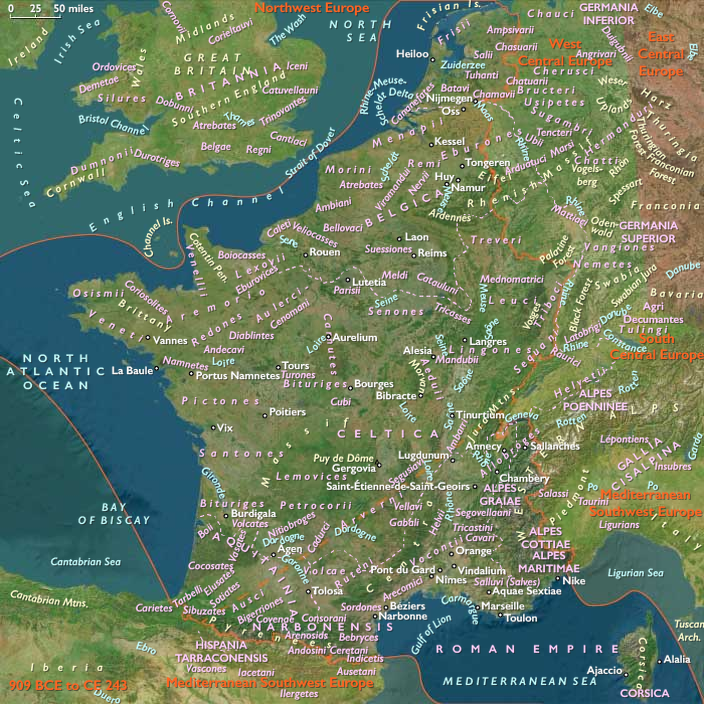
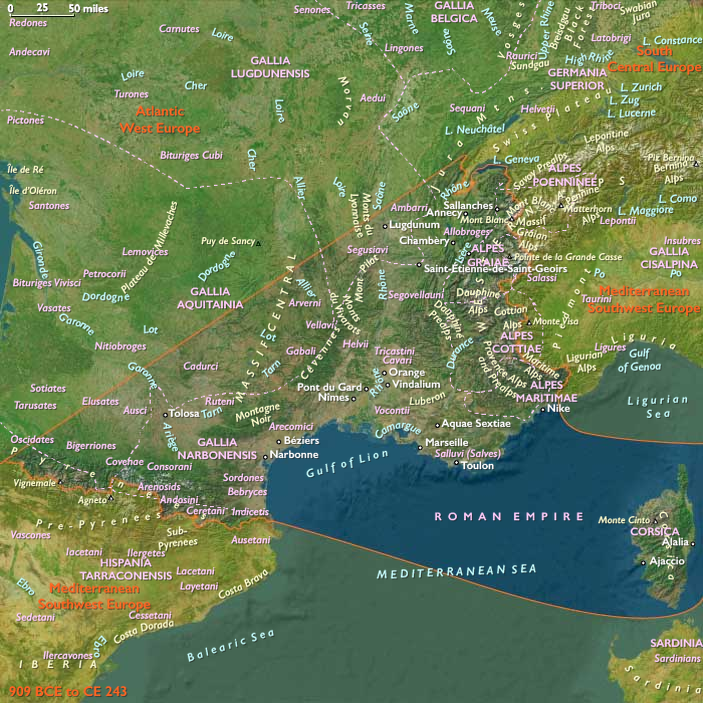
Despite the fact that this migration encroaches on Sequani land, the Gaulish Sequani seek Ariovistus’ allegiance against the Aedui, a numerous Celtic people occupying the drainage system of the upper Loire.
They are nearly between their neighbors to the northeast, the Sequani, who occupy the Doubs river valley, and the Arverni in the Massif Central.
When, in about 62 BCE, a Gaulish Roman client state, the Arverni, conspires with the Sequani and the Germanic Suebi nation east of the Rhine to attack the Aedui, a strong Roman ally, Rome turns a blind eye.
The Romans appear to be unconcerned about a conflict between non-client, client and allied states.
the Suebic leader Ariovistus and the events he was part of are known from Caesar's Commentarii de Bello Gallico.
Caesar, as a participant in the events, is a primary source, although as his Commentaries are in part political propaganda they may be suspected of being self-serving.
Later historians, notably Dio Cassius, are suspicious of his motives.
Caesar does not say what the cause of the conflict was, but the Sequani control access to the Rhine river along the valley of the Doubs.
To that end, they have gradually built up an oppidum or fortified town at Vesontio.
Tradesmen headed up the Rhone and its tributary the Saône (the ancient Arar) cannot pass the Doubs at Vesontio without coming to terms with the Sequani, nor can anyone pass from the Rhine to the Rhone except on similar terms.
The east of the entire great channel is bordered by the Jura mountains and the west by the Massif Central.
Vesontio is seventy-five miles (one hundred and twenty-one kilometers) from that stretch of the Rhine between Mulhouse and Basel.
The Arar forms part of the border between the Aedui and the Sequani.
Strabo, who lived a generation after Caesar in the late republic and early empire, does make a statement concerning the cause of the conflict between the Sequani and Aedui, and it was in fact commercial, at least in Strabo's view.
Each tribe claimed the Arar and the transportation tolls from traffic along it, "but now", says Strabo, "everything is to the Romans."
The Sequani also habitually supported the Germans in their previous frequent expeditions across the river, which shows that Ariovistus’ subsequent devastation of Sequani lands represented a new policy.
Locations
People
Groups
Topics
Commodoties
Subjects
Regions
Subregions
Related Events
Showing 3 events out of 3 total
Years: 62BCE - 62BCE
Locations
People
Groups
Topics
Commodoties
Subjects
Regions
Subregions