
Aribert, Archbishop of Milan, had gone to …
Years: 1026 - 1026
March
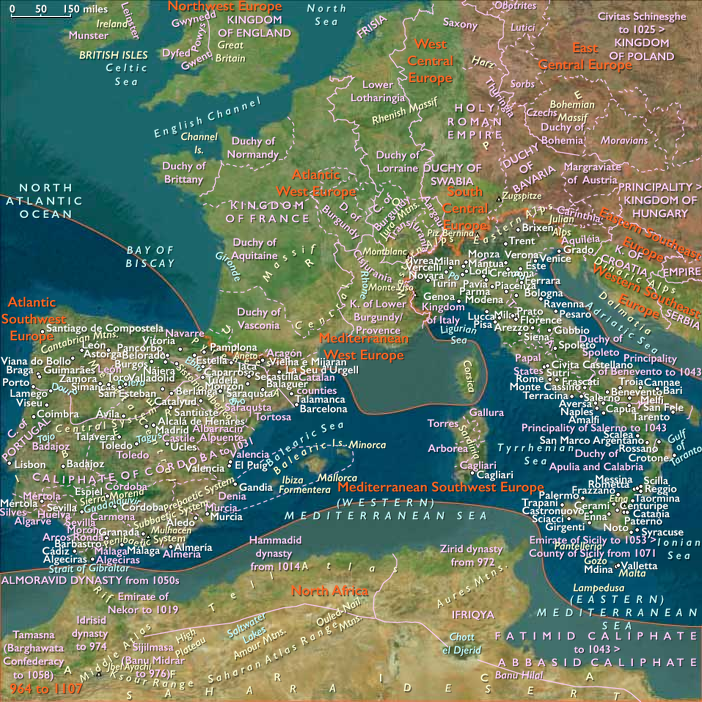
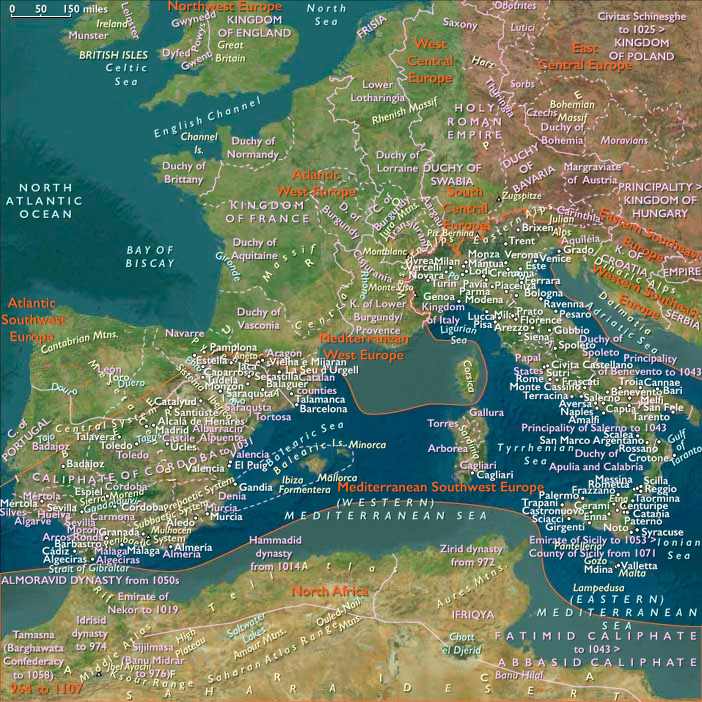
Aribert, Archbishop of Milan, had gone to Konstanz in June 1025, with other bishops of Northern Italy, to pay homage to Conrad II of Germany, the beleaguered founder of the Salian dynasty.
There, in exchange for privileges, he had agreed to crown Conrad with the Iron Crown of Lombardy, which the magnates had offered to Odo of Blois.
This he does, on March 31, 1026, at Milan, for the traditional seat of Lombard coronations, Pavia, remains in revolt against imperial authority.
Locations
People
Groups
- Lombards (West Germanic tribe)
- Milan, Archdiocese of
- Christianity, Chalcedonian
- Papal States (Republic of St. Peter)
- Mainz, Electoral Archbishopric of
- German, or Ottonian (Roman) Empire
- Italy, Kingdom of (Holy Roman Empire)
Subjects
Regions
Subregions
Related Events
Filter results
Showing 10 events out of 51585 total
Mahmud, by 1026, has waged the last of seventeen campaigns in a quarter-century of holy war of conquest in the northern Indian plains, demolishing Hindu temples, defacing idols, and carrying treasures back to Ghazni.
Mahmud has defeated the Gurjara-Pratiuharas, the Chandellas of Khajuraho, the Rajputs of Gwalior, and the Arab ruler of Multan.
A ferocious warrior, he is also a lover of literature who brings intellectuals to his capital.
Although a harsh master of his conquered territories, he does not force conversions to Islam, and employs Hindu troops in his depredations.
The deposed Muhammad III, assassinated in Uclés when he is fifty years old, is believed to have died by poison..
His only child is the famous poet Wallada bint al-Mustakfi, whose early childhood was during the high period of the Caliphate of Córdoba, under the rule of Al-Mansur Ibn Abi Aamir.
Her adolescent years had come during the tumultuous period following the eventual succession of Aamir's son, Sanchuelo, who in his attempts to seize power from Hisham II, had plunged the caliphate into civil war.
As Muhammad III has no male heir, Wallada inherits his properties.
Pope John XIX had in 1024 confirmed the right of Otto Orseolo, Doge of Venice, to hold Grado and had confirmed the patriarchal rights of his see vis-à-vis Aquileia.
Otto has continued to use church appointments to his own personal and familial advantage. however, and the enemies of the Orseoli in Venice, with popular support, move to depose him in 1026.
They arrest him, shave his beard, and banish him to Constantinople.
There he is well received by Constantine VIII, the uncle of his sister-in-law, who repeals trade privileges previously granted to the Republic under Pietro II Orseolo.
Not for nothing has Otto built up a good rapport with the emperors of Europe: the Holy Roman Emperor Conrad II likewise revokes Venetian trade privileges in response to his deposition.
Although the people have Venice have spoken out against hereditary monarchy, Otto’s successor, Pietro Barbolano, will never fully able to win over the Venetians as he is not nearly as charismatic as the two previous Doges from the Orseolo family.
The Rule of Henry V of Bavaria and the Transfer of the Duchy (1009–1026)
Henry V of Luxembourg, Duke of Bavaria, experienced a turbulent relationship with his brother-in-law, Emperor Henry II, who removed and later reinstated him as duke before his death in 1026. His lack of heirs led to a reshuffling of Bavarian authority, ultimately returning the duchy to imperial control.
Henry V’s Removal and Reinstatement as Duke of Bavaria (1009–1017)
- Henry V of Luxembourg, brother of Empress Cunigunde, was originally granted the Duchy of Bavaria by Emperor Henry II.
- However, in 1009, a quarrel between the two rulers led to Henry V’s removal from power.
- For nearly a decade, the Bavarian duchy remained in imperial hands until 1017, when Henry II reinstated Henry V as Duke of Bavaria.
- Despite this return to favor, Henry V never married, leaving his rule without a direct heir.
Succession and the Transfer of Bavaria (1026)
- Upon Henry V’s death in 1026, his county of Luxembourg passed to his nephew Henry, strengthening the Luxembourg dynasty.
- The Duchy of Bavaria, however, reverted to the Holy Roman Empire, as Henry V had no heirs to continue his ducal line.
- By 1027, the new emperor, Conrad II, placed Bavaria under imperial control, preparing it for new governance within the Salian dynasty.
Conrad II’s Grant of Bavaria to His Son (1027)
- In 1027, Emperor Conrad II bestowed the Duchy of Bavaria upon his son, the future Emperor Henry III, securing Salian control over one of the most important duchies of the empire.
- This transition marked Bavaria’s return to direct imperial administration, reinforcing Conrad II’s authority over the German nobility.
- Henry III would later become Holy Roman Emperor, ensuring that Bavaria remained a key imperial power base throughout his reign.
Legacy
- Henry V of Bavaria’s reign demonstrated the precarious nature of ducal appointments in the Holy Roman Empire, where imperial favor could make or break a ruler’s tenure.
- His lack of heirs resulted in the recentralization of Bavaria, allowing Conrad II to consolidate dynastic control over the region.
- The transfer of Bavaria to Henry III strengthened imperial authority, setting the stage for the duchy’s integration into the Salian dynasty’s long-term strategy of governance.
Henry V’s rule and succession crisis exemplified the interplay between dynastic ambition and imperial authority, reinforcing the emperor’s power while shaping the future of Bavaria as a cornerstone of the Holy Roman Empire.
The reign of Constantine, who lacks courage and political savvy, is a disaster.
He reacts to every challenge with impulsive cruelty, persecuting ambitious nobles and allegedly ordering the execution or mutilation of hundreds of innocent men.
Constantine carries on as he always has—hunting, feasting, and enjoying life—and avoids state business as much as possible.
He is poor at appointing officials.
Within months, the land laws of Basil II are dropped under pressure from the Anatolian aristocracy (the dynatoi), although Constantine strikes at the nobility when threatened by conspiracy.
Cnut claims to rule "part of Sweden" together with England, Denmark, and Norway.
At some time after the Battle of the Helgeå, he subjugates the core provinces of Sweden around Lake Mälaren, where he has his own coins minted either in the capital, Sigtuna, or in Lund, at this time part of Denmark, with the inscription CNVT REX SW ("Cnut King of the Swedes").
Western Götaland or Blekinge have been suggested.
It is probably an overlordship more than actual rule; Cnut does not have to be present in Sweden to order the minting of coins.
Coins are also minted asserting he rules Ireland, and Swedish history at this early date is so uncertain that we can hardly be sure even of the names of the kings.
Denmark is threatened by Norway and Sweden in the 1020s, and Cnut decides in 1026 to strengthen its defenses by bringing over his eight-year-old son to be the future king under a council headed by his brother-in-law, Earl Ulf.
However, Ulf alienates Cnut by getting the Danish provinces to acknowledge Harthacnut as king without reference to Cnut's overall authority and by failing to take vigorous measures to meet Norwegian and Swedish invasions, instead waiting for Cnut's assistance.
Ulf's assistance to Cnut at the Battle of the Helgeå has not caused Cnut to forgive Ulf for his coup.
At a banquet in Roskilde, the two brothers-in-law are playing chess and start arguing with each other.
The next day, Christmas of 1026, Cnut has one of his housecarls kill Earl Ulf in Trinity Church, the predecessor of Roskilde Cathedral.
Accounts are contradictory, however.
Ulf is the father of Sweyn Estridson, and thus the progenitor of the House of Estridsen, which will rule Denmark from 1047 to 1375, and which is also sometimes, specially in Swedish sources, referred to as the Ulfinger dynasty to honor him.
The death of Sultan al-Dawla in late 1024 had prompted a succession crisis within the Buyid state.
The army, which has taken charge of the succession, takes more than two years before finally definitively agreeing to Jalal al-Dawla, the surviving brother of Sultan al-Dawla and Musharrif al-Dawla, as amir.
Avicenna continues to write compendious works, producing a notable philosophical encyclopedia and numerous works on medicine.
The Book of Healing (Arabic: Kitab Al-Shifaʾ, Latin: Sufficientia) is a scientific and philosophical encyclopedia.
Despite its English title, it is not concerned with medicine.
Also called The Cure, it is intended to "cure" or "heal" ignorance of the soul.
He probably began to compose the al-Shifa in 1014, completed it around 1020, and published it in 1027.
The book is divided into four parts: logic, natural sciences, mathematics (a quadrivium of arithmetic, geometry, astronomy, and music), and metaphysics.
It is influenced by ancient Greek philosophers, such as Aristotle, Hellenistic thinkers such as Ptolemy, earlier Persian and Muslim scientists and philosophers such as Al-Kindi (Alkindus), Al-Farabi (Alfarabi) and Abū Rayhān al-Bīrūnī.
The book proposes the theory that Venus is closer to Earth than the Sun.
Ibn Sina's theory on the formation of metals combines Jābir ibn Hayyān's sulfur-mercury theory from Islamic alchemy (although he was a critic of alchemy) with the mineralogical theories of Aristotle and Theophrastus.
He creates a synthesis of ideas concerning the nature of the mineral and metallic states.
Avicenna suggests a hypothesis about the origin of mountain ranges, and contributes to paleontology with his explanation of how the stoniness of fossils was caused.
Aristotle previously explained it in terms of vaporous exhalations, which Ibn Sina modified into the theory of petrifying fluids (succus lapidificatus).
Avicenna discusses the mind, its existence, the mind and body relationship, sensation, perception, etc.
He writes that at the most common level, the influence of the mind on the body can be seen in voluntary movements, in that the body obeys whenever the mind wishes to move the body.
He further writes that the second level of influence of the mind on the body is from emotions and the will.
He also writes that strong negative emotions can have a negative effect on the vegetative functions of an individual and may even lead to death in some cases.
Avicenna also gives psychological explanations for certain somatic illnesses, and he always links the physical and psychological illnesses together.
Years: 1026 - 1026
March
Locations
People
Groups
- Lombards (West Germanic tribe)
- Milan, Archdiocese of
- Christianity, Chalcedonian
- Papal States (Republic of St. Peter)
- Mainz, Electoral Archbishopric of
- German, or Ottonian (Roman) Empire
- Italy, Kingdom of (Holy Roman Empire)
