
Archbishop Jakub Świnka, on January 6, 1285, …
Years: 1285 - 1285
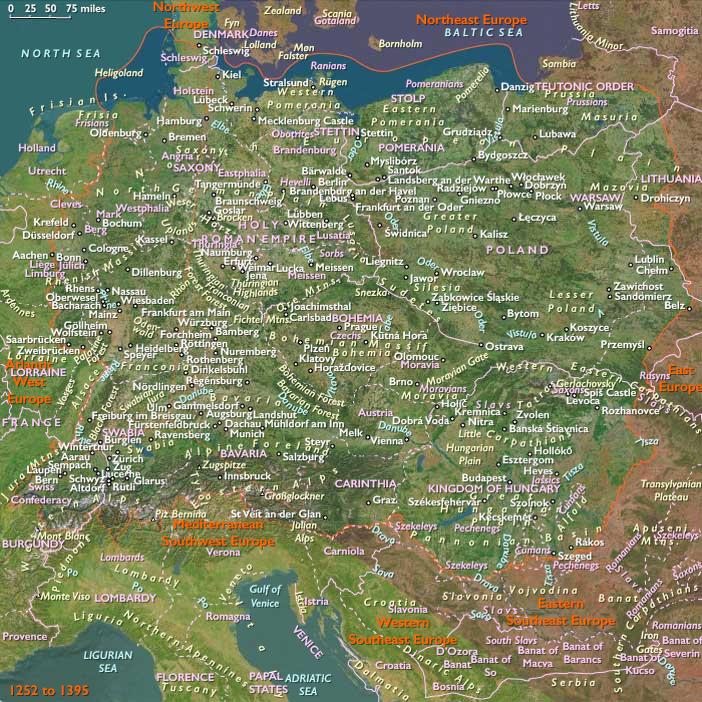
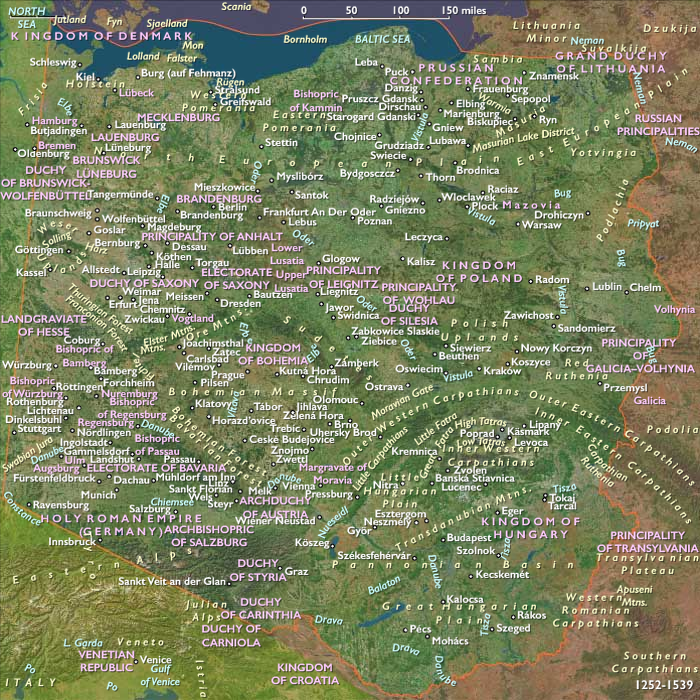
Archbishop Jakub Świnka, on January 6, 1285, orders all priests subject to his bishopry in Poland to deliver sermons in Polish rather than German, thus further unifying the Catholic Church in Poland and fostering a national identity.
Locations
People
Groups
- Germans
- Poles (West Slavs)
- Christians, Roman Catholic
- Poland during the period of fragmentation, Kingdom of
- Poland, Greater
- Holy Roman Empire
Topics
Subjects
Regions
Subregions
Related Events
Filter results
Showing 10 events out of 696 total
Northeastern North America (1684–1827 CE): Empires, Nations, and Atlantic Gateways
Geography & Environmental Context
Northeastern North America includes all territory east of 110°W, except the lands belonging to Gulf and Western North America. This encompasses the Great Lakes basin, the St. Lawrence River corridor, Hudson Bay and Labrador, Newfoundland, Greenland, the Arctic, the Maritime provinces, and the Atlantic seaboard from New England through Virginia, the Carolinas, and most of Georgia. It also contains the Mississippi Valley north of Illinois’ Little Egypt and the Upper Missouri above the Iowa–Nebraska crossing, as well as northeast Alabama, central and eastern Tennessee, and nearly all of Kentucky.
Anchors included the Great Lakes–St. Lawrence system, Hudson Bay, the Mississippi headwaters, the Appalachian piedmont and coastal plain, and the Greenland ice sheet. This was a land of forests and prairies, river valleys and tundra, increasingly tied to transatlantic markets.
Climate & Environmental Shifts
This age unfolded under the continuing Little Ice Age. Winters were harsh: ice closed the St. Lawrence, snow lingered across New England and the Maritimes, and Greenland’s fjords froze for longer periods, forcing Inuit hunters to adapt routes and tools. In the Great Lakes and Midwest, shorter growing seasons sometimes strained maize harvests. Atlantic storms battered coastlines, while the cod-rich Grand Banks remained among the world’s most productive fisheries.
Subsistence & Settlement
-
Indigenous nations:
-
Iroquois (Haudenosaunee), Huron-Wendat, and Algonquian peoples relied on maize horticulture, deer, moose, caribou, and fisheries.
-
Inuit in Greenland and Labrador centered subsistence on seals, whales, and caribou, adapting to changing sea ice.
-
Southeastern groups (Cherokee, Creek) combined horticulture with hunting.
-
-
Colonial settlements:
-
New France spread from Quebec to the Great Lakes and Mississippi through forts and missions.
-
New England, New York, and the Chesapeake grew rapidly, displacing Native peoples.
-
Hudson’s Bay Company (chartered 1670) expanded posts like York Factory and Fort Albany, anchoring the fur trade.
-
Spanish Florida persisted tenuously until ceded to Britain (1763), then to the U.S. (1821).
-
Greenland saw Inuit continuity until Danish missions after 1721.
-
-
Economic systems: Fur and cod in the north, wheat and mixed farms in the interior, tobacco, rice, and indigo in the southern reaches.
Technology & Material Culture
-
Indigenous technologies: canoes, snowshoes, fishing gear, longhouses, wampum belts, dog sleds, umiaks, and harpoons.
-
European imports: firearms, iron tools, textiles, plows, ships, and mills.
-
Trade goods: kettles, knives, and muskets became embedded in Native economies.
-
Colonial towns: churches, courthouses, colleges, and printing presses reflected European traditions, while frontier cabins and missions reflected adaptation.
Movement & Interaction Corridors
-
Fur trade networks: Carried beaver pelts from the Great Lakes and Hudson Bay into Europe, exchanged for manufactured goods.
-
Maritime corridors: The Grand Banks drew fleets from England, France, Spain, and Portugal; New England merchants trafficked with the Caribbean and Africa.
-
Indigenous corridors: Canoe routes and portages linked Hudson Bay, the Great Lakes, and the Mississippi basin.
-
Greenland: Inuit maintained ice routes across Baffin Bay; Danish missions established lasting presence after 1721.
Cultural & Symbolic Expressions
-
Indigenous nations:
-
The Haudenosaunee Confederacy remained a powerful political and diplomatic bloc.
-
Oral traditions, seasonal rituals, and clan governance reinforced autonomy.
-
-
Colonial cultures:
-
Catholic missions dominated New France; Protestant congregations spread in New England and the South.
-
Anglicanism tied seaboard elites to Britain.
-
Jewish communities established early synagogues in port cities like Newport.
-
-
Greenland Inuit: Rituals around whale and seal hunting persisted; Christian teaching blended with older cosmologies after Danish missions.
-
Symbols of territory: forts, flags, treaties, and wampum belts embodied contested claims of sovereignty.
Environmental Adaptation & Resilience
Indigenous farmers rotated crops, built surpluses, and shifted villages as conditions required. Hunters diversified prey; Inuit adjusted hunting gear and routes to ice changes. Colonists overexploited cod, timber, and beaver but also relied on Native knowledge for survival in harsh climates. Beaver depletion shifted fur trade routes deeper into the interior, while forest clearing transformed seaboard ecosystems.
Political & Military Shocks
-
Imperial wars: The Nine Years’ War, Queen Anne’s War, and the Seven Years’ War drew Indigenous peoples into shifting alliances.
-
Seven Years’ War (1756–63): Britain seized New France, transforming the balance of power.
-
American Revolution (1775–83): Created the United States from New England to Georgia; Loyalists resettled in Canada, reshaping its demographics.
-
War of 1812: Britain and the U.S. clashed over the Great Lakes and Chesapeake; Native confederacies (notably Tecumseh’s) collapsed in defeat.
-
Greenland: Danish rule consolidated after missions, linking Inuit more firmly into European frameworks.
Transition
By 1827 CE, Northeastern North America had become a patchwork of Indigenous nations, colonial legacies, and new settler republics. The fur trade and cod fisheries tied forests and coasts to Atlantic markets; French Canada endured under British rule; the United States secured independence and expanded inland. Greenland was drawn into Danish orbit. Indigenous nations remained vital, but faced epidemic disease, land dispossession, and broken alliances. What had begun as an imperial frontier was by the early 19th century a continental zone of nations, settler societies, and Native resilience under unprecedented pressure.
Americans have developed an ideology of "republicanism" asserting that government rests on the will of the people as expressed in their local legislatures.
They demand their rights as Englishmen and "no taxation without representation".
The British insist on administering the empire through Parliament, and the conflict escalates into war.
Following the passage of the Lee Resolution, on July 2, 1776, which is the actual vote for independence, the Second Continental Congress adopts the Declaration of Independence on July 4, which proclaims, in a long preamble, that humanity is created equal in their unalienable rights and that those rights are not being protected by Great Britain, and declares, in the words of the resolution, that the Thirteen Colonies are independent states and have no allegiance to the British crown in the United States.
The fourth day of July is celebrated annually as Independence Day.
In 1777, the Articles of Confederation establish a weak government that operates until 1789.
In the peace treaty of 1783, American sovereignty is recognized from the Atlantic coast west to the Mississippi River.
Nationalists lead the Philadelphia Convention of 1787 in writing the United States Constitution, ratified in state conventions in 1788.
The federal government is reorganized into three branches, on the principle of creating salutary checks and balances, in 1789.
George Washington, who had led the revolutionary army to victory, is the first president elected under the new constitution.
The Bill of Rights, forbidding federal restriction of personal freedoms and guaranteeing a range of legal protections, is adopted in 1791.
Its European territory keeps growing, however, with notable acquisitions such as Lorraine (1766) and Corsica (1770).
An unpopular king, Louis XV's weak rule, his ill-advised financial, political and military decisions—as well as the debauchery of his court—discredits the monarchy, which arguably paves the way for the French Revolution fifteen years after his death.
Northwest Europe (1768–1779): Industrial Growth, Enlightenment Thought, and the American Crisis
Britain's American Crisis and Imperial Tensions
Between 1768 and 1779, Britain faced profound challenges within its empire, particularly escalating tensions with its North American colonies. Following expensive military engagements during the Seven Years’ War, Britain attempted to offset debts by enforcing unpopular taxes, including the Townshend Acts (1767–1768). American resistance culminated in the Boston Massacre (1770), deepening hostility. Parliament’s subsequent repeal of most Townshend duties did little to quell tensions, which escalated dramatically after the Boston Tea Party (1773), leading to punitive measures—the so-called Intolerable Acts (1774)—and ultimately igniting the American Revolutionary War (1775). By 1776, American colonies declared independence, fundamentally challenging Britain’s imperial dominance and reshaping global political dynamics.
Adam Smith and "The Wealth of Nations"
Amidst political and economic turmoil, Scottish Enlightenment philosopher and economist Adam Smith published his seminal work, An Inquiry into the Nature and Causes of the Wealth of Nations, in 1776. Building upon earlier lectures delivered in Edinburgh and his philosophical foundation outlined in The Theory of Moral Sentiments (1759), Smith’s masterpiece articulated principles of free trade, market-driven economics, and limited governmental intervention—what he termed the "system of natural liberty." Smith’s theories profoundly influenced economic policy, advocating that prosperity emerged through individuals pursuing rational self-interest guided by competition—the concept famously summarized as the "invisible hand." His critiques of colonialism, monopolies, and mercantilist policies resonated widely, reshaping economic thought and policy throughout Europe and North America.
Industrial Struggles and Zinc Production: The Champion Brothers
The zinc industry in Britain, initially pioneered by William Champion and advanced by his brother John Champion, experienced both innovation and financial distress during this era. Although John Champion's refined calcination process—patented earlier in 1758—advanced British metallurgy, by 1765 William faced severe economic troubles. By 1768, Champion was declared bankrupt, and the Warmley works near Bristol were acquired in 1769 by the older Bristol Brass Company, which unfortunately never fully utilized the site's production capacity. This event marked an early cautionary example of the precarious nature of industrial entrepreneurship.
Public Health and Prison Reform
Continuing public health concerns persisted, especially regarding the appalling conditions within British prisons. Following repeated outbreaks of gaol fever (typhus), notably in Newgate Prison—where poor sanitation regularly sparked epidemics reaching London’s broader population—pressure steadily grew for prison reform. Though major systemic reforms were not yet realized, heightened awareness steadily laid the groundwork for future humanitarian improvements in prison conditions.
Life Insurance and the Actuarial Revolution
The sophistication of financial services evolved significantly with the pioneering work of actuaries such as Edward Rowe Mores. The Society for Equitable Assurances on Lives and Survivorship, founded by Mores in 1762, continued to flourish, laying down foundational practices of modern insurance. Its innovative methods, calculating premiums based on accurate mortality rates and actuarial principles, increasingly influenced financial institutions throughout Britain and Europe, shaping the growth of modern insurance industries.
Cultural Innovations: The Sandwich and Bathing Machines
Cultural habits continued evolving during these years. The sandwich, named after the 4th Earl of Sandwich, John Montagu, who popularized it—reputedly while engrossed at gaming tables or working at his naval office—became widely accepted. This culinary innovation symbolized convenience, modernity, and changing social customs in British life.
Similarly, the popularity of seaside leisure expanded rapidly. Bathing machines, mobile wooden structures providing privacy for changing clothes before entering the sea, became increasingly common across coastal Britain. Initially appearing decades earlier, their adoption during this period symbolized changing attitudes toward recreation, modesty, and social customs, driving tourism to coastal resorts like Margate and Brighton.
Rococo Portraiture: A Flourishing British Art
Artistic innovation remained vibrant, particularly in the realm of Rococo portraiture. Notable artists such as Joshua Reynolds, Thomas Gainsborough, Francis Hayman, and the Swiss-born Angelica Kauffman produced portraits that captured the sophisticated elegance and cultural aspirations of British elites. These artists, influenced by the elegant compositions of Flemish master Anthony van Dyck, balanced realism and idealization, significantly shaping British visual culture.
Captain James Cook and Maritime Exploration
Between 1768 and 1779, Captain James Cook undertook his three major voyages, profoundly expanding European geographic knowledge. Sponsored by the Royal Society and the Admiralty, Cook’s first voyage (1768–1771) aboard HMS Endeavour famously included the observation of the Transit of Venus (1769) and extensive charting of New Zealand and Australia’s east coast. Subsequent expeditions (1772–1775; 1776–1779) further explored the Pacific Ocean, bringing new scientific, geographic, and ethnographic knowledge to Europe. Cook’s voyages symbolized Britain’s Enlightenment-driven exploration and maritime dominance.
Denmark-Norway Under Christian VII: Reform and Instability
In Denmark-Norway, King Christian VII (reigned 1766–1808) came to the throne. His reign was characterized by political instability, personal mental illness, and court intrigue. Nevertheless, under influential statesman and reformer Johann Friedrich Struensee (in power from 1770 to 1772), Denmark-Norway briefly experienced a flurry of Enlightenment-inspired reforms aimed at modernizing administration, promoting economic liberalism, and reducing censorship. Though Struensee’s tenure was short-lived—ending dramatically with his execution in 1772—these brief reforms left a lasting imprint on the kingdom’s future political evolution.
Ireland’s Continued Economic Struggle
In Ireland, economic hardship under restrictive Penal Laws persisted, exacerbating rural poverty and emigration. By the late 1760s and 1770s, increasingly vocal calls for reform and relief emerged, reflecting growing discontent. While urban areas like Dublin displayed signs of economic activity, Ireland’s countryside remained largely impoverished and politically disenfranchised, setting the stage for future unrest.
Scientific and Technological Progress
The late 1760s and 1770s continued to witness significant scientific and technological advancements in Northwest Europe. Building upon the navigational triumphs of John Harrison’s marine chronometer (H4), Britain’s naval and commercial fleets adopted chronometric navigation extensively, boosting maritime efficiency and safety. Concurrently, agricultural experimentation and improved manufacturing processes marked the early phases of Britain’s industrial transformation.
Between 1768 and 1779, Northwest Europe navigated complex changes characterized by imperial turmoil, revolutionary economic thought exemplified by Adam Smith, maritime exploration, scientific innovation, and the early industrial revolution. Cultural trends in art, leisure, and everyday life evolved rapidly alongside significant developments in public health, finance, and governance. Collectively, these transformations set the stage for Europe's continued global dominance, industrialization, and future revolutionary upheavals.
Northeastern North America
(1768 to 1779 CE): Revolutionary Turmoil, Frontier Expansion, and Indigenous Realignments
The years 1768 to 1779 in Northeastern North America marked a time of profound revolutionary upheaval, rapid frontier expansion, complex indigenous interactions, and significant social change. Frontier settlements expanded despite prohibitions, indigenous alliances shifted, and regional economies were restructured by warfare and trade. This era fundamentally reshaped the political, social, and cultural dynamics of the region.
Frontier Expansion and Conflicts
Treaty of Fort Stanwix (1768) and Kentucky Settlements
In 1768, the Treaty of Fort Stanwix—negotiated between British colonial authorities and the Iroquois Confederacy—aimed to ease frontier tensions by shifting the boundary line established in 1763. However, the treaty opened extensive territory south of the Ohio River, including modern-day Kentucky, to American colonial settlement, exacerbating intertribal conflict and sparking resistance from displaced native nations.
In 1775, renowned frontiersman Daniel Boone blazed a trail through the Cumberland Gap on behalf of the Transylvania Company, establishing Boonesborough in central Kentucky. His route was soon extended to reach the Falls of the Ohio (modern-day Louisville), accelerating the settlement and territorial ambitions of frontier colonists.
The Watauga Settlements and Cherokee Conflicts (1770–1777)
European settlers began moving into the Watauga, Nolichucky, and Holston River valleys (modern-day Tennessee) during the late 1760s and early 1770s. Initially believing these lands had been ceded by the Cherokee in the 1770 Treaty of Lochaber, settlers soon learned through Colonel John Donelson’s survey that these lands remained Cherokee territory, making their settlement illegal under British law.
In 1772, settlers negotiated a ten-year lease with the Cherokee, forming the independent Watauga Association to govern themselves. These actions were strongly opposed by Cherokee factions, notably led by the influential chief Dragging Canoe.
When war erupted in 1775, Watauga settlers formed the Washington District, pledging allegiance to the American revolutionary cause. Following petitions, North Carolina annexed the territory as Washington County in November 1777. Cherokee attempts to forcibly reclaim the region culminated in their defeat in 1776, leading to the Treaty of Long Island (1777), ceding the Watauga and Nolichucky valleys to the Americans.
Revolutionary War and Southern Devastation
South Carolina and Civil Conflict
South Carolina emerged as a central theater during the American Revolutionary War (1775–1783), with about one-third of the war’s combat actions taking place within its borders—more than in any other colony. The state suffered intensely from British invasions and violent internal conflict between Patriot partisans and Loyalist factions, particularly devastating the backcountry. Approximately 25,000 enslaved persons (around thirty percent of South Carolina's enslaved population) fled, migrated, or perished due to wartime upheaval.
The destruction and displacement in South Carolina profoundly altered the region's demographic, economic, and social structure, reshaping its political identity and intensifying its reliance on slavery in subsequent decades.
Indigenous Alliances and Frontier Warfare
Iroquois and Ohio Valley Conflicts
The American Revolution profoundly disrupted indigenous alliances. The previously unified Iroquois Confederacy split over revolutionary allegiances. Tribes like the Mohawk, Cayuga, Seneca, and Onondaga generally allied with the British, while the Oneida and Tuscarora largely supported the Americans. This schism escalated warfare on the New York frontier, culminating in punitive campaigns against Iroquois settlements, notably the Sullivan Expedition (1779), which severely impacted Iroquois communities.
Mandan Trade Networks and Equine Culture
On the northern Great Plains, the Mandan significantly enhanced their economic and territorial influence during this era, capitalizing on extensive trade networks involving furs, horses, firearms, and buffalo products. Having acquired horses in the mid-eighteenth century from southern Apache intermediaries, the Mandan used horses to expand their hunting territories and enhance their role as trade intermediaries. Mandan villages served as hubs connecting European traders from British, French, and Spanish backgrounds. After France ceded territory west of the Mississippi to Spain (1763), Spanish officials in St. Louis actively pursued stronger trade relations with the Mandan (whom they called Mandanas), hoping to curb British and American influence. Nevertheless, the Mandan continued open trade with all European competitors, refusing exclusive alliances and maximizing their commercial advantages.
In parallel, French traders based in St. Louis—particularly the influential Chouteau brothers—established direct trade routes to Santa Fé, further integrating the Great Plains into an expansive transcontinental economic network.
Northern Settlements and Indigenous Populations
Greenland and Egedesminde Colony
In Greenland’s Aasiaat Archipelago, indigenous populations dating back millennia had traditionally subsisted through seasonal migrations, hunting seals, reindeer, halibut, narwhals, and beluga whales. The establishment of Egedesminde Colony in 1759 by Norwegian missionary Niels Egede, son of Hans Egede, initiated a small-scale European settlement initially located north of Nordre Strømfjord. In 1763, the settlement was relocated to its current position.
By the 1770s, European settlers, primarily whalers, inadvertently introduced smallpox. The ensuing epidemic ravaged Greenland's indigenous population around Egedesminde, dramatically impacting local demographics and destabilizing traditional lifeways.
Ideological Developments and Cultural Transformations
Influence of the Great Awakening
The evangelical fervor of the Great Awakening (1730s–1740s), which had continued influencing the colonies into this era, shaped revolutionary ideology by emphasizing individual liberty, religious independence, and democratic principles. Ministers across the colonies openly supported the revolutionary cause, reinforcing political commitments through religious conviction.
Legacy of the Era (1768–1779 CE)
The years 1768–1779 significantly reshaped Northeastern North America. Frontier expansion, such as Boone’s Kentucky settlements and the Watauga communities in Tennessee, challenged British prohibitions, escalating tensions. South Carolina’s intense civil conflict and widespread displacement of enslaved populations demonstrated the deep social disruptions caused by war. Indigenous nations—including the Iroquois and Cherokee—experienced internal divisions and external pressures, resulting in substantial territorial and cultural losses. At the same time, the Mandan and other Plains tribes successfully capitalized on expanding trade networks, reshaping regional economic dynamics.
Together, these developments irrevocably altered regional political structures, demography, indigenous relationships, and colonial ambitions, laying foundational elements for the subsequent emergence of an independent United States and reshaping indigenous North America in lasting ways.
Inhabitants of the state endure being invaded by English forces and an ongoing civil war between loyalists and partisans that devastates the backcountry.
It is estimated that twenty-five thousand enslaved people (thirty percent of those in South Carolina) flee, migrate or die during the war.
In 1775, Daniel Boone blazes a trail for the Transylvania Company from Virginia through the Cumberland Gap into central Kentucky.
It is later lengthened to reach the Falls of the Ohio at Louisville.
These settlers mistakenly believe (or at least will claim to have believed) the Watauga and Nolichucky valleys are part of lands ceded to Virginia by the Cherokee in the 1770 Treaty of Lochaber, but a subsequent survey by Colonel John Donelson confirms that these lands are still part of the Cherokee domain.
As settlement on lands west of colonial boundaries violates the Royal Proclamation of 1763, the Watauga and Nolichucky settlers are ordered to leave.
In May 1772, the Watauga and Nolichucky settlers negotiate a ten-year lease directly with the Cherokee, and being outside the claims of any colony, establish the Watauga Association to provide basic government functions.
The lease and the subsequent purchase of these lands in 1775 are considered illegal by the British Crown, and are vehemently opposed by a growing faction of the Cherokee led by the young chief Dragging Canoe.
With the outbreak of the American Revolutionary War (April 1775), the settlers organize themselves into the "Washington District," loyal to the "united colonies," and form a Committee of Safety to govern it, marking the end of the so-called "Watauga Republic".
In Spring of 1776, the Washington District Committee of Safety drafts a petition asking the colony of Virginia to annex the district.
After Virginia refuses, the Committee drafts a similar petition (dated July 5, 1776) asking the North Carolina Assembly to annex the district.
In November of this year, North Carolina grants the petition and formally annexes the area.
The Washington District is finally admitted to North Carolina as Washington County in November 1777.
The Cherokee, who are aligned with the British, launch an all-out invasion against the settlements in July 1776, but are soundly defeated.
In 1777, the Cherokee sign he Treaty of Long Island, ceding control of the Watauga and Nolichucky valleys to the American colonies.
Eastern West Indies (1768–1779 CE): Earthquakes, Warfare, and Revolutionary Tensions
Devastating Earthquakes and Their Aftermath
Between 1768 and 1779, severe natural disasters profoundly impacted the Eastern West Indies. A catastrophic earthquake struck Port-au-Prince on June 3, 1770, devastating the city and surrounding regions, including Lake Miragoâne and Petit-Goâve. The quake caused extensive soil liquefaction in the Plain of the Cul-de-Sac, leveling buildings and sinking the village of Croix des Bouquets below sea level. Approximately 200 people died in Port-au-Prince alone, with severe casualties elsewhere. The earthquake triggered a tsunami affecting the Gulf of Gonâve.
The quake's aftermath saw thousands of enslaved individuals fleeing in chaos, severely disrupting the local economy. Approximately 15,000 enslaved people died from subsequent famine, while another 15,000 succumbed to gastrointestinal anthrax contracted from tainted meat sold by Spanish traders.
Economic and Strategic Rivalries
In 1777, French botanist Nicolas-Joseph Thiéry de Menonville attempted to smuggle valuable cochineal insects from New Spain to Saint-Domingue. Although initially successful, this attempt ultimately failed, leaving Spain's monopoly on this lucrative dyestuff intact.
Grenada: Conflict and Reconstruction
The principal town of Grenada, St. George, faced destructive fires in 1771 and again in 1775, prompting reconstruction efforts in stone and brick. During the American War of Independence, French forces under Comte d'Estaing recaptured Grenada between July 2-4, 1779, with British naval forces defeated in the Battle of Grenada on July 6, 1779.
Sint Eustatius and the American Revolution
The small Dutch island of Sint Eustatius became pivotal during the American Revolutionary War. In 1776, it was the first foreign power to officially acknowledge American independence by saluting the brig Andrew Doria. Due to British blockades, Sint Eustatius became a crucial supply hub for the American forces, facilitated by Dutch, British colonial, and Jewish merchant networks.
French and British Conflicts
French and British forces clashed repeatedly throughout the Caribbean. The French captured Dominica in September 1778, led by Governor-General François Claude Amour, Marquis de Bouillé, capitalizing on weak British defenses. News of Dominica’s fall shocked Britain, leading to severe criticism of Admiral Samuel Barrington for inadequate naval defenses.
In response, Admiral William Hotham and Admiral Barrington launched an assault on French-held St. Lucia in December 1778, securing it as a strategic position. Reinforcements arrived for both sides in early 1779, shifting power dynamics. Admiral John Byron reinforced the British but departed in June 1779 to protect merchant convoys, leaving Admiral d'Estaing free to act.
D'Estaing and Bouillé captured Saint Vincent on June 18, 1779, and subsequently targeted Grenada, capturing it after fierce fighting on July 4, 1779.
Severe Weather Events
A devastating hurricane hit Guadeloupe on September 6, 1776, resulting in over 6,000 fatalities, highlighting the ongoing vulnerability of Caribbean islands to extreme weather events.
Conclusion
The period 1768–1779 witnessed significant upheaval in the Eastern West Indies, shaped by destructive earthquakes, the tumult of the American Revolutionary War, and severe weather disasters. The era demonstrated both the volatility and strategic significance of these colonial territories, setting the stage for continued geopolitical complexities.
Years: 1285 - 1285
Locations
People
Groups
- Germans
- Poles (West Slavs)
- Christians, Roman Catholic
- Poland during the period of fragmentation, Kingdom of
- Poland, Greater
- Holy Roman Empire
Topics
Subjects
Regions
Subregions