Archbishop Agobard of Lyon, having written a …
Years: 838 - 838
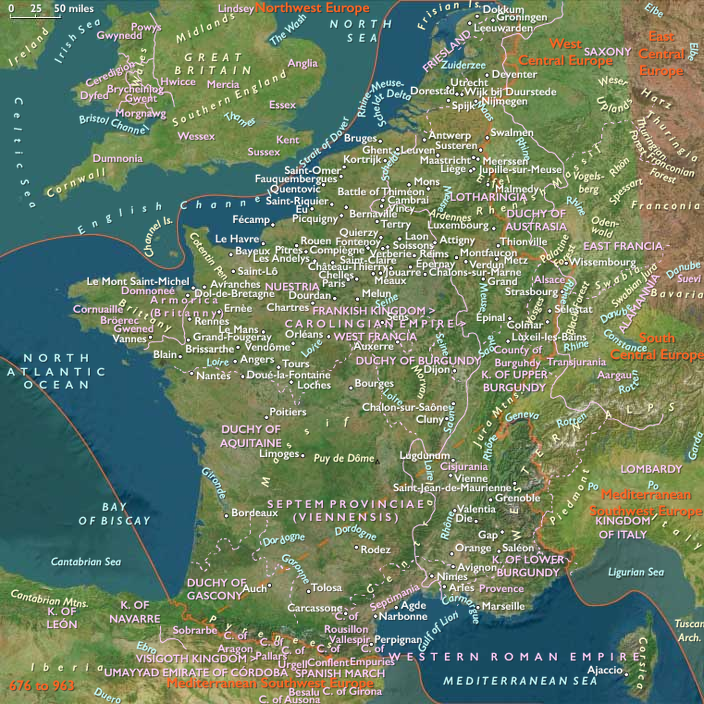
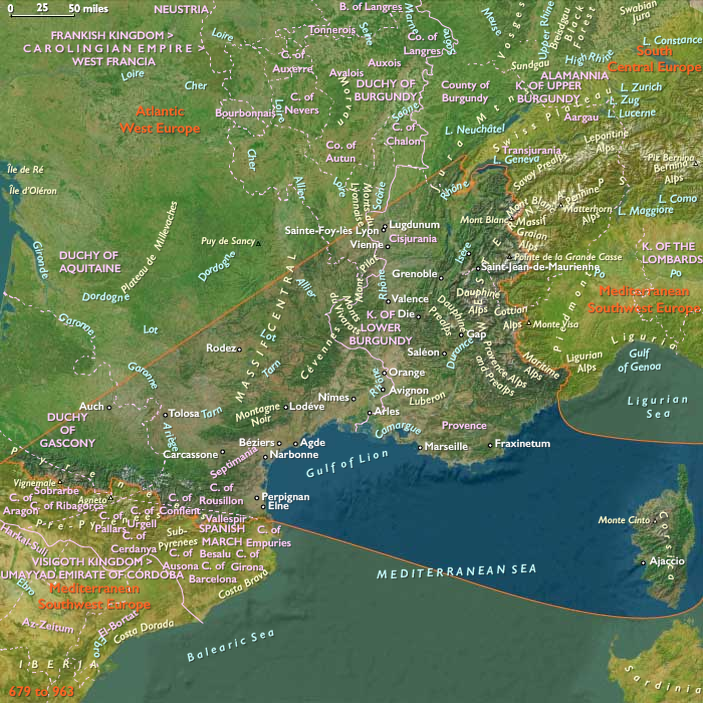
Archbishop Agobard of Lyon, having written a public justification of the deposition of Louis the Pious in 833, had lost his see when Louis was restored to his throne, but is reinstated in 838.
Locations
People
Groups
Topics
Subjects
Regions
Subregions
Related Events
Filter results
Showing 10 events out of 54281 total
The Final Years of Louis the Pious and the Succession of Charles the Bald (834–840)
After regaining his throne in 834, Emperor Louis the Pious rules with renewed energy, rewarding loyal supporters and punishing those who had betrayed him during the civil war. However, his favoritism toward his youngest son, Charles the Bald, at the expense of his other sons and grandsons, leads to further conflict and resentment.
The Controversial Favoring of Charles the Bald
- Despite opposition from his son Louis the German, Louis the Pious continues to favor Charles, his son by Judith of Bavaria.
- He grants Charles key territories, which had previously been assigned to his older half-brothers, creating further dynastic tensions.
The Death of Pepin I of Aquitaine (838) and the Succession Crisis
- In 838, Pepin I of Aquitaine dies, leaving behind a son, Pepin II, who expects to inherit the kingdom.
- However, Emperor Louis ignores Pepin II’s claim and instead grants Aquitaine to Charles the Bald, overriding the traditional Carolingian practice of inheritance.
The Growing Resentment of Louis the German
- Louis the German, who already opposed his father’s favoritism toward Charles, becomes even more estranged by this decision.
- The rejection of Pepin II’s claim alienates the Aquitanian nobility, further weakening imperial unity.
The Inevitable Civil War
- This controversial redistribution of land ensures that conflict will erupt again after Louis the Pious’ death in 840.
- As expected, after Louis' passing, his sons—Lothair I, Louis the German, and Charles the Bald—engage in yet another civil war, leading to the Battle of Fontenay (841) and the Treaty of Verdun (843), which permanently divides the Carolingian Empire.
Though Louis the Pious reclaims his authority, his insistence on favoring Charles the Bald over his elder sons and grandsons ensures that his empire will not remain united after his death.
Sahl Smbatean captures Babak in January 838 and surrenders him to Afshin, for which service Sahl receives one million silver dirhams as a reward.
Babak is soon executed by gruesome torture.
According to Movses Kaghankatvatsi, the Caliphate assigned Sahl sovereignty over Armenia, Georgia and Albania.
Al-Mu’tasim, determined to crush the Greeks, leads the largest army yet assembled under one caliph—composed of Arab warriors, Turkish guards, and enslaved men—into Anatolia, where he defeats Theophilus's forces in July 838 at the bloody Battle of Dazimon (now Dazmana, Turkey) on the Halys River.
Al-Mu'tasim thus becomes the first caliph to employ the Turkish mercenaries who will later come to dominate the 'Abbasid dynasty.
In the aftermath of this defeat, and with rumors circulating in Constantinople of his death, Theophilos's position is precarious.
He abandons the campaign and withdraws to Dorylaion, whence he soon departs for the imperial capital.
Ancyra itself is left abandoned, and plundered by the Arab army on 27 July, after which …
…the united Abbasid army marches unopposed to Amorion, besieging the fortress for two weeks.
Just before its capture by the Arabs, fighting breaks out between Jews and Christians.
Included in the conflict is a Judaizing Christian sect that keeps Biblical Law (except circumcision) and allows both men and women to serve as spiritual leaders.
Rumors are spread that the late Emperor Michael II had come from this sect.
Out of its entire population of some seventy thousand, only about half survive the brutal sack, to be sold as slaves.
The fall of the city is to be one of the heaviest blows suffered by the Empire in the entire ninth century, both in material and symbolic terms.
Luckily for the Empire, news of a rebellion in the Caliphate forces al-Mu'tasim to withdraw soon after.
Tragic though they are for the Empire at the time, the defeat at Anzen and the subsequent sack of Amorion are militarily of no long-term importance to the Empire, since the Abbasids fail to follow up on their success.
They do, however, play a crucial role in discrediting iconoclasm, which has always relied on military success to maintain its validity.
Immediately after the sack, rumors reach the caliph that Theophilos was advancing to attack him.
Mu'tasim sets out with his army a day's march along the road in the direction of Dorylaion, but encounters no sign of an imperial attack.
According to al-Tabari, Mu'tasim now pondered extending his campaign to attack Constantinople, when news reached him of a rebellion headed by his nephew, al-Abbas ibn al-Ma'mun.
Mu'tasim is forced to cut short his campaign and return quickly to his realm, leaving intact the fortresses around Amorium as well as Theophilos and his army in Dorylaion.
Taking the direct route from Amorium to the Cilician Gates, both the caliph's army and its prisoners suffer in the march through the arid countryside of central Anatolia.
Some captives are so exhausted that they cannot move and are executed, whereupon others find the opportunity to escape.
In retaliation, Mu'tasim, after separating the most prominent among them, executes the rest, some six thousand in number.

Theophilos now sends a second embassy to the caliph, headed by the tourmarches of Charsianon, Basil, bearing gifts and an apologetic letter, and offering to ransom the high-ranking prisoners for twenty thousand imperial pounds (about sixty-five hundred kilograms) of gold and to release all Arabs held captive by the Empire.
In reply, Mu'tasim refuses the ransom, saying that the expedition alone had cost him over one hundred thousand pounds, and demands the surrender of Theophobos and the Domestic of the Schools, Manuel the Armenian, who had some years ago deserted from Arab service.
The imperial ambassador refuses to comply to this and indeed cannot, as Theophobos is in revolt and Manuel may have been dead.
Instead, Basil hands over a second, much more threatening letter by Theophilos.
Mu'tasim, angered by this, returns the emperor's gifts.
The investigation, headed by Mu'tasim's trusted Turkish general Ashinas following the discovery of the conspiracy to assassinate Mu'tasim and place his nephew al-Abbas on the throne, results in the execution of most conspirators.
This is broadened into a virtual purge of the army, in which the hitherto dominant Khurasani element is replaced with Mu'tasim's favored Turks.
Abbas himself is incarcerated and dies in prison at Manbij in 838, while his male descendants are imprisoned and executed by Ashinas.
Ancona had been one of the cities of the Pentapolis of the Roman Exarchate of Ravenna in the seventh and eighth centuries, and had come under Carolingian control after Charlemagne’s conquest of northern Italy.
Saracen raiders from the south sack and burn the city in 840.
The Partition of 839: Lothair I's Middle Frankish Kingdom
In 839, Emperor Louis the Pious reorganizes the Carolingian succession, granting Lothair I sovereignty over the Middle Frankish Kingdom, a vast territory stretching from the North Sea to Italy. This new partition further escalates tensions among Louis' surviving sons, especially Louis the German and Charles the Bald.
Lothair’s Middle Frankish Kingdom (839)
The lands assigned to Lothair I include:
- Most of the present Low Countries (modern Belgium, the Netherlands, and Luxembourg).
- Alsace-Lorraine (modern northeastern France and western Germany).
- Switzerland (a crucial region linking the empire’s northern and southern territories).
- Northern Italy, securing control over key cities such as Milan and Pavia.
Louis II Designated as King of Italy
- Louis II, Lothair’s eldest son, is formally designated as King of Italy under his father’s sovereignty.
- This decision ensures that the imperial control over Rome and the Papal States remains within Lothair’s lineage, maintaining a connection between the Carolingian dynasty and the imperial title.
Consequences of the 839 Partition
- Louis the German and Charles the Bald are angered by the decision, as it relegates them to the peripheries of the empire while Lothair controls its central lands.
- The new arrangement overturns previous partitions, further fueling civil war after Louis the Pious’ death in 840.
- The division fails to create a lasting empire, as the Treaty of Verdun (843) permanently fragments the Carolingian realm into three independent kingdoms.
Though Lothair's inheritance makes him the most powerful Carolingian ruler, his control over the Middle Frankish Kingdom proves fragile, and his descendants struggle to maintain dominance over this politically unstable region.