
Upper East Asia (909 BCE – CE …
Years: 909BCE - 819
Upper East Asia (909 BCE – CE 819): Steppe Empires, Frontier Kingdoms, and Transcontinental Corridors
Geographic and Environmental Context
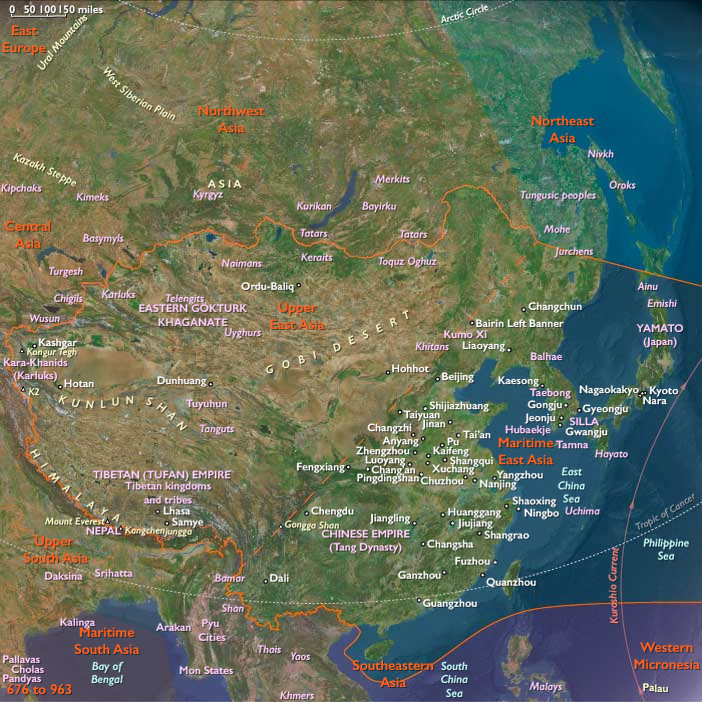
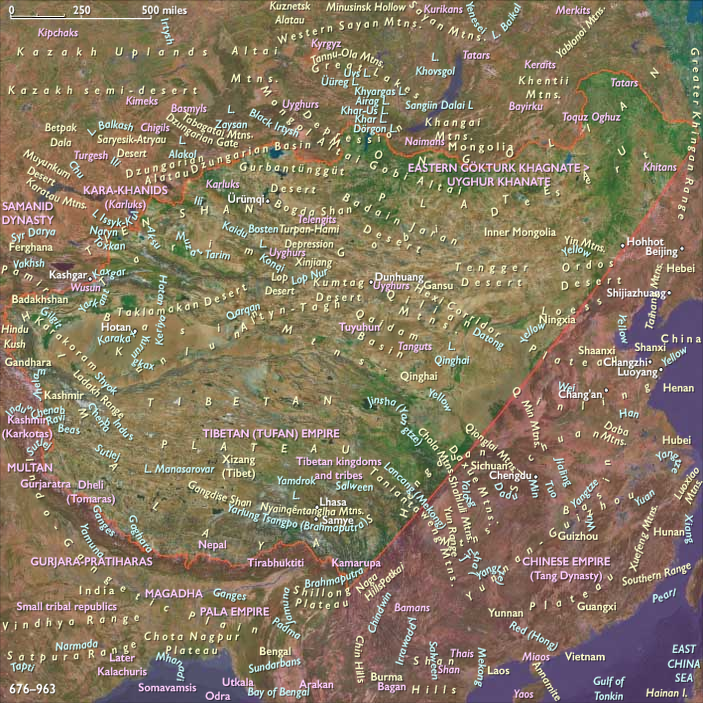
Upper East Asia includes Mongolia and the parts of western China comprising Tibet, Xinjiang, Qinghai, Gansu, Ningxia, Inner Mongolia, and western Heilongjiang.
-
This is a region of vast steppe and desert basins, high mountain ranges such as the Altai, Kunlun, and Himalayas, and the high plateau of Tibet.
-
Key river systems include the upper Yellow River, Tarim, and Amu Darya headwaters, while oases along the Tarim Basin edge sustain agriculture in otherwise arid landscapes.
Climate and Environmental Shifts
-
The region’s continental climate brought cold, dry winters and short, warm summers in the steppe, and harsh alpine conditions in the plateau.
-
Rainfall was scarce in lowland deserts but more abundant in mountain foothills and river valleys.
-
Climatic fluctuations could expand or contract pastureland, influencing nomadic migrations and trade.
Societies and Political Developments
-
Nomadic confederations such as the Xiongnu, Xianbei, and Türkic Khaganates rose to prominence, controlling steppe trade and threatening or allying with Chinese dynasties.
-
The Tibetan Plateau saw the emergence of the Tubo (Tibetan) Empire, which at its height in the 7th–9th centuries CE contested influence in Central Asia and the Himalayas.
-
Oasis states like Khotan and Turpan thrived as Silk Road hubs, balancing allegiance between steppe powers and Chinese dynasties.
-
Semi-sedentary agricultural communities persisted in fertile river valleys, often under the control of nomadic elites.
Economy and Trade
-
Pastoral nomadism centered on horses, sheep, goats, cattle, and camels, with seasonal migration between summer and winter pastures.
-
Oases supported agriculture—wheat, barley, millet, grapes, and melons—and served as caravan rest points.
-
Trade along the Silk Road moved silk, jade, and ceramics westward, and glassware, precious metals, and textiles eastward.
-
Control of trade routes brought wealth to steppe and oasis states alike.
Subsistence and Technology
-
Nomadic societies excelled in mounted warfare, metalworking, and portable felt tent (yurt/ger) architecture.
-
Irrigation systems in oases allowed intensive farming despite aridity.
-
Camel caravans made long-distance trade possible across deserts and mountain passes.
Movement and Interaction Corridors
-
The Silk Road and its northern branches connected China with Central Asia, Persia, and the Mediterranean.
-
Mountain passes in the Altai, Tian Shan, and Kunlun ranges acted as strategic gateways.
-
Rivers such as the upper Yellow and Tarim provided local transport and irrigation sources.
Belief and Symbolism
-
Religious traditions included shamanism, Buddhism, Nestorian Christianity, and Zoroastrian influences.
-
The spread of Buddhism along the Silk Road left a legacy of cave temples, murals, and monasteries in oasis cities.
-
Nomadic art featured animal motifs, emphasizing strength, mobility, and spiritual guardianship.
Adaptation and Resilience
-
Seasonal mobility ensured sustainable use of pastures.
-
Alliances and tribute relationships with neighboring states provided stability and trade security.
-
Oases acted as refuges in times of drought or political instability, enabling recovery and continuity.
Long-Term Significance
By CE 819, Upper East Asia was a strategic bridge between China, Central Asia, and the Middle East—home to powerful steppe empires, thriving Silk Road towns, and enduring pastoral traditions that would continue to influence Eurasian history for centuries.
Groups
- Chinese Kingdom, Zhou, or Chou, Western, Dynasty
- Chinese Kingdom, Zhou, or Chou, Eastern Dynasty
- Zoroastrians
- Buddhism
- Buddhism, Tibetan
- Khotan, Kingdom of
- Xiongnu (Hsiung-nu)
- Xianbei
- Chinese Empire, Tung (Eastern) Han Dynasty
- Xianbei state
- Chinese Empire, Tung (Eastern) Jin Dynasty
- Rouran Khaganate
- Christians, Eastern (Diophysite, or “Nestorian”) (Church of the East)
- Göktürks (First Khaganate)
- Western Turkic Khaganate
- Chinese Empire, Tang Dynasty
- Tibetan Empire
- Göktürk Khanate, Second
- Uyghur Khaganate
Topics
- Iron Age China
- Warring States Period in China
- Qin dynasty China
- Han dynasty China
- Silk Road transmission of Buddhism
Commodoties
Subjects
Regions
Subregions
Years: 909BCE - 819
Groups
- Chinese Kingdom, Zhou, or Chou, Western, Dynasty
- Chinese Kingdom, Zhou, or Chou, Eastern Dynasty
- Zoroastrians
- Buddhism
- Buddhism, Tibetan
- Khotan, Kingdom of
- Xiongnu (Hsiung-nu)
- Xianbei
- Chinese Empire, Tung (Eastern) Han Dynasty
- Xianbei state
- Chinese Empire, Tung (Eastern) Jin Dynasty
- Rouran Khaganate
- Christians, Eastern (Diophysite, or “Nestorian”) (Church of the East)
- Göktürks (First Khaganate)
- Western Turkic Khaganate
- Chinese Empire, Tang Dynasty
- Tibetan Empire
- Göktürk Khanate, Second
- Uyghur Khaganate
Topics
- Iron Age China
- Warring States Period in China
- Qin dynasty China
- Han dynasty China
- Silk Road transmission of Buddhism
Commodoties
Subjects
Regions
Subregions