Apollodotus, a general with Demetrius of Bactria, …
Years: 180BCE - 180BCE
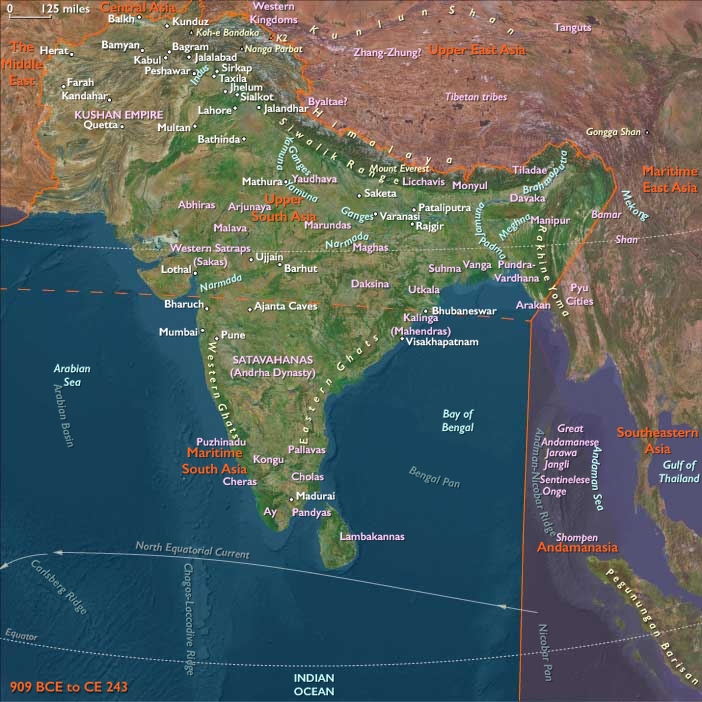
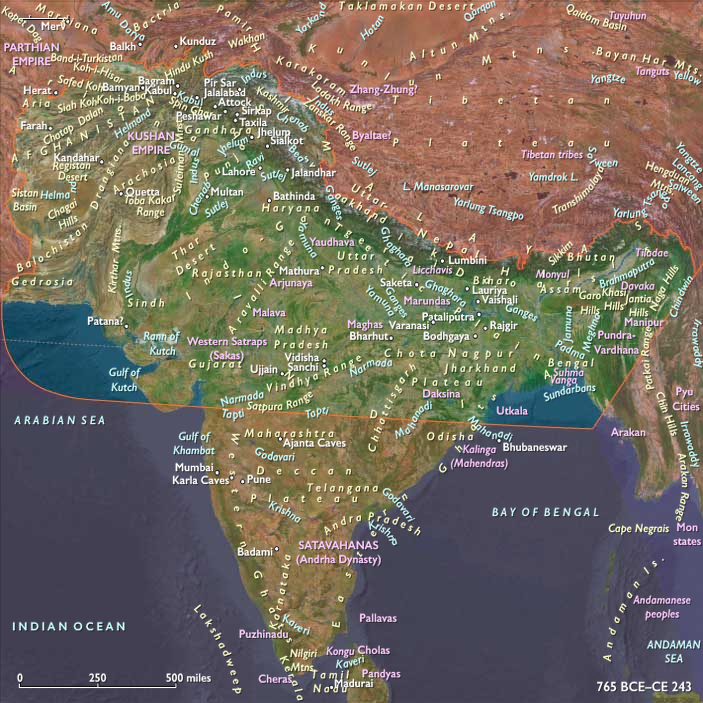
Apollodotus, a general with Demetrius of Bactria, becomes king of the western and southern parts of the Indo-Greek kingdom, from Taxila in Punjab to the areas of Sindh and possibly Gujarat.
Reigning from as early as 180 or as late as 165 BCE, he maintains his allegiance to Demetrius.
Locations
People
Groups
Topics
Commodoties
Subjects
Regions
Subregions
Related Events
Filter results
Showing 10 events out of 63323 total
North Island’s Lake Taupo lies in a caldera created following a huge volcanic eruption approximately twenty-six thousand five hundred years ago.
According to geological records, the volcano has erupted twenty eight times in the last twenty-seven thousand years.
The largest eruption, known as the Oruanui eruption, which occurred around 26,500 Years Before Present in Late Pleistocene, ejected an estimated eleven hundred and seventy cubic kilometers of material and caused several hundred square kilometers of surrounding land to collapse and form the caldera.
The caldera later filled with water, eventually overflowing to cause a huge outwash flood.
Several later eruptions occurred over the millennia before the major eruption in 180 CE, the most recent.
Known as the Hatepe eruption, it is believed to have ejected one hundred cubic kilometers of material, of which thirty cubic kilometers was ejected in the space of a few minutes.
This is one of the most violent eruptions in the last five thousand years (alongside the Tianchi eruption of Baekdu at around 1000 and the 1815 eruption of Tambora), with a Volcanic Explosivity Index rating of 7.
The eruption column is twice as high as the eruption column from Mount St. Helens in 1980, and the ash turns the sky red over Rome and China.
Liu Heng is a son of Emperor Gao of Han and Consort Bo, later empress dowager.
When Emperor Gao of Han suppressed the rebellion of Dai, he had created Liu Heng Prince of Dai.
After Empress Dowager Lü's death in 180, the court officials eliminate the powerful Lü clan, and deliberately choose the Prince of Dai as the emperor, since his mother, Consort Bo, has no powerful relatives, and her family is known for its humility and thoughtfulness.
His nephew, Emperor Houshao, viewed as a mere puppet of Grand Empress Dowager Lü and suspected of not being actually a son of Emperor Wen's older brother Emperor Hui, is deposed and executed.
Emperor Wen’s reign brings a much needed political stability that will lay the groundwork for prosperity under his grandson Emperor Wu.
Demetrius, the son of Euthydemus, starts an invasion of India from 180 BCE, a few years after the overthrow of the Mauryan empire by the Sunga dynasty.
Historians differ on the motivations behind the invasion.
Some historians suggest that the invasion of India was intended to show their support for the Mauryan empire, and to protect the Buddhist faith from the religious persecutions of the Sungas as alleged by Buddhist scriptures (Tarn).
Other historians have argued however that the accounts of these persecutions have been exaggerated (Thapar, Lamotte).
Pantaleon, who reigns in Arachosia, some time between 190 BCE and 180 BCE, is one of the most enigmatic of the Greek kings in Bactria and India.
A younger contemporary or successor of the Greco-Bactrian king Demetrius, he is sometimes believed to have been his brother and/or subking.
He is the first Greek king to strike Indian coins, peculiar irregular bronzes which suggests he has his base in Arachosia and Gandhara and wants support from the native population.
The limited size of his coinage indicates a short reign.
Known evidence suggests that he is replaced by his (probable) brother or son Agathocles, by whom he is commemorated on a "pedigree" coin.
Some of his coins (as well as those of Agathocles and Euthydemus II) have another surprising characteristic: these kings are the first in the world to issue coins of copper-nickel (75/25 ratio) alloy, a technology that will not be developed in the West until the eighteenth century, but is known by the Chinese at this time, as some weapons from China’s Warring States Period are known to have been made from the copper-nickel alloy known as "white copper".
This suggests that exchanges of the metallic alloy, or possibly exchanges of technicians, are occurring at this time between China and the region of Bactria.
The practice of exporting Chinese metals, in particular iron, for trade is attested around this period.
Taxila, or Takshashila, in the western Punjab (today represented by the remains in the present Bhir Mound) had become a great Buddhist center of learning during the reign of Ashoka, grandson of Chandragupta Maurya, founder of the Mauryan empire in eastern India.
Nonetheless, Taxila had briefly been the center of a minor local rebellion, subdued only a few years after its onset.
Two years after the assassination of the last Maurya emperor in 185, the Greco-Bactrian King Demetrius, who had succeeded his father Euthydemus around 200 BCE and conquered extensive areas in what now is eastern Iran and Afghanistan, led his troops across the Hindu Kush to conquer Gandhāra, the Punjab and the Indus valley, thus creating an Indo-Greek kingdom far from Hellenistic Greece.
It is generally considered that Demetrius ruled in Taxila (where many of his coins will be found in the archaeological site of Sirkap, on the opposite bank of the Tamranal River from Taxila.
The Indian records also describe Greek attacks on Saketa, Panchala, Mathura and Pataliputra.)
Demetrius I dies of unknown reasons, and the date 180 BCE is merely a suggestion aimed to allow suitable regnal periods for subsequent kings, of which there are to be several.
Even if some of them are co-regents, civil wars and temporary divisions of the empire are most likely.
The kings Pantaleon, Antimachus, Agathocles and possibly Euthydemus II rule after Demetrius I, and theories about their origin include all of them being relatives of Demetrius I, or only Antimachus.
Eventually, the kingdom of Bactria would fall to the able newcomer Eucratides, who in about 171 would uproot the Euthydemid dynasty of Greco-Bactrian kings and replace it with his own lineage.
Buddhism flourishes in the realms of the Bactrian kings.
The Sunga Empire's wars with the Indo-Greek Kingdom figure greatly in the history of this age, although the net result of these wars remains uncertain.
The Jews under the Syrian Seleucids are treated even more liberally than they had been under the Egyptian Ptolemids, being granted a charter to govern themselves by their own constitution, namely, the Torah.
Greek influence, however, is already becoming manifest.
Some of the twenty-nine Greek cities of Palestine attain a high level of culture.
The years from 188 BCE onward are lean years for the dynasty, because the war with Rome, which had ended in a complete Roman victory, had cost it not only almost the whole of Asia Minor but also a yearly indemnity of fifteen thousand talents.
Unsurprisingly, the first account of Seleucid rule in Palestine tells of an attempt by Heliodorus, the leading minister of Seleucus IV, to deprive the Second Temple in Jerusalem of its treasure.
His failure is soon ascribed to divine protection.
The apocryphal writer Jesus ben Sirach so bitterly denounces the Hellenizers in Jerusalem that he is forced by the authorities to temper his words.
Aristophanes of Byzantium, a Greek scholar, critic and grammarian, particularly renowned for his work in Homeric scholarship, but also for work on other classical authors such as Pindar and Hesiod, had moved to Alexandria when young and studied under Zenodotus and Callimachus.
He had succeeded Eratosthenes as head librarian of the Library of Alexandria sometime in the late 190s BCE at the age of sixty.
Aristophanes is credited with the invention of the accent system used in Greek to designate pronunciation, as the tonal, pitched system of archaic and classical Greek was giving way (or had given way) to the stress-based system of koine.
This is also a period when Greek, in the wake of Alexander's conquests, has been a lingua franca for the Eastern Mediterranean (replacing various Semitic languages).
The accents have been designed to assist in the pronunciation of Greek in older literary works.
He has also invented one of the first forms of punctuation; single dots (distinctiones) that separate verses (colometry), and indicate the amount of breath needed to complete each fragment of text when reading aloud (not to comply with rules of grammar, which would not be applied to punctuation marks until several centuries of years later).
For a short passage (a komma), a media distinctio dot is placed mid-level (·).
This is the origin of the modern comma punctuation mark, and its name.
For a longer passage (a colon), a subdistinctio dot is placed level with the bottom of the text (.), similar to a modern colon or semicolon, and for very long pauses (periodos), a distinctio point near the top of the line of text (·).
Aristophanes dies in Alexandria around 185-180 BCE, and is apparently succeeded as chief librarian by his pupil Aristarchus of Samothrace, a grammarian noted as the most influential of all scholars of Homeric poetry.
He establishes the most historically important critical edition of the Homeric poems, and he is said to have applied his teacher's accent system to it, pointing the texts with a careful eye for metrical correctness.
It is likely that he, or more probably, another predecessor at Alexandria, Zenodotus, is responsible for the division of the Iliad and Odyssey into twenty-four books each.

Greek artists working around 180 BCE create the magnificently opulent Altar of Zeus, or Pergamon Altar, for King Eumenes II of Pergamon.
A high podium encloses the altar, decorated with a monumental frieze of the battle between the gods and the giants, portraying exaggerated emotion, movement, and physical pain, against a background of swirling draperies.
Philip V of Macedon, a member of the Antigonid dynasty, has devoted what is to be the last decade of his life to consolidating his kingdom, reorganizing finances, transplanting populations, reopening mines, and issuing central and local currencies.
Neighboring states constantly and successfully accuse him at Rome, however; his loyalty to Rome has gone unrewarded.
His territory continually chipped away as a result of Roman arbitration in disputes, he has focused his energies on reorganizing and expanding in the north, while possibly contemplating a war of revenge.
Becoming convinced that Rome intends to destroy him, he has extended his authority into the Balkans in three campaigns in 184, 183, and 181.
Rome's return of Philip’s son Demetrius has tragic consequences.
Demetrius during his years as a hostage had made senatorial friendships, which arouse suspicions at home that the Romans would prefer to see Demetrius succeed Philip, rather than his elder brother, Perseus.
Perseus had commanded troops in his father's wars against Rome in 199) and Aetolia in 189.
After three years of intriguing against his younger brother, Perseus, jealous of Demetrius' success as ambassador to Rome and accusing him of coveting the succession to the Macedonian throne and being allied to Rome, in 18 persuades Philip to have Demetrius poisoned as a potential usurper.
Rome, in the Illyrian Wars of 229 BCE and 219 BCE, had overrun the Illyrian settlements in the Neretva river valley and suppressed the piracy that had made the Adriatic unsafe.
The Dalmatians and …