Antyllus, a Greek surgeon living in Rome, …
Years: 143 - 143
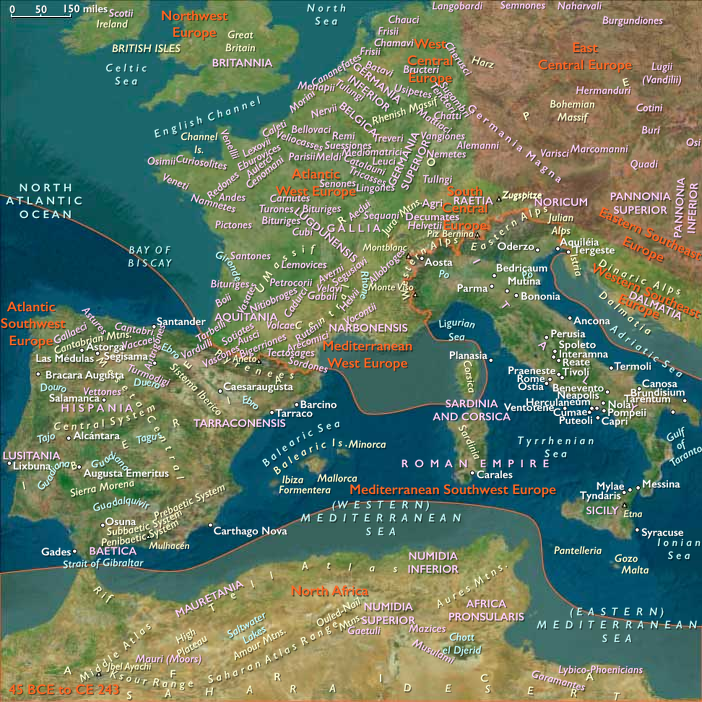
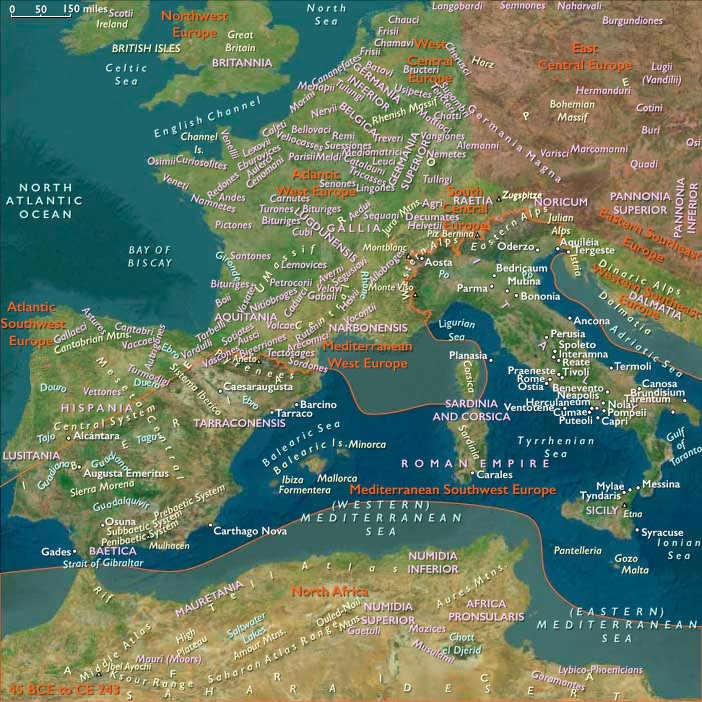
Antyllus, a Greek surgeon living in Rome, describes the types of aneurysms and creates a taxonomy related to the lesions' potential for rupture.
He develops specific instructions for a number of operations, also listing the indications and contraindications and describing the complications that could arise from the operations.
His operation for aneurysm will remain the standard procedure until the nineteenth century.
Locations
People
Groups
Topics
Subjects
Regions
Subregions
Related Events
Filter results
Showing 10 events out of 61095 total
Herodes Atticus, a fabulously wealthy financier and landowner from Athens, who rises to be consul of Rome in CE 143 (and whose bequests still adorn his home city), is one example of the new Romanized Greek citizens.
Quintus Lollius Urbicus, governor of Roman Britain between 139 and 142, has ordered garrisons from the three legions stationed in Britain to move one hundred miles (one hundred and sixty kilometers) north of Hadrian’s Wall to strategic positions partially fortified in 80 by governor Agricola.
Along this new frontier the Romans build a thirty-seven-mile- long (fifty-nine kilometer) turf wall—called the Antonine Wall for the emperor Antoninus Pius—on a low, rubble platform about fourteen feet high (four point two meters) and about thirty-five feet thick (three point six meters), protected by a ditch about thirty-five feet wide (twelve meters) and twelve feet deep (three point six meters).
Crossing the isthmus from the Firth of Forth to the Firth of Clyde, the Antonine Wall, meant to protect the peaceful lowland tribes and provide a reservoir of manpower for conscription, supersedes Hadrian’s Wall.
A military road connects the garrison posts and signal-beacon platforms behind the wall, and forts on either coast protect the flanks.
The Roman poet Juvenal, writing in the early second century, depicts a Roman father urging his son to win glory by destroying the forts of the Brigantes, a British Celtic tribe who live between the rivers Tyne and Humber, and it is possible that one of the purposes of Hadrian's Wall (begun in 122) had been to keep the Brigantes from making discourse with the “Scottish” tribes on the other side.
Antoninus is said by Pausanias to have defeated them after they began an unprovoked war against Roman allies, perhaps as part of the campaign that led to the building of the Antonine Wall.
Emperor Shun is apparently already ill in 144, when he creates his only son Liu Bing, born of his concubine Consort Yu in 143, crown prince.
Virtually nothing is known about his mother, other than that she entered the palace when she was twelve (the year is unknown), and that she was also the mother of Prince Bing's sister Princess Sheng.
Later in the year, Emperor Shun dies, and Crown Prince Bing succeeds him as Emperor Chong.
Empress Dowager Liang serves as regent, and while she personally appears capable, her trust in her brother Liang Ji will lead to a major decline of the Eastern Han Dynasty.
Marcion, a native of Sinope in Pontus and a devoted Christian, had immigrated to Rome around 140 and attached himself to the church there.
Associating in Rome with the Syrian Gnostic, Cerdo, Marcion had developed unorthodox perspectives that soon brought him into conflict with the Roman church.
Arguing that the Christian God of love could not have also been the Creator God of the Old Testament, Marcion had maintained that Judaizing tendencies among the earliest disciples have corrupted the original gospel of Jesus and that the Old Testament holds no validity for Christians.
The only one to have correctly understood the original teachings of Jesus, claims Marcion, was Paul.
Rejecting the gospels of Matthew, Mark, and John, he collects ten of Paul's letters and an edited “Gospel According to Luke,” from which he removes all legalistic and Old Testament references; he claims that these documents constitute the rule or canon of the church's teaching.
The Christian church in Rome, compelled to define what it accepts as the true canon, excommunicates Marcion in about 144 and begins assembling the New Testament canon (the version accepted today, inclusive of all four gospels).
Marcion’s substantial following grows rapidly into a sect, based mainly on the premise that the gospel of Jesus Christ is entirely a gospel of love to the exclusion of the Mosaic Law.
Emperor Shun's wife Empress Dowager Liang serves as regent, as Emperor Chong is an infant.
She apparently is fairly diligent and open-minded in her duties, but her major fault is in trusting her corrupt and violent brother Liang Ji, who is the most powerful official in the administration (the near-absolute power that he wields has become even more evident after Emperor Shun's death.)
When the young and capable official Huangfu Gui submits a report suggesting, in circumspect language, that Liang Ji and his brother Liang Buyi show some humility and live less extravagantly, Liang removes Huangfu from his post, then tries several times to falsely accuse him of capital crimes.
Emperor Chong dies early in 145; he is buried in his father's tomb complex in order to save costs.
Empress Dowager Liang initially intends to keep Emperor Chong's death a secret until she chooses a successor, but Li Gu, a key advisor, persuades her to make a proper public announcement of Emperor Chong's death without delay.
She summons to the capital a pair of candidates: Emperor Chong's third cousins Liu Suan, the Prince of Qinghe, and Liu Zuan, the son of Liu Hong, Prince Xiao of Bohai.
Liu Suan is apparently an adult (his birth year is uncertain) and is described as solemn and proper.
The officials largely favor him.
However, Liang Ji wants a younger emperor so that he can retain absolute control for the longest possible stretch, and so persuades Empress Dowager Liang to elevate the seven-year-old Prince Zuan.
To avoid having a person without an official title becoming emperor directly, he is first created the Marquess of Jianping.
Immediately thereafter on the same day, he ascends the throne as Emperor Zhi.
During Emperor Chong's reign, agrarian revolts, already a problem late in Emperor Shun's reign, had become more serious: bandits even pillage the tomb of Emperor Shun.
Empress Dowager Liang serves as Emperor Zhi's regent, and while she continues to misplace trust in her brother Liang Ji, she herself is diligent and interested in good governance, entrusting much of the important matters to Li Gu, an honest official.
The agrarian rebellions that began during the reign of Emperors Shun and Chong are largely quelled in 145, after she appoints the appropriate generals to lead the Han armies.
She also encourages young scholars from all over the empire to come to the capital Luoyang to study at the Imperial Academy.

Emperor Zhi, as young as he is, is keenly aware of how much Liang Ji is abusing power (but befitting of a young child, not aware of how Liang Ji also has the power to do him harm), and on one occasion, at an imperial gathering, he blinks at Liang Ji and refers to him as "an arrogant general."
Liang Ji becomes angry and concerned.
In the summer of 146, he poisons a bowl of pastry soup and has it given to the emperor.
After the young emperor consumes the soup, he quickly experiences great pain; he summons Li immediately and also requests water, believing that water will save him.
However, Liang immediately orders that the emperor not be given any water, and (regardless of whether water would have helped), the young emperor quickly expires.
Li advocates a full investigation, but Liang is able to have the investigation efforts quashed.
After Emperor Zhi's death, Liang Ji, under pressure by the key officials, is forced to summon a meeting of the officials to decide whom to enthrone as the new emperor.
The officials are again largely in favor of Prince Suan, but Liang Ji remains concerned about how the difficulty of controlling an adult emperor, and instead persuades Empress Dowager Liang to make the fourteen-year-old Liu Zhi, the Marquess of Liwu, a great-grandson of Emperor Zhang, to whom Liang Ji's younger sister Liang Nüying is betrothed, emperor (as Emperor Huan).
In addition to his effective governance, Antoninus bestows upon Italy a grand array of public buildings in the traditional style, constructing temples, theaters, and mausoleums, promoting the arts and sciences, and bestowing honors and salaries upon the teachers of rhetoric and philosophy.
Marcus Aurelius, given the powers of an imperial heir in 146 and schooled by the best tutors in Rome and Athens, becomes a devotee of Greek learning; he abandons rhetoric philosophy for the Stoicist doctrine.
Empress Dowager Liang continues to serve as regent after Emperor Huan's ascension at age fourteen.
However, her brother Liang Ji is increasingly in complete control, even over the empress dowager.
Emperor Huan posthumously honors his grandfather and father as emperors, but because the empress dowager is regent, does not honor his mother Yan Ming as an empress dowager; rather, she is given the title of an imperial consort. (His father's wife Lady Ma will be belatedly honored as an imperial consort as well in 148.)
In 147, he marries Liang Nüying, the sister of Empress Dowager Liang and Liang Ji, and creates her empress.
It appears that while the Liangs are in control, Emperor Huan is not a complete puppet—but instead, in a portent of things to come, trusts court eunuchs in his decision-making.
In 147 as well, Liang Ji, in conjunction with the eunuchs Tang Heng and Zuo Guan, but with Emperor Huan's clear approval, falsely accuses the honest officials Li Gu and Du Qiao of conspiring to overthrow Emperor Huan and replace him with Prince Suan.
Li and Du are executed, while Prince Suan is demoted to marquess status and commits suicide.
The legitimate successors of Pacorus II: Osroes I (105–116 and 117–129), Parthamaspates (116–117), and Mithridates IV (129–140), who ruled Mesopotamia, had been preoccupied by conflicts with the Romans, particularly the invasion by Roman emperor Trajan (98–117), and thus were unable to effectively challenge Vologases III.
Following the death of Osroes I, Vologases III had extended his rule through most of Parthia but had to contend with Mithridates IV, incursions of the nomadic Alans into Cappadocia, Armenia, and Media, and rebellion in Iran by an unknown usurper around 140.
The Parthian realm is finally reunited after Vologases III's death in 147 by Vologases IV (147–191), the son of his rival Mithridates IV.
Vologases III's Armenian kingship had been given to Sohaemus in 144, for unknown reasons.
Arrian, had retired on the death of his patron, the Emperor Hadrian, in 138 to Athens, where he has become a citizen and a member of the Boule (Council).
He holds the post of Archon in 145, once the city's leading political post but by this time an honorary one.
It is here that he has devoted himself to history, writing his most important work, the Anabasis Alexandri or The Campaigns of Alexander, basing the biography on the writings of Alexander's generals Ptolemy and Aristobulus.
He also writes the Indica, an account of the voyage by Alexander's fleet from India to the Persian Gulf under Nearchus, and a political history of the Greek world after Alexander, most of which is lost.