
Antonio Vivarini’s son Alvise, a more original …
Years: 1494 - 1494
Antonio Vivarini’s son Alvise, a more original painter than his late father or his uncle Bartolomeo, draws inspiration from Antonello da Messina, whose style is clearly echoed in the crisp modeling and firm outlines of “Christ Blessing,” executed in 1494.
The works of Vivarini show an advance on those of his predecessors, and some of them are productions of high attainment; one of the best was executed for the Scuola di San Girolamo in Venice, representing the saint caressing his lion, and some monks decamping in terror.
The architecture and perspective in this work are superior.
Many churches in Venice have examples.
Other works by Vivarini are in Treviso, Milan and the National Gallery, London.
He paints some remarkable portraits.
The Adoration of Christ dated 1476, in the sacristy of the church of Montefiorentino, is one of his early productions.
In 1480 he had painted a Virgin and Saints for San Francesco, Treviso, now in the Venice Accademia.
To about this date belong the SS.
Matthew and John the Baptist, in the same collection; and the fresco of Christ Carrying His Cross in Santi Giovanni e Paolo.
In 1488, Alvise Vivarini had written a letter to the Signory of Venice, requesting permission to share with Bellini in the commission to decorate the Hall of Great Council in the Doge's Palace.
To this he received a favorable reply, and thereupon executed two paintings, which were burned in the fire of 1577.
The subjects, Vasari tells us, were Otho promising to mediate between Venice and Barbarossa and Barbarossa receiving his Son.
The Council were so pleased with the pictures that, in 1492, Alvise was named Depentor in Gran Conseio, with a salary of five ducats a month.
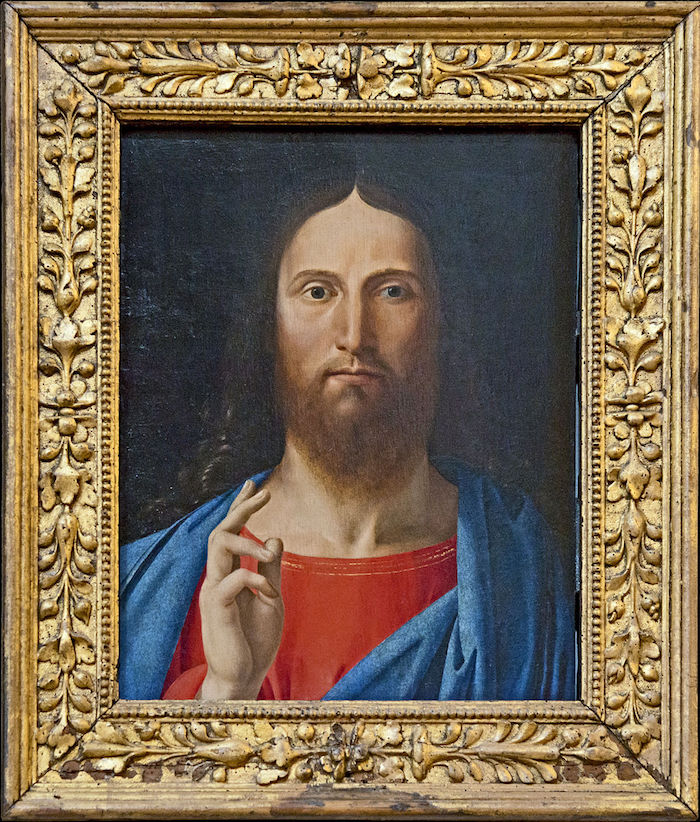
Alvise Vivarini: Christ Blessing (Cristo Benedicente) (1494; San Giovanni in Bragora)
Locations
People
Groups
Topics
Subjects
Regions
Subregions
Years: 1494 - 1494
Alvise Vivarini: Christ Blessing (Cristo Benedicente) (1494; San Giovanni in Bragora)
Locations
People
Groups
Topics
Subjects
Regions
Subregions