Antiochus safeguards his access to Egypt with …
Years: 169BCE - 169BCE
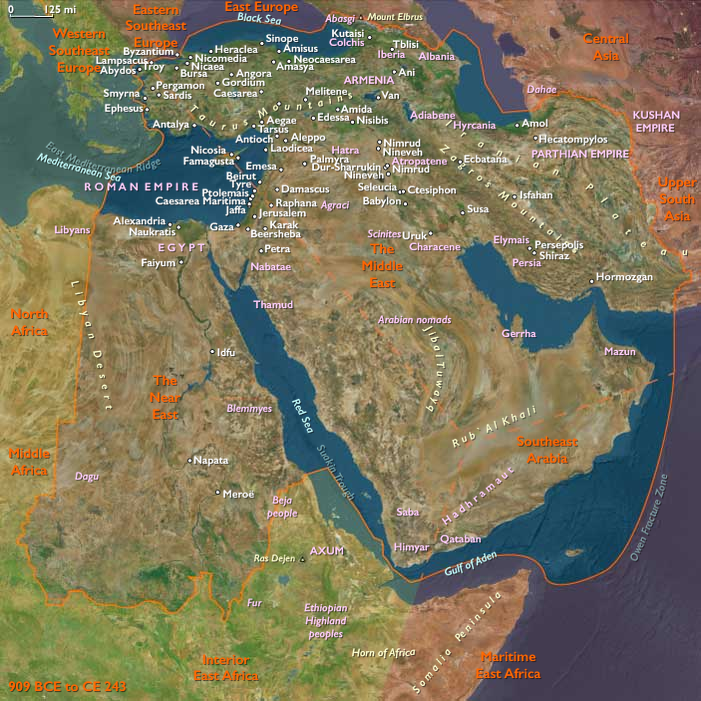
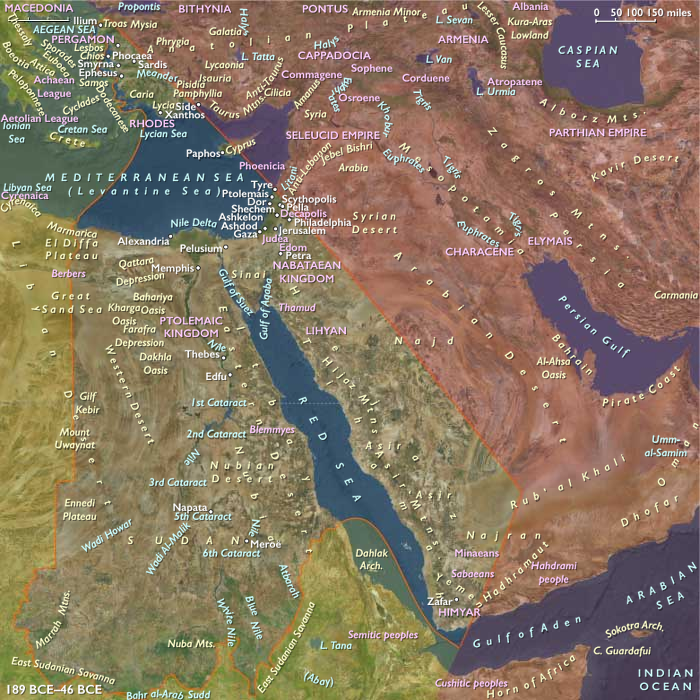
Antiochus safeguards his access to Egypt with a strong garrison in Pelusium.
Locations
People
Groups
Topics
Commodoties
Subjects
Regions
Subregions
Related Events
Filter results
Showing 10 events out of 63255 total
The Egyptians realize their folly in starting the war, Eulaeus and Lenaeus are overthrown and replaced by two new regents, Comanus and Cineas, and envoys are sent to negotiate a peace treaty with Antiochus.
Antiochus takes Ptolemy VI (who is his nephew) under his guardianship, giving him effective control of Egypt.
Antiochus thus gives Rome no excuse for intervention.
This arrangement is, however, unacceptable to the people of Alexandria, who respond by proclaiming Ptolemy Physcon as sole king.
Antiochus besieges Alexandria but he is unable to cut communications to the city.
As he needs also to deal with the civil war in Judaea so, he withdraws his army at the end of 169.
In his absence, Ptolemy VI and his brother are reconciled.
Syrian military operations do not begin until 169 BCE, when Antiochus defeats the Egyptians between the important strategic frontier city of Pelusium and Mount Kasion, seizing Pelusium and occupying Egypt with the exception of Alexandria, the capital.
Antiochus' ouster of Jason has meanwhile occasioned a civil war in the Jewish temple-state, with the wealthy aristocrats supporting Menelaus and the masses, Jason.
While Antiochus is campaigning in Egypt, a rumor spreads that he had been killed.
The deposed High Priest gathers a force of one thousand soldiers and makes a surprise attack on Jerusalem.
Jason conquers Jerusalem, with the exception of the citadel, and murders many adherents of his rival, Menelaus, who is forced to flee the city.
There is a stalemate near Phalanna involving Perseus and Crassus.
Consul Quintus Marcius Philippus in 169 BCE crosses the Olympus Range and enters Macedon.
His army runs out of provisions, however, and retires on a narrow strip of coast near Tempe.
The Romans had at first won a number of small victories, largely due to Perseus' refusal to consolidate his armies.
By the end of the year, the tide has changed dramatically and Perseus has regained most of his losses, including the important religious city of Dion.
Perseus then establishes himself in northeastern Greece on the river Elpeus in an unassailable position.
He tries but fails to win the support of Eumenes of Pergamon.
He does, however, succeed in the autumn of 169 BCE in buying the support of the Illyrian king Genthius.
Perseus in the winter of 169/168 vainly begs Antiochus IV of the Seleucid Empire over to his side to join forces with him against the danger that Rome presents to all of the Hellenistic monarchs.
Aquileia is connected by road with Bologna probably in 173 BCE.
Fifteen hundred more Latin colonists with their families are settled in the town in 169 BCE as a reinforcement to the garrison.
Marcus Porcius Cato, commonly known as Cato the Elder, stimulates Roman rhetoric by publishing his own speeches.
A supporter of traditional Roman ways, Cato patronizes the poet Quintus Ennius, having brought the southern Italian native to Rome from Sardinia.
Ennius, whose eighteen-book epic historical poem, the Annales, glorifies the Roman state from its origins to his own time, writes in an astonishing variety of genres—comedy, tragedy, philosophy, satire, and even a work on food entitled The Delicatessen.
Annales is the first Latin poem to adopt the dactylic hexameter meter used in Greek epic and didactic poetry, leading it to become the standard meter for these genres in Latin poetry.
The Annals become a school text for Roman schoolchildren, eventually supplanted by Virgil's Aeneid.
About six hundred lines survive.
Held by some to be the father of Roman literature, Ennius dies in 169.
Cato’s highly original Origines ("Origins"), a historical work, is the first prose history in Latin, and among the very first Latin prose works in any genre.
At the time Cato publishes Origines, there were two existing historical works in Latin, by Naevius and Ennius, but they are in verse, not prose.
There are two existing prose histories by Romans, Q. Fabius Pictor and Lucius Cincius Alimentus, but they are written in Greek.
All four of these existing works focus on Rome throughout; moreover, the two poems weave Roman history inextricably into the adventures of the Graeco-Roman gods.
Cato evidently chose to do it differently in Origines, which no longer survives as a complete text, but substantial fragments are known because they were quoted by later Latin authors.)
According to Cato's biographer Cornelius Nepos, the Origines consisted of "seven books.
Book I is the history of the early kings of Rome; books II and III the beginnings of each Italian city.
This seems to be why the whole work is called Origines."
The city histories in books II and III of the work were apparently treated on an individual basis, drawing on their own local traditions.
The last four books dealt with Rome's later wars and the growth in the city's power; they "outweighed the rest", according to one later reader.
With this work, along with those by Livius Andronicus, Naevius, Ennius and Plautus, Cato helps to found a new literature.

The ancient country of Lycia (Lycian chieftains Glaucus and Sarpedon figure in Homer's Iliad as allies of Troy in the Trojan War) occupies a mountainous promontory on the Mediterranean coast of southwestern Anatolia.
Having by 240 BCE become part of the Ptolemaic Kingdom, Lycia remained in their control through 200 BCE, and had apparently come under Seleucid control by 190 BCE, when the Seleucids' defeat in the Battle of Magnesia resulted in Lycia being awarded to Rhodes in the Peace of Apamea in 188 BCE.
The Lycian League (Lukiakou systema in Strabo's Greek, transliterated, a "standing together") is first known from two inscriptions of the early second century BCE in which it honors two citizens. T. Bryce ("Bryce, T.; Zahle, J. [1986]. The Lycians. 1. Copenhagen: Museum Tusculanum Press) hypothesizes that it was formed as an agent to persuade Rome to rescind the annexation of Lycia to Rhodes.
A fragment from Livy records a "pitiful embassy" in 178 BCE from Lycia to the Roman Senate complaining that the Lycians were being treated as slaves.
Whipping had been instituted as corporeal punishment and the women and children were being abused.
The Romans sent back a stern warning with the Lycians to Rhodes saying that they had not intended the Lycians or any other people born in freedom to be enslaved by Rhodes, and that the assignment was only a protectorate.
A fragment from Polybius tells a slightly different version of the story, which has the Romans sending legates to Rhodes to say that "the Lycians had not been handed over to Rhodes as a gift, but to be treated like friends and allies."
The Rhodians sent an embassy in return claiming that the Lycians had made the story up for reasons of their own and that in fact they were a financial burden on Rhodes.
The continuation of the story has not survived, but in 168 BCE, Rome takes Lycia away from Rhodes and turns over home rule to the League.
There is no question of independence.
Lycia is not to be sovereign, only self-governing under democratic principles.
It can neither negotiate with foreign powers nor disobey the Roman Senate.
It is not independent.
It can govern its own people and (for a time) mint its own coins as a right granted by Rome.
It does not determine its own borders.
Land and people can be assigned or taken away by the Senate.
This native government is an early federation with democratic principles; these will later came to the attention of the framers of the United States Constitution, influencing their thoughts.
Antiochus, angered at his loss of control over the Egyptian king, leads a second attack on Egypt in 168 BCE and sends a fleet to capture Cyprus, whose governor surrenders the island to Seleucid control.
Rumors have Eumenes of Pergamon negotiating secretly with the enemy as the Third Macedonian War drags on.
The mere suspicion of disloyalty, whatever the truth of the report, is enough to put Eumenes permanently in the shadow of Rome's displeasure.