
Antiochus IV, having in 173 BCE paid …
Years: 166BCE - 166BCE
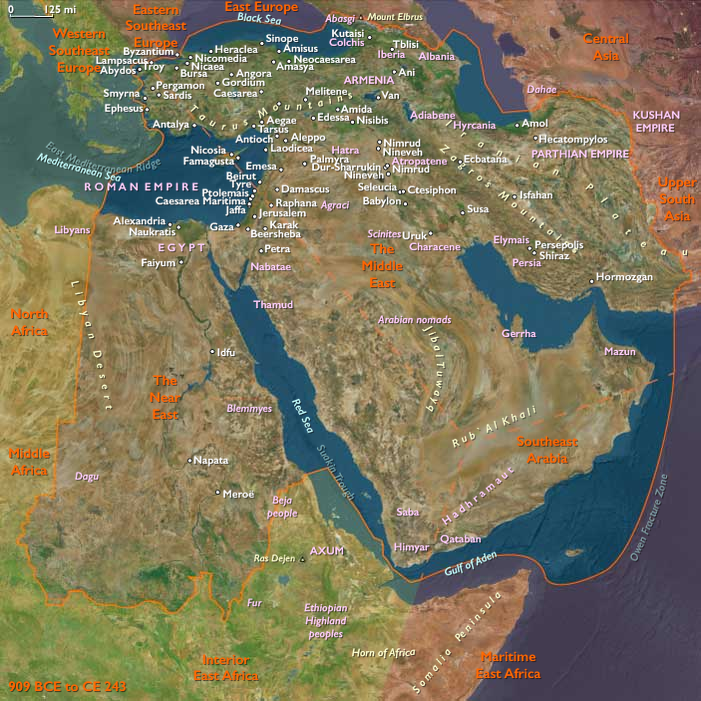
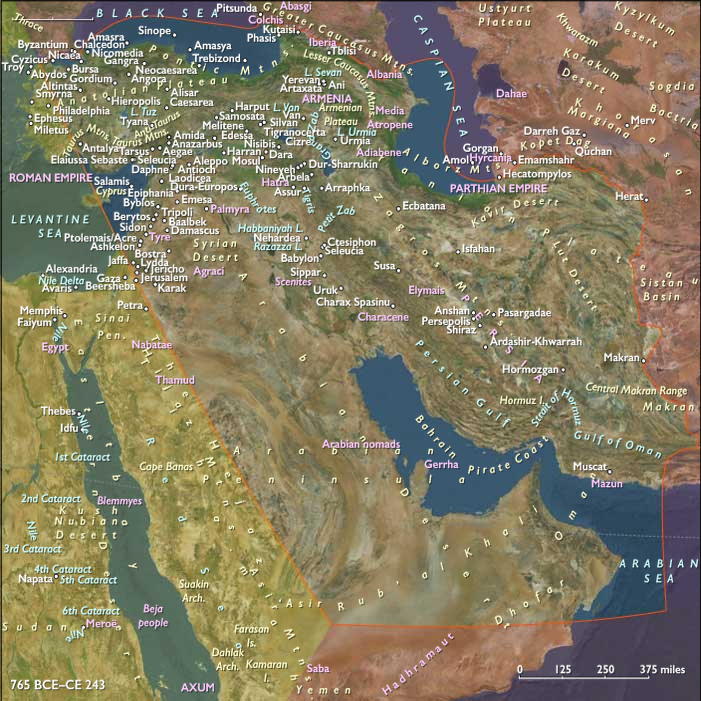
Antiochus IV, having in 173 BCE paid the remainder of the war indemnity that had been imposed by the Romans on his father in 188 at the Treaty of Apamea, demonstrates his might to the world at Daphne, near Antioch, with a grand review of his army.
Forty-six thousand foot soldiers are on parade, among them a Macedonian phalanx of twenty thousand men and five hundred mercenaries equipped with Roman arms, followed by eighty-five hundred horsemen and three hundred and six armored elephants.
Locations
People
Groups
Topics
Commodoties
Subjects
Regions
Subregions
Related Events
Filter results
Showing 10 events out of 63230 total
Antiochus appears to have underestimated the strength of the Hasidean movement, the Seleucid king's military might notwithstanding.
His sense of his own divinity, represented by the title Epiphanes (God Manifest), is unacceptable to the orthodox Jews who recognize the absolute claims of the God of Israel.
Antiochus' promulgation of decrees against the practice of Judaism and the offensive and cruel measures to enforce them lead to the revolt of an old priest, Mattathias, who kills an apostate Jew who is about to offer sacrifice to Zeus on the altar erected by the Seleucid king.
Mattathias, great-great grandson of Hasmon, flees to his home village of Modein with his five sons, and a guerilla war ensues, led by the Hasmonean family.
The strictly observant Hasideans at first refuse to fight on the Sabbath and at once lose a thousand lives.
Mattathias then insists that all groups of resisters should fight if required on the holy sabbath.
The resistance comes from only a section of the population.
The century-and-a-half of Greek rule has Hellenized much of the upper class of Jerusalem, and some of the characteristic features of Greek city life have been established on the initiative of this section of the ruling class, which is able to accept a less radical observance of Judaism and combine it with loyalty to the throne.
The Rebellion of the Seven States or Revolt of the Seven Kingdom takes place in 154 BCE against China's Han Dynasty to resist the emperor's attempt to centralize the government further.
The nomadic tribes of the Yuezhi, according to the Han chronicles, following a crushing defeat in 162 BCE by the Xiongnu (Huns?), flee from the Tarim Basin towards the west, crosses the neighboring urban civilization of the "Dayuan" (probably the Greek possessions in Ferghana), and resettle north of the Oxus in modern-day Kazakhstan and Uzbekistan, in the northern part of the Greco-Bactrian territory.
The Dayuan are to remain a healthy and powerful urban civilization that is to have numerous contacts and exchanges with China from 130 BCE.
The Yuezhi apparently occupy the Greco-Bactrian territory north of the Oxus during the reign of Eucratides, who is busy fighting in India against the Indo-Greeks.
The Middle East: 165–154 BCE
The Maccabean Revolt and the Fragmentation of Seleucid Power
The era from 165 to 154 BCE witnesses profound political and religious upheaval in the Middle East, epitomized by the Maccabean Revolt, a pivotal event highlighting Jewish resistance to Greek cultural hegemony under the Seleucid Empire. Antiochus IV Epiphanes’ aggressive promotion of Hellenism reaches a climax with his desecration of the Temple in Jerusalem, erecting a statue of Zeus there in 167 BCE—an act seen as intolerable sacrilege by the Jewish population.
This incendiary act triggers the uprising in 165 BCE, initiated by Mattathias the Hasmonean, a rural Jewish priest from Modiin. Mattathias vehemently rejects Antiochus' decrees banning traditional Jewish religious practices, notably circumcision and Sabbath observance. When a fellow Jew attempts to sacrifice to a Greek idol under pressure from Seleucid representatives, Mattathias intervenes violently, killing the man. He flees into the wilderness of Judah with his five sons, beginning the armed resistance.
Following Mattathias’ death in 166 BCE, his son Judah Maccabee takes command, adopting guerrilla warfare tactics that prove highly effective against the Seleucid military. Judah’s forces earn the moniker "Maccabees," meaning "hammer," signifying their tenacious resistance and military prowess. The Maccabean campaign initially targets Hellenized Jews, forcibly reinstating Jewish law and religious traditions across rural areas.
In 164 BCE, after a series of successful battles, Judah Maccabee and his forces recapture Jerusalem, ritually cleanse the desecrated Temple, and restore traditional Jewish worship. This momentous event is commemorated by the Jewish festival of Hanukkah. Subsequently, Judah appoints his brother Jonathan Maccabee as high priest, marking a crucial political as well as religious victory.
The Seleucid response is formidable, dispatching a large army under commander Lysias to suppress the revolt. However, internal Seleucid crises following the death of Antiochus IV in 164 BCE distract Lysias, forcing him to negotiate rather than fight prolonged battles. Recognizing the futility of continued conflict, Lysias agrees to a political compromise, restoring religious freedom to the Jews and effectively granting a significant measure of autonomy.
This era further sees the accelerating fragmentation of Seleucid control, exemplified by the loss of strategic territories such as Commagene in Syria and Judea in Palestine. The Maccabean Revolt serves as a catalyst for broader political fragmentation, as local leaders throughout the region increasingly assert independence from Seleucid authority.
Thus, the period from 165 to 154 BCE signifies a pivotal moment in Middle Eastern history, characterized by the rise of Jewish self-governance under the Hasmonean dynasty, the erosion of Seleucid imperial cohesion, and the emergence of new regional powers that will shape the region’s political landscape for decades to come.
Jewish resistance to Greek cultural hegemony peaks during the reign of Antiochus IV (175-164), whose promotion of Hellenism culminates in his raising a statue to Zeus in the temple at Jerusalem.
This act sparks the Maccabean uprising beginning in 165.
The inexorable decline of the Seleucid Empire accelerates after the death of Antiochus IV with the loss of Commagene in Syria and of Judea in Palestine.
In the narrative of I Maccabees, a book written in Hebrew by a Jewish author after the restoration of an independent Jewish kingdom, a rural Jewish priest from Modiin, Mattathias the Hasmonean, sparks a revolt against the Seleucid Empire by refusing to worship the Greek gods after Antiochus IV issues his decrees forbidding Jewish religious practice.
Mattathias kills a Hellenistic Jew who steps forward to offer a sacrifice to an idol in Mattathias' place.
He and his five sons flee to the wilderness of Judah.
After Mattathias' death about one year later in 166 BCE, his son Judah Maccabee leads an army of Jewish dissidents against the Seleucid dynasty in guerrilla warfare, which at first is directed against Hellenized Jews, of whom there are many.
The Maccabees destroy pagan altars in the villages, circumcise boys and force Jews into outlawry.
The term Maccabees as used to describe the Jewish army is taken from the Hebrew word for "hammer".
The revolt itself involves many battles, in which the Maccabean forces gain notoriety among the Seleucid army for their use of guerrilla tactics.
After the victory, the Maccabees enter Jerusalem in triumph and ritually cleanse the Temple, reestablishing traditional Jewish worship there and installing Jonathan Maccabee as high priest.
A large Seleucid army is sent to quash the revolt, but returns to Syria on the death of Antiochus.
Its commander, Lysias, preoccupied with internal Seleucid affairs, agrees to a political compromise that restores religious freedom.
The Brahman-led Hindu reaction has led to the dissolution of the Maurya empire into hundreds of smaller kingdoms together with the Sunga Empire.
Near East (165–154 BCE): The Maccabean Revolt and Seleucid Decline
The era from 165 to 154 BCE in the Near East is marked by heightened Jewish resistance against Greek cultural hegemony under Seleucid rule. The aggressive Hellenization efforts of Seleucid king Antiochus IV Epiphanes, including the erection of a statue to Zeus within the Jerusalem Temple, trigger widespread Jewish unrest. This culminates in the Maccabean Revolt, which begins in earnest in 165 BCE.
The revolt is sparked by Mattathias the Hasmonean, a rural Jewish priest from Modiin, who defies Antiochus IV's decrees forbidding traditional Jewish practices. After Mattathias publicly kills a Hellenistic Jew who attempts to sacrifice to a pagan idol, he flees to the Judean wilderness with his five sons, igniting an armed rebellion. Upon Mattathias' death around 166 BCE, his son Judas Maccabee assumes leadership of the insurgency, leading effective guerrilla campaigns against both Seleucid forces and Hellenized Jews. The name "Maccabees," derived from the Hebrew word for "hammer," aptly symbolizes the fierce and relentless tactics employed by Judas's forces.
Judas Maccabee and his followers achieve significant victories, notably reclaiming and ritually cleansing the Jerusalem Temple, thereby restoring traditional Jewish worship. Jonathan Maccabee is installed as high priest. Although Seleucid commander Lysias attempts to suppress the revolt with a large military force, internal Seleucid political upheaval following Antiochus IV's death ultimately compels him to withdraw and reach a political compromise. This compromise restores religious freedoms to the Jews, marking a significant turning point in Jewish history.
The aftermath of Antiochus IV’s demise accelerates the weakening of the Seleucid Empire, characterized by the loss of regions such as Commagene in Syria and Judea in Palestine. This erosion of Seleucid power significantly reshapes the political landscape of the Near East.
Legacy of the Era
The Maccabean Revolt represents a critical juncture in Jewish history, laying the foundation for Jewish autonomy and cultural resilience against external pressures. The events of this period underscore the declining strength of the Seleucid Empire and the increasingly complex dynamics between Hellenistic rulers and local populations, setting the stage for future developments in the region.
Carneades, a native of Cyrene who heads the New Academy at Athens when antidogmatic skepticism reaches its greatest strength, is attacked by his fellow Greeks for advocating an intellectual Skepticism that, they argue, renders man incapable of any action whatsoever.
Carneades replies that “probability” (“approvability”) is a practical guide for day-to-day living.
Carneades also defends the third-century BCE philosopher Arcesilaus against the Stoics and Epicureans in the controversy over knowledge.
Because no reliable criterion of truth exists, Carneades argues, Arcesilaus had been right to urge the withholding of assent from any experience that claimed to be knowledge. (Carneades leaves no writings; his teachings will be preserved by Cleitomachus.)
Mediterranean Southwest Europe (165–154 BCE): Lusitanian Uprising and Roman Response
The era 165–154 BCE witnesses escalating conflicts in Iberia as Rome struggles to assert its authority over fiercely independent indigenous peoples, particularly the Lusitanians. The Roman Republic, consolidating its power in other Mediterranean territories, faces significant resistance that shapes its policies and strategies in the Iberian Peninsula.
Lusitanian Resistance Intensifies
Around 155 BCE, the Lusitanian tribes, inhabiting parts of what is now southern and western Portugal and western Spain, significantly challenge Roman rule. Under leaders like Punicus, the Lusitanians begin conducting raids into Roman-controlled territories, displaying formidable guerilla tactics and fierce resilience. This marks the beginning of a sustained Lusitanian resistance against Roman encroachment, highlighting the challenges Rome encounters in subjugating Iberia’s indigenous populations.
Roman Military and Diplomatic Efforts
In response to the Lusitanian uprisings, Rome intensifies military operations throughout Hispania Ulterior, attempting to suppress the rebellion through both direct confrontation and strategic diplomacy. Roman commanders engage in punitive expeditions aimed at breaking Lusitanian morale, but these actions instead exacerbate hostilities and increase resentment toward Roman governance.
Cultural Integration and Administrative Expansion
Despite military setbacks, Rome continues efforts to consolidate administrative control and cultural integration within Mediterranean Southwest Europe. Roman policies aim to extend Roman law and administrative norms throughout Iberia and the Western Mediterranean islands. This era sees continued Roman infrastructure improvements, including roads and fortified settlements, which facilitate military logistics and foster economic integration.
Broader Mediterranean Context
Meanwhile, Rome continues to solidify its influence in other regions, notably southern Italy, Sicily, and Sardinia, where Roman governance becomes increasingly entrenched. Greek influence, combined with Roman administration, further enriches the emerging Greco-Roman cultural synthesis that defines this historical period.
Long-term Significance
The era 165–154 BCE is marked by Rome’s ongoing struggle to manage peripheral resistance while expanding and solidifying its authority. The persistent Lusitanian rebellion foreshadows future conflicts and resistance movements, particularly the notable rise of Viriathus. The challenges Rome faces in this period underscore the complexities involved in governing diverse and resilient populations, laying critical groundwork for its imperial governance strategies across Mediterranean Southwest Europe.
North Africa (165–154 BCE)
Sustained Economic Growth, Diplomatic Prudence, and Cultural Flourishing
Carthaginian Economic Consolidation and Diplomatic Stability
From 165 to 154 BCE, Carthage further solidifies its economic resurgence, continuing strategic investments in agriculture and regional commerce. Increased productivity in fertile hinterlands and sustained activity in critical trade centers such as Leptis and Oea (modern Tripoli) underpin Carthage’s renewed economic strength.
Diplomatically, Carthage maintains cautious and balanced relations with Rome and neighboring Mediterranean powers, prioritizing regional stability and economic continuity. This prudent diplomatic stance prevents new conflicts and allows Carthage to steadily strengthen its internal and external positions.
Cyrenaica’s Continued Economic Prosperity and Cultural Prominence
Under continued Ptolemaic oversight, Cyrenaica sustains its economic prosperity through ongoing trade in grain, wine, wool, livestock, and particularly the valuable medicinal plant Silphium. The Greek Pentapolis—Cyrene, Barce (Al Marj), Euhesperides (Benghazi), Teuchira (Tukrah), and Apollonia (Susah)—maintains political autonomy and consistent economic growth.
In 155 BCE, Ptolemy VIII Euergetes travels to Rome to seek support for acquiring Cyprus, bequeathing the kingdom of Cyrene to Rome should he die prematurely. Although initially supported by the Roman Senate, his brother, Ptolemy VI Philometor, effectively employs diplomacy to delay Roman intervention. In 154 BCE, Philometor successfully defeats his brother's military attempt to seize Cyprus. Nevertheless, Philometor generously restores Euergetes to rule in Cyrenaica, arranges his marriage to a daughter, and grants him a grain subsidy. The Roman statesman Cato the Elder praises Philometor’s wise and beneficent rule, further stabilizing the Hellenistic Egyptian kingdom.
Cyrene remains a major cultural and intellectual center, attracting scholars and philosophers drawn to its renowned academies, medical schools, and architectural splendor. This ongoing intellectual and cultural vibrancy reinforces Cyrenaica’s distinguished role in the Hellenistic world.
Masinissa’s Succession and Numidian Stability
In 165–154 BCE, Numidia remains stable and prosperous under Masinissa, who successfully manages diplomatic and economic ties until his death in 148 BCE. Succession sees his son, Micipsa, continue his policies of cautious diplomacy and economic development.
Berber Economic Integration and Cultural Stability
Berber communities continue their active engagement with regional economies, substantially contributing to trade, agriculture, and artisanal industries. Prosperous coastal economic hubs, notably Oea (Tripoli), deepen their role in regional trade networks, enhancing economic connectivity between coastal and inland Berber populations.
Inland Berber tribes uphold their autonomy and traditional governance structures, indirectly benefiting from coastal prosperity. This interdependence sustains regional stability, economic resilience, and cultural continuity.
Cultural Exchange and Religious Syncretism
The dynamic interactions among Berber, Carthaginian, and Greek communities continue enriching local artistic and artisanal traditions, particularly in pottery, textiles, and metalwork. Religious syncretism thrives, seamlessly merging indigenous Berber beliefs with Phoenician and Greek religious practices, further enriching North Africa’s cultural diversity and complexity.
Robust Foundations for Regional Stability
By 154 BCE, North Africa firmly establishes itself on a trajectory of sustained economic prosperity, diplomatic prudence, and cultural integration. Carthage’s economic consolidation and diplomatic care, Cyrenaica’s cultural prominence, and Berber communities’ enduring stability collectively ensure regional coherence and ongoing prominence within the broader Mediterranean geopolitical framework.
Years: 166BCE - 166BCE
Locations
People
Groups
Topics
Commodoties
Subjects
Regions
Subregions