The late Nikephoros, deposed as patriarch of …
Years: 847 - 847
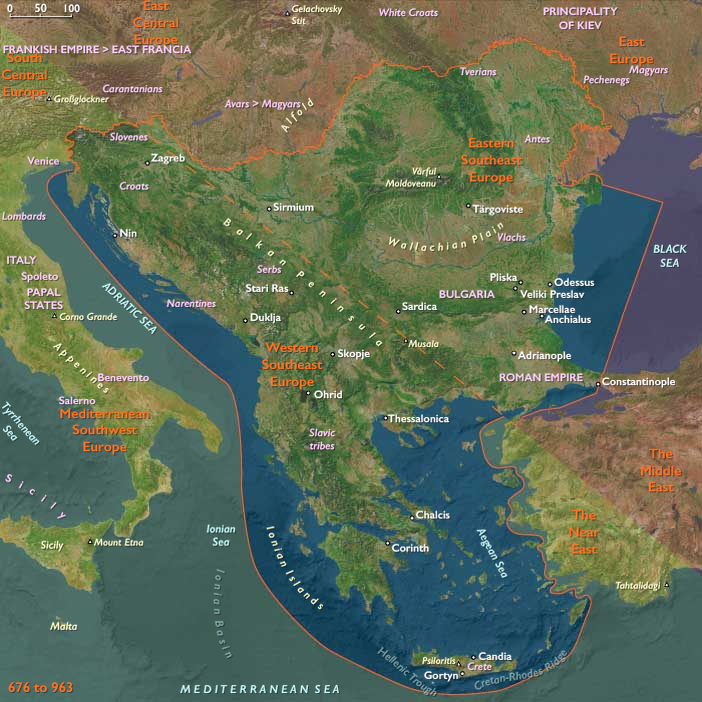
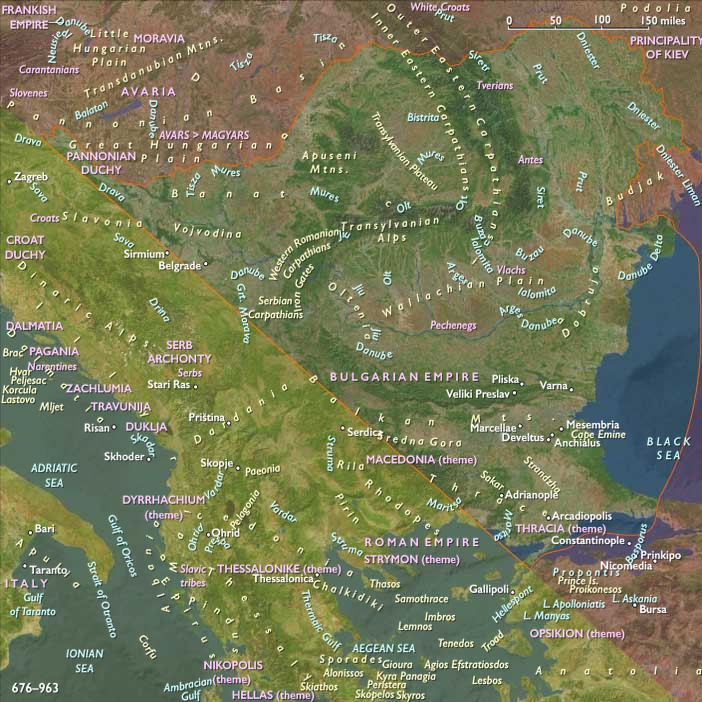
The late Nikephoros, deposed as patriarch of Constantinople for his anti-iconoclast position, is canonized in 847.
Locations
People
Groups
- Christianity, Chalcedonian
- Greeks, Medieval (Byzantines)
- Roman Empire, Eastern: Phrygian or Armorian dynasty
Subjects
Regions
Subregions
Related Events
Filter results
Showing 10 events out of 54167 total
The process of Islamization gains added momentum under the 'Abbasids as a result of further restrictions imposed on non-Muslims, particularly by al Mutawakkil, who, when he succeeds al-Wathiq as caliph in 847, reverts to a position of Islamic orthodoxy and begins a persecution of all non-orthodox or non-Muslim groups.
Synagogues and churches in Baghdad are torn down or converted into mosques, while ...
...in Karbala', the shrine of al-Husayn ibn 'Ali, the first saint of the Shi'a Muslims, is razed, and further pilgrimages to the town are forbidden.
Sergius dies in January 847 while negotiating between two patriarchs.
The cardinal of Santi Quattro Coronati, Roman by birth, a former subdeacon of Gregory IV and archpriest under Sergius, is unanimously chosen as his successor, elected on April 10, 847.
The pontificate of Leo IV will chiefly be distinguished by his efforts to repair the damage done by the Saracens during the reign of his predecessor to various churches of the city, especially those of St Peter and St Paul.
The Spanish Muslim pirates called Saracens set up small Muslim states on Italy’s southern coast at Taranto and Bari, using these as bases from which to ravage the Adriatic and Tyrrhenian seacoasts, often raiding inland.
Kalfun, of Berber descent, hails from the Aghlabid emirate in North Africa; a former servant, and possibly formerly enslaved, he had been part of the mercenary garrison installed in Bari, by Radelchis I of Benevento, In 847, Kalfun captures the formerly imperial city of Bari and sets himself up as the emir in this city, hereby founding the Emirate of Bari, which will last until 871.
Rabanus Maurus is again constrained to enter public life by his election in 847 to succeed Otgar in the archbishopric of Mainz, where he will write a number of works including “De arte grammatica,” “De institutione clericorum,” and biblical commentaries and poetry.
Nominoe’s Wars Against the Vikings and Raids into Neustria (844–847)
According to the Annales Bertiniani, Nominoe, ruler of Brittany, wages war against the Vikings in 844 and 847, demonstrating his commitment to defending Breton territory against Norse incursions. At the same time, however, he continues his campaigns against West Francia, launching further raids into Neustria, particularly near Bayeux in late December 846.
Nominoe’s Dual Wars: Against Vikings and Franks
- In 844, Nominoe fights the Vikings, likely attempting to secure Brittany’s coastline against Norse raids.
- By late 846, his Breton forces raid Neustria, particularly near Bayeux, extending their influence into Carolingian lands.
- This suggests that while Nominoe opposes Viking raids, he simultaneously seeks to expand Breton autonomy at the expense of Charles the Bald.
Possible Instigation by Lothair I
- The raids near Bayeux may have been instigated by Emperor Lothair I, who rivals Charles the Bald for control over Carolingian territories.
- Lothair had previously tried to gain allies among Charles’ enemies, possibly encouraging Nominoe’s continued aggression to weaken his brother.
The Council of Meerssen (February 847)
- In February 847, Charles the Bald meets with his brothers, Lothair I and Louis the German, at Meerssen, seeking a resolution to the ongoing Breton and Aquitanian conflicts.
- The three rulers agree to send orders to Nominoe and Pepin II of Aquitaine, demanding that they cease hostilities against Charles.
- This marks a rare moment of unity among the Carolingian brothers, demonstrating their recognition of Nominoe and Pepin II as significant threats.
The Growing Power of Brittany
- Despite these orders, Nominoe continues to act independently, further solidifying Breton sovereignty.
- His military campaigns against both Vikings and Franks illustrate his ambition to make Brittany not just a vassal duchy, but a fully independent state.
- By resisting Frankish authority, he sets the stage for continued conflicts between Brittany and West Francia throughout the 9th century.
Thus, while the Meerssen agreement in 847 attempts to curb Nominoe’s expansion, it ultimately fails to halt Brittany’s path toward independence, as Nominoe remains defiant against Carolingian rule.
There is little reliable information on the Cholas during the period between the early Cholas and Vijayalaya dynasties, but there is an abundance of materials from diverse sources on the Vijayalaya and the Later Chola dynasties.
A large number of stone inscriptions by the Cholas themselves and by their rival kings, Pandyas and Chalukyas, and copper-plate grants have been instrumental in constructing the history of Cholas of this period.
Muthurajas are Tamil kings who have ruled parts of Thanjavur, Tiruchy, Pudukkottai, Perambalur, Tiruvarur, Nagappattian, Dindikkal, Karur, Sivaganga and Madurai districts of Tamil Nadu from 655.
They are a longtime feudatory to the Pallavas.
Some historians have suggested that Mutharaiyars may have belonged to the Pandya clan while others have associated them with Pallavas.
Vijayalaya, possibly a feudatory of the Pallavas, takes an opportunity arising out of a conflict between Pandyas and Pallavas in about 850, captures Thanjavur from Elango Mutharaiyar, the final ruler of Mutharaiyar dynasty, and establishes the imperial line of the medieval Cholas.
Amalfi, first mentioned in the sixth century, had soon afterwards acquired importance as a maritime power, trading grain from its neighbors, salt from Sardinia and enslaved people from the interior, and even timber, in exchange for the gold dinars minted in Egypt and Syria, in order to buy the East Roman silks that it resells in the West.
Grain-bearing Amalfi traders enjoy privileged positions in the Islamic ports, Fernand Braudel notes.
The Amalfi tables (Tavole amalfitane) provide a maritime code that is widely used by the Christian port cities.
Merchants of Amalfi are using gold coins to purchase land in the ninth century, while most of Italy works in a barter economy.
When Mediterranean trade revives in the eighth and ninth centuries, Amalfi shares with Gaeta the Italian trade with the East, while Venice is in its infancy, and in 848 its fleet goes to the assistance of Pope Leo IV against the Saracens.
The village of Pagan, on the Irrawaddy River in central Burma, is established in 849.
Modern scholarship holds that the Pagan dynasty was founded by the Mranma (Burmans) of the Nanzhao Kingdom in the mid-to-late ninth century CE; that the earlier parts of the chronicle are the histories and legends of the Pyu people, the earliest inhabitants of Burma of whom records are extant; and that Pagan kings had adopted the Pyu histories and legends as their own.
Although the size of the Pyu city-states and the scale of political organization had grown during the seventh to early ninth centuries, no sizable kingdom had yet emerged by the ninth century.
According to a reconstruction by G.H. Luce, the millennium-old Pyu realm came crashing down under repeated attacks by the Nanzhao Kingdom of Yunnan between the 750s and 830s CE.
Like that of the Pyu, the original home of Burmans prior to Yunnan is believed to be present-day Qinghai and Gansu provinces.
After the Nanzhao attacks had greatly weakened the Pyu city-states, large numbers of Burman warriors and their families first enter the Pyu realm in the 830s and 840s, and settle at the confluence of the Irrawaddy and Chindwin rivers, perhaps to help the Nanzhao pacify the surrounding countryside.
Indeed, the naming system of the early Pagan kings—Pyusawhti and his descendants for six generations—is identical to that of the Nanzhao kings where the last name of the father becomes the first name of the son.
The chronicles date these early kings to between the second and fifth centuries CE, scholars to between the eighth and tenth centuries CE. (A minority view, led by Htin Aung, contends that the arrival of Burmans may have been a few centuries earlier, perhaps the early seventh century.
The earliest human settlement at Pagan is radiocarbon dated to about 650 CE, but evidence is inconclusive to prove that it was specifically a Burman (and not just another Pyu) settlement.)

News of a massing of Saracen ships off Sardinia reaches Rome early in 849.
When the Muslims approach Portus, Pope Leo summons the Repubbliche Marinare (or mariner cities of Italy)—Naples, Gaeta and Amalfi—to form a league.
The command of the unified fleet is given to Cesarius, son of Duke Sergius I of Naples.
The Christian armada assembles off recently refortified Ostia, and Pope Leo IV comes out to bless it and offer a mass to the troops.
The subsequent Battle of Ostia is one of the most famous in history of the papacy of the Middle Ages and is celebrated in a famous fresco by Raphael and his pupils in his Rooms of the Vatican Palace in the Vatican City.
After the pirate ships appear, battle is joined with the Neapolitan galleys in the lead.
Midway through the engagement, a storm divides the Muslims and the Christian ships manage to return to port.
The Saracens, however, are scattered far and wide, with many ships lost and others sent ashore.
When the storm dies down, the remnants of the Arab fleet are easily picked off, with many prisoners taken.
In the aftermath of the battle, much booty washes ashore and is pillaged by the locals, per ius naufragii.
The prisoners taken in battle are sent to work in chain gangs building the Leonine Wall which is to encompass the Vatican Hill.
Rome will never again be threatened by a Muslim army.
Years: 847 - 847
Locations
People
Groups
- Christianity, Chalcedonian
- Greeks, Medieval (Byzantines)
- Roman Empire, Eastern: Phrygian or Armorian dynasty