
Anthony Van Dyck’s great success has compelled …
Years: 1636 - 1636
Anthony Van Dyck’s great success has compelled the painter to maintain a large workshop in London, a studio which is to become "virtually a production line for portraits".
According to a visitor to his studio he usually only makes a drawing on paper, which is then enlarged onto canvas by an assistant; he then paints the head himself.
The clothes are left at the studio and often sent out to specialists.
In his last years these studio collaborations will account or some decline in the quality of work.
In addition, many copies untouched by him, or virtually so, are produced by the workshop, as well as by professional copyists and later painters; the number of paintings ascribed to him will by the nineteenth century become huge, as with Rembrandt, Titian and others.
However most of his assistants and copyists cannot approach the refinement of his manner, so compared to many masters consensus among art historians on attributions to him is usually relatively easy to reach, and museum labeling is now mostly updated (country house attributions may be more dubious in some cases).
The relatively few names of his assistants that are known are Dutch or Flemish; he probably prefers to use trained Flemings, as no English equivalent training yet exists.
Van Dyck paints many portraits of men, notably Charles I and himself, with the short, pointed beards in fashion at this time; consequently this particular kind of beard will much later (probably first in America in the nineteenth century) be named a vandyke or Van dyke beard (which is the anglicized version of his name).
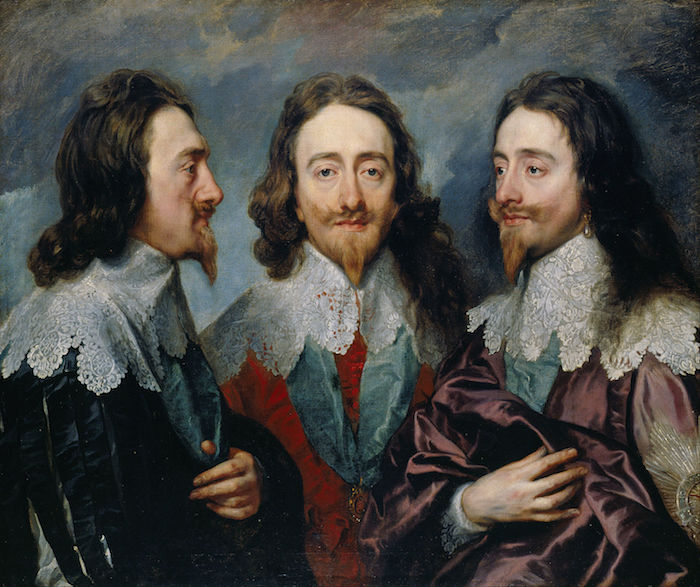
Anthony van Dyck: Triple portrait of King Charles I (1535-36), sent to Rome for Bernini to model a bust. Oil on canvas, 85 × 100 cm, Royal Art Collection, London
Locations
People
Groups
Topics
Subjects
Regions
Subregions
Years: 1636 - 1636
Anthony van Dyck: Triple portrait of King Charles I (1535-36), sent to Rome for Bernini to model a bust. Oil on canvas, 85 × 100 cm, Royal Art Collection, London
Locations
People
Groups
Topics
Subjects
Regions
Subregions