The former emperor Michael Asen II, another …
Years: 1302 - 1302
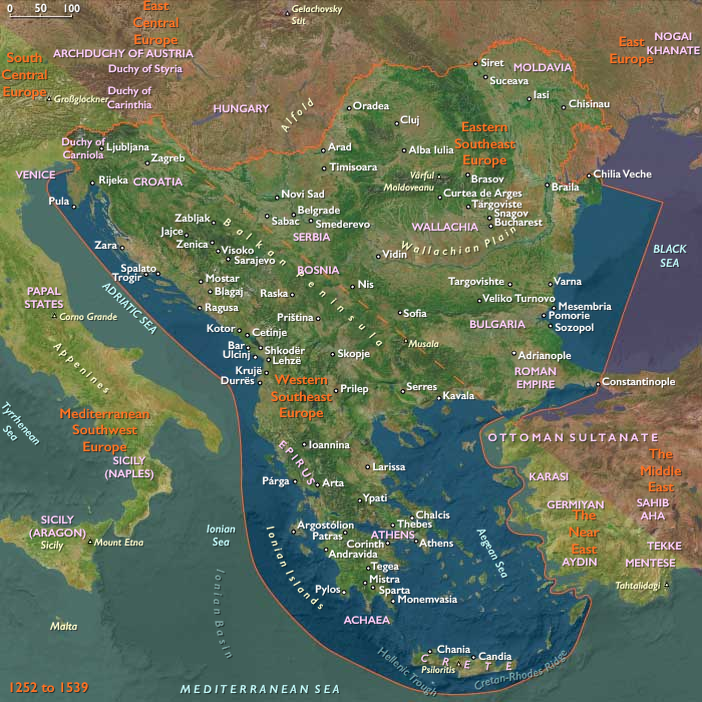
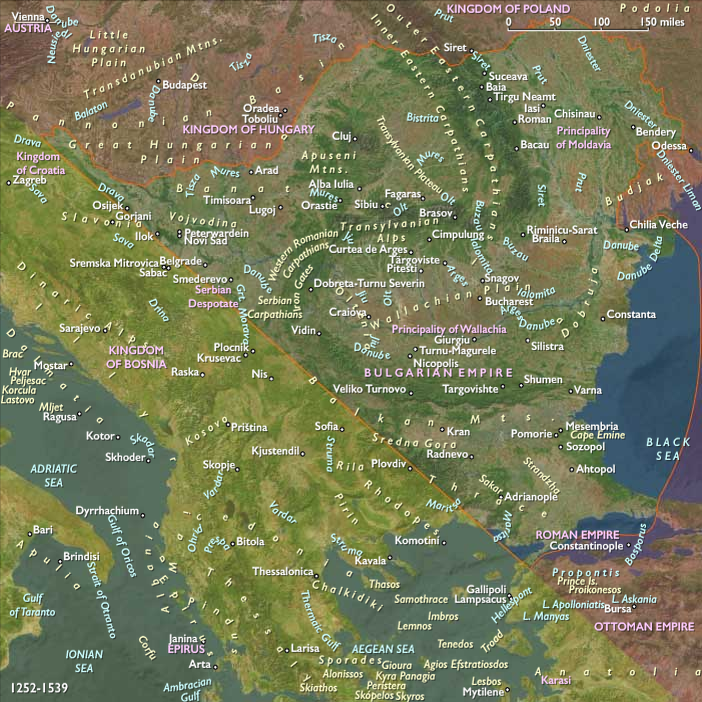
The former emperor Michael Asen II, another pretender to the Bulgarian throne, tries unsuccessfully to advance into Bulgaria with a Constantinople-backed army in about 1302.
Theodore Svetoslav exchanges thirteen high-ranking imperial officers captured on Radoslav's defeat for his father George Terter I, whom he settles in a life of luxury in an unidentified city.
Locations
People
Groups
- Bulgarian Empire (Second), or Empire of Vlachs and Bulgars
- Roman Empire, Eastern: Palaiologan dynasty
Topics
Commodoties
Subjects
Regions
Subregions
Related Events
Filter results
Showing 10 events out of 45053 total
The Mongol rulers have established peace in Asia by the early 1300s Access to China becomes relatively easy, and China enters another age of cosmopolitanism and broad foreign contact, particularly with the West.
The Mongol Yuan dynasty supports foreign mercantile ventures in China, welcome foreign faiths like Nestorian Christianity and Islam, and patronize Tibetan Buddhism, or Tantrism.
The Mongol rulers also employ numerous foreigners in the state bureaucracy, but systematically discriminate against the native Chinese for government service, saddling them with numerous legal disabilities.
Despite the oppressive nature of Yuan rule, China experiences a flowering of native arts, especially calligraphy and painting produced by the scholar-gentry class, and two literary forms—drama and the novel.
A census in Imperial China finds that it has roughly sixty million inhabitants (having lost twenty million after nearly a century of Mongolian conquests).
The Temple of Confucius at Beijing, the second largest Confucian Temple in China after the one in Confucius' hometown of Qufu, is built in 1302, and imperial officials will use it to pay their respects to Confucius until 1911.
Daniil Aleksandrovich, the youngest son of Alexander Nevsky and forefather of all the Grand Princes of Moscow, had been born in 1261 in Vladimir, the capital of the Great Vladimir principality.
One of the most junior princes in the House of Rurik, Daniel is thought to have been named after his celebrated relative, Daniel of Galicia.
His father died when he was only two years young.
Of his father's patrimonies, he had received the least valuable, Moscow.
When he was a child, the tiny principality was being governed by tiuns (deputies), appointed by his paternal uncle, Grand Prince Yaroslav III.
During the Mongol occupation and internecine wars among the Rus' princes, Daniel has created peace in Moscow without bloodshed, participating in battle only once during thirty years of rule.
(According to legend, Daniel was popular and respected by his subjects for his meekness, humbleness and peacefulness.)
Daniel had taken part in the struggle of his brothers—Dmitri of Pereslavl and Andrey of Gorodets— for the right to govern Vladimir and Novgorod, respectively.
After Dmitry's death in 1294, Daniel had made an alliance with Mikhail of Tver and Ivan of Pereslavl against Andrey of Gorodets of Novgorod.
Daniel's participation in the struggle for Novgorod in 1296 indicates Moscow's increasing political influence.
Constantine, the prince of Ryazan, had decided to capture the Moscow lands with the help of a Mongol force, but Prince Daniel had defeated it near Pereyaslavl.
In 1300, he had imprisoned the ruler of the Ryazan Principality, "by some ruse", as the chronicle says.
To secure his release, the prisoner had ceded to Daniel his fortress of Kolomna.
It is an important acquisition, as now Daniel controls all the length of the Moskva River.
His childless cousin and ally, Ivan of Pereslavl, bequeaths to Daniel all his lands, including Pereslavl-Zalessky, in 1302.
The earliest signs of human settlement at Rakvere, a town in what is today northern Estonia, have been found on the present theater hill, dating back to the third to fifth centurie.
A wooden stronghold had been built on the present Vallimäg, probably to protect that settlement.
When it had changed owners in 1220, the Danes had begun to erect buildings from stone.
A settlement called Tarvanpea was first mentioned in the Chronicle of Henry of Livonia in 1226.
The new Danish stronghold in 1252 was for the first time called Wesenbergh in Middle Low German.
The Battle of Rakovor between the Danish and German knights and Russians had occurred nearby on February 18, 1268.
Rakvere is on June 12, 1302, granted Lübeck rights.
The Lübeck law, which is the constitution of a municipal form of government developed at Lübeck in Schleswig-Holstein after it was made a free city in 1226, provides for self-government.
It had replaced the personal rule of tribal monarchs descending from ancient times or the rule of the regional dukes and kings that had been established by Charlemagne.
Lübeck had set about spreading its form of government to other cities around the Baltic Sea.
(Eventually about 100 will adopt a government based on the law, which today still serves as a foundation for German town laws in many of those cities.)
Charlemagne had held all of his aristocratic vassals personally responsible for the defense, health and welfare of the tribesmen settled on their estates, including the towns.
The Lübeck Law, in theory, makes the cities to which it applies independent of royalty.
Later in the century, cities governed by the Lübeck Law will form into a powerful trade association, the Hanseatic League, which amounts to a confederacy with headquarters at Lübeck.
Eckhart, a Dominican friar sent to study at Paris and Cologne, becomes, in 1294, prior of the Dominican house in Erfurt.
A band of Osman's warriors defeats the imperial army in 1302 near Nicomedia in northwestern Anatolia.
As the Turks encroach on their land, refugees in growing numbers flee to the coast or to Constantinople, bringing new problems for the government.
Imperial attempts to secure Il-Khanid support against the Ottomans from the east are unsuccessful.
Dante is condemned to exile for two years, and ordered to pay a large fine.
The poet is still in Rome, where the Pope had "suggested" he stay, and is therefore considered an absconder.
He does not pay the fine, in part because he believes he is not guilty, and in part because all his assets in Florence have been seized by the Black Guelphs.
He is now condemned to perpetual exile, and if he returns to Florence without paying the fine, he can be burned at the stake. (The city council of Florence will finally pass a motion rescinding Dante's sentence in June 2008.)
Those who are not connected to either side, or who have no connections to either Guelphs or Ghibellines, consider both factions unworthy of support but are still affected by the change of power in their respective cities.
The spread of heretical Christian movements from the twelfth century can be seen at least in part as a reaction to the increasing moral corruption of to the clergy, which included illegal marriages and the possession of wealth.
The Inquisition's main focus in the Middle Ages has been to eradicate these new sects.
Thus its range of action is predominantly set in Italy and France, where such sects had settled.
The two main heretic movements of the period are the Cathars and the Waldensians.
The former are mostly in south of France, in cities like Toulouse.
They appear to have been originally founded by some soldiers from Second Crusade, who, on their way back, had been converted by a Bulgarian sect, the Bogomils.
The Cathars' main heresy is their belief in dualism: the evil God has created the materialistic world and the good God has created the spiritual world.
Therefore, Cathars preach poverty, chastity, modesty and all those values which in their view help people to detach themselves from materialism.
The Waldensians are mostly in Germany and North Italy.
In contrast with the Cathars and in line with the Church, they believe in only one God, but they do not recognize priesthood nor the veneration (not synonymous with worship) of saints and martyrs, which are part of the Church's orthodoxy.
The other two main sects of the period, which preach against the moral corruption of the Church, are the Dominicans and the Franciscans.
However, instead of persecuting them, Pope Innocent III had decided early in the thirteenth century to employ them in the fight against heresy.
As a result, many Franciscans and Dominicans had become inquisitors.
For example, Robert le Bougre, the "Hammer of Heretics" (Malleus Haereticorum), was a Dominican friar who became an inquisitor known for his cruelty and violence.
Another example is the case of the province of Venice, which had been handed to the Franciscan inquisitors, who quickly became notorious for their frauds against the Church, by enriching with confiscated property from the heretics and the selling of absolutions.
Because of their corruption, they are eventually forced by the Pope to suspend their activities in 1302.
The earliest reference to an iron fish-like compass in the Islamic world occurs in a Persian talebook from 1232; the earliest Arabic reference to a compass—in the form of magnetic needle in a bowl of water—comes from the Yemeni sultan and astronomer Al-Ashraf in 1282.
He also appears to be the first to make use of the compass for astronomical purposes.
Since the author describes having witnessed the use of a compass on a ship trip some forty years earlier, some scholars are inclined to antedate its first appearance in the Arab world accordingly.
Another Arabic treatise written in 1300 by the Egyptian astronomer and muezzin Ibn Simʿūn describes a dry compass for use as a "Qibla indicator" to find the direction to Mecca.
Like Peregrinus' compass, however, Ibn Simʿūn's compass did not feature a compass card In the Mediterranean, the introduction of the compass, at first only known as a magnetized pointer floating in a bowl of water, had gone hand in hand with improvements in dead reckoning methods, and the development of Portolan charts, leading to more navigation during winter months in the second half of the thirteenth century.
While the practice from ancient times had been to curtail sea travel between October and April, due in part to the lack of dependable clear skies during the Mediterranean winter, the prolongation of the sailing season has resulted in a gradual, but sustained increase in shipping movement: By around 1290 the sailing season could start in late January or February, and end in December.
The additional few months are of considerable economic importance.
For instance, it enables Venetian convoys to make two round trips a year to the Levant, instead of one.
At the same time, traffic between the Mediterranean and northern Europe has also increased, with first evidence of direct commercial voyages from the Mediterranean into the English Channel coming in the closing decades of the thirteenth century, and one factor may be that the compass made traversal of the Bay of Biscay safer and easier.
The familiar dry compass (commonly called a mariner's compass), invented in Europe around 1300, consists of three elements: A freely pivoting needle on a pin enclosed in a little box with a glass cover and a wind rose, whereby "the wind rose or compass card is attached to a magnetized needle in such a manner that when placed on a pivot in a box fastened in line with the keel of the ship the card would turn as the ship changed direction, indicating always what course the ship was on".
Later, compasses would often be fitted into a gimbal mounting to reduce grounding of the needle or card when used on the pitching and rolling deck of a ship.
While pivoting needles in glass boxes had already been described by the French scholar Peter Peregrinus in 1269, and by the Egyptian scholar Ibn Simʿūn in 1300, there is an inclination to honor tradition and credit Flavio Gioja, an Italian marine pilot from Amalfi who flourishes around 1302, with perfecting the sailor's compass by suspending its needle over a compass card, giving thus the compass its familiar appearance.
The compass, in conjunction with the rudder, is to greatly ease maritime navigation.

The present-day city of Algiers had been founded in 944 by Buluggin ibn Ziri, the founder of the Berber Zirid-Senhaja dynasty, which had been overthrown by Roger II of Sicily in 1148, although the Zirids had already lost control of Algiers before the final fall of the dynasty.
The city had been occupied by the Almohades in 1159, and in the thirteenth century had come under the dominion of the Abd-el-Wadid sultans of Tlemcen.
Nominally part of the sultanate of Tlemcen, Algiers has had a large measure of independence under amirs of its own due to Oran being the chief seaport and center of power of the Abd-el-Wahid.
The islet of Penon in front of Algiers harbor is occupied in 1302 by Spaniards under the flag of Castile.
From this point forward, a considerable amount of trade will begin to flow between Algiers and Spain.
Years: 1302 - 1302
Locations
People
Groups
- Bulgarian Empire (Second), or Empire of Vlachs and Bulgars
- Roman Empire, Eastern: Palaiologan dynasty