Another of the loosely organized Korean tribal …
Years: 37BCE - 37BCE
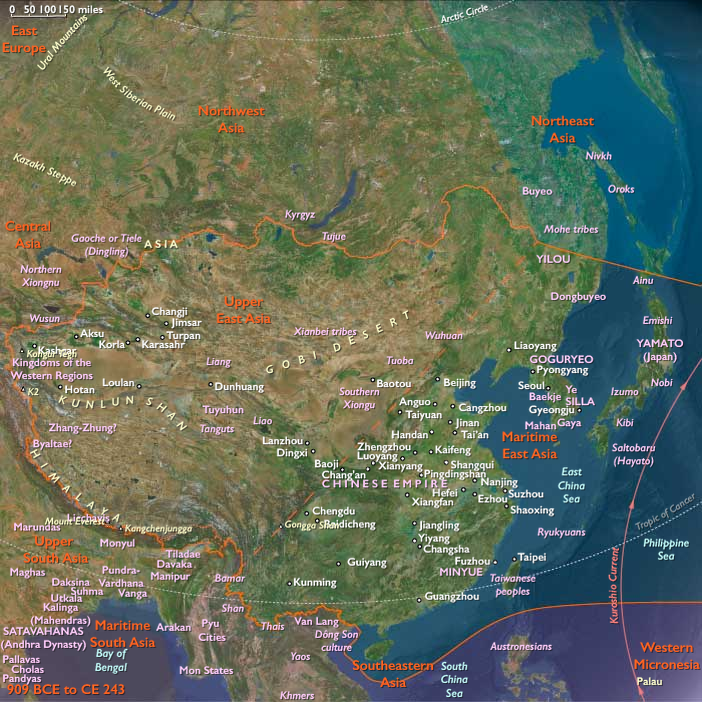
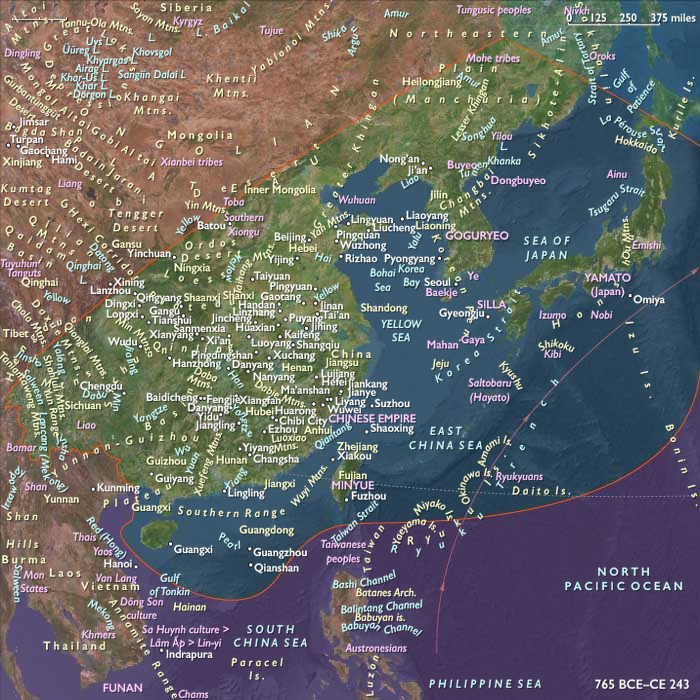
Another of the loosely organized Korean tribal federations emerges, in 37, as the kingdom of Goguryeo, or Koguryo, based in southeast Manchuria in a region called Jolbon Buyeo, usually thought to be located in the middle Yalu and T'ung-chia river basin, overlapping the current China-North Korea border.
The Samguk Sagi, a twelfth century CE Goryeo text, indicates that Goguryeo was founded in 37 BCE by Jumong, a prince from Buyeo, although there is archaeological and textual evidence that suggests Goguryeo culture was in existence since the second century BCE around the fall of Gojoseon, an earlier kingdom that also occupied southern Manchuria and northern Korea.
Locations
Groups
Topics
Subjects
Regions
Subregions
Related Events
Filter results
Showing 10 events out of 62281 total
Jing Fang, a music theorist, mathematician and astrologer born in 78 BCE present-day Puyang, Henan during the Han Dynasty, is most known for being the first to notice how closely a succession of fifty-three just fifths approximates thirty-one octaves.
He came upon this observation after learning to calculate the Pythagorean comma between twelve fifths and seven octaves (this had been published around 122 BCE in the Huainanzi, a book written for the prince of Huainan), and extended this method fivefold to a scale composed of sixty fifths, finding that after fifty-three, new values became incredibly close to tones already calculated.
This value will later be calculated precisely by Nicholas Mercator in the seventeenth century.
Jing Fang is also a proponent of the 'radiating influence' theory in China, which states that the light of the moon is merely the light reflected from the sun, and that the celestial bodies are spherical.
Dismissed by the philosopher Wang Chong (CE 27–97), yet embraced by the mathematician, inventor, and scientist Zhang Heng (CE 78–139), Jing Fang’s theory would eventually be accepted as accurate.
He dies in 37 BCE.
Antony leaves again for the east in 37 BCE and arranges for Cleopatra to join him in Syria.
Henceforward, apart from his absences on land campaigns, they will live together for the remaining seven years of their lives.
Religious propaganda declares Cleopatra the New Isis, or Aphrodite, to his New Dionysus, and it is possible (but unlikely) that they contracted an Egyptian marriage: it would not have been valid in Roman law since Romans could not marry foreigners.
Apart from their undoubted mutual affection, Cleopatra needs Antony in order to revive the old boundaries of the Ptolemaic kingdom.
Although she fails in her efforts to persuade him to give her Herod's Judaea, she does persuade him to give her large portions of Syria and Lebanon and even the rich balsam groves of Jericho in Herod's own kingdom.
Antony, for his part, needs Egypt as a source of supplies and funds for his planned attack on Parthia.
Herod had pitched his camp north of the Temple, near a saddle allowing access to the city walls, the same location chosen by Pompey twenty-six years earlier.
Herod had thirty thousand men under his command according to Josephus, though a modern estimate puts the number at about half of that.
These are reinforced by several Roman legions, six thousand cavalry and Syrian auxiliaries sent by Antony and led by Gaius Sosius.
With the coming of spring, Herod begins executing his siege with vigor.
His engineers follow Roman practices, erecting a wall of circumvallation and guard towers, cutting down the trees surrounding the city, and employing siege engines and artillery.
The besieged suffer from lack of provisions, compounded by a famine brought about by the sabbatical year, but are nevertheless able to put up an effective defense.
They sally from the walls, ambushing the besieging troops and hindering Herod's attempts to raise ramparts, and fight Roman efforts to mine under the walls with countermining.
Herod's forces after forty days breach what Josephus calls "the north wall", apparently Jerusalem's second wall.
The first wall falls fifteen days later, and soon the outer court of the Temple falls also, during which its outer porticoes are burnt down, apparently by Antigonus' supporters.
While Antigonus shuts himself up in citadel known as the Baris, the defenders are left holding the Temple's inner court and Jerusalem's upper city (southwestern quarter of the city).
These now appeal to Herod to permit the passage of animals and other offerings into the temple for the sacrifices to continue.
Antigonus during the siege has used Herod's lack of pedigree as propaganda, calling him a "commoner and an Idumaean, that is a half-Jew", publicly questioning Herod's right to the throne.
Herod, fearful for his legitimacy and popularity, therefore complies with the requests.
Further negotiations prove fruitless, however, and Herod's forces assault the city.
The Herodian troops, having taken Jerusalem by storm and despite Herod's pleas for restraint, now act without mercy, pillaging and killing all in their path, prompting Herod to complain to Mark Antony.
Herod also attempts to prevent Roman soldiers from descecrating the temple's inner sanctuary, eventually bribing Sosius and his troops in order that they do not leave him "king of a desert".
Herod's conquest of the kingdom is complete in 37 BCE with the fall of Jerusalem.
Antigonus surrenders to Sosius, and is sent to Antony for the triumphal procession in Rome.
Herod, fearing that Antigonus will also win backing in Rome, bribes Antony to execute Antigonus.
Antony, who recognizes that Antigonus will remain a permanent threat to Herod, has the Hasmonean beheaded in Antioch, the first time the Romans have executed a subjugated king.
Herod also has forty-five leading men of Antigonus' party executed.
Reestablishing himself at Jerusalem, Herod assumes the sole rulership of Judea and takes for himself the title of basileus, ushering in the Herodian Dynasty and ending the Hasmonean Dynasty.
Herod is of Edomite descent, though of Jewish faith, and is allied through his mother with the nobility of Nabataean Petra, the rich Arab state that lies to the east of the Jordan River.
His accession averts a clash with Jewish nationalism and brings to Palestine the peace that in the years of independence it has often lacked.
He marries at about the same time a teenaged niece of Antigonus, Mariamne, to whom he has been betrothed for two years, thus probably consoling those who remain loyal to the memory of the nearly defunct Hasmonean house while helping to secure him a claim to the throne and gaining some Jewish favor.
Inconveniently, Herod already has a wife, Doris, and a three-year-old son, Antipater; he therefore chooses to banish Doris and her child.

Antony sends Octavia back to Italy from Corcyra (modern Corfu, or Kérkira).
Agrippa is summoned back to Rome by Octavian to assume the consulship for 37 BCE.
He is well below the usual minimum age of 43, but Octavian has suffered a humiliating naval defeat against Sextus Pompey and needs his friend to oversee the preparations for further warfare.
Agrippa refuses the offer of a triumph for his exploits in Gaul – on the grounds, says Dio, that he thought it improper to celebrate during a time of trouble for Octavian.
Since Sextus has command of the sea on the coasts of Italy, Agrippa's first care is to provide a safe harbor for his ships.
He accomplishes this by cutting through the strips of land which separate the Lacus Lucrinus from the sea, thus forming an outer harbor, while joining the lake Avernu—a crater lake about eight miles (thirteen kilometers) west of Naples and about two miles (more than three kilometers) in circumference and one hundred and eighteen feet (thirty-six meters) deep—to the Lucrinus to serve as an inner harbor.
The new harbor-complex, named Portus Julius in Octavian's honor, is used to train the ships for naval battles.
A new fleet is built, with twenty thousand oarsmen gathered by freeing slaves.
The new ships are built much larger in order to carry many more naval infantry units, which are being trained at the same time.
Furthermore, Antony exchanges twenty thousand infantry for his Parthian campaign with one hundred and twenty ships, under the command of Titus Statilius Taurus.
A tunnel, the Grotta della Sibill, connects the new harbor to …
…Cumae.
Agrippa is also responsible for technological improvements, including larger ships and an improved form of grappling hook.
About this time, he marries Caecilia Pomponia Attica, daughter of Cicero's friend Titus Pomponius Atticus.
The territorial agreement among the triumvirs and Sextus Pompeius had begun to crumble once Octavian divorced Scribonia and married Livia on January 17, 38 BCE.
Octavian and Antony's frequent quarrels are a strong political motivation for resuming the war against Sextus.
One of Sextus' naval commanders betrays him and hands over Corsica and Sardinia to Octavian; however, Octavian needs Antony's support to attack him.
The differences that have arisen between Antony and Octavian are ostensibly settled by the Treaty of Tarentum, which prolongs the triumvirate, in which Lepidus is only formally included, for a further five years.
Under the original deal, Lepidus had received both Hither and Further Spain, along with southern Gaul, as his portion.
He had been consul again in 42, but his two colleagues had soon deprived him of most of his power.
His provinces of Gaul and Spain taken from him, he has been confined to the government of Roman Africa.
The upper stratum of the Xiongnu had been in chaos caused by war after the death in 60 BCE of the former Shanyu, the title used by the rulers of the Xiongnu Luanti clan during the Qin and Han dynasties.
Hutuwusi had in 56 BCE risen against his elder brother Jihoushan or Huhanye Shanyu (the legitimate Shanyu), and the other three Shanyus by proclaiming himself as Zhizhi Guduhou Shanyu (full title) in the east.
Zhizhi Shanyu had won over most of Mongolian steppe by 54 BCE, forcing Huhanye to move south.
Huhanye, with the help of the Han Dynasty, had regained power over Mongolia and Zhizhi had in 44 BCE and fled west to Kangju with an army that numbered three thousand men by the time he arrived.
Kangju, with the help of Zhizhi, staged a successful raid against the rival Wusun tribe.
Zhizhi then compelled Kangju to build a fortress in Talas valley, near modern day Taraz, Kazakhstan, and where he had established his own state "Zhizhi," also known in European historiography as Western Xiongnu.
His conflicts with Eastern Xiongnu eventually lead the Han to launch an an expedition in 42 BCE, after Zhizhi had executed a Chinese emissary, Gu Ji, who had reached his court.
Zhizhi is killed in the Battle of Zhizhi in 36 BCE at Taraz, defending his fortress against the Han expedition led by Gan Yanshou and Chen Tang.
Zhizhi’s head is sent to Chang'an.
This action leads to what will be a half century of peace between the Han Dynasty and the Xiongnu until Wang Mang engages them in the year 10, resuming hostilities between both sides.
Antony, after invading Cilicia and Syria with an army of one hundred thousand legionnaires in 36 BCE, and hoping to further avenge the death of Crassus, launches an invasion of Parthia's ally Media Atropatene (southwest of the Caspian, named Atropatene after one of Alexander's generals, Atropates, who had established a small kingdom there).
Crossing the Armenian mountains in winter without the support of the Armenian king, his supply train is continuously raided by the Parthians, who destroy his siege engines.
Failing in his attempt to capture the Parthian fortress of Praspa, he is forced to retreat with severe losses to his legions.
Artavasdes I, king of Media Atropatene, is the ally of the Parthian king Phraates IV when Antony leads his campaign against Parthia in 36 BCE,
Antony leads his troops from Zeugma northward into Armenia and then invades the domain of Artavasdes I. Antony does not want to attack Parthia from the west, which is the shortest way, but—surprisingly—from the north.
Antony allegedly uses this strategy on the advice of Artavasdes II of Armenia, the enemy of Artavasdes I.
Antony moves with his army in fast marches to Phraaspa (possibly Zahhak Castle) , the strongest fortress in Media Atropatene, where Artavasdes I has gotten his family to safety.
Artavasdes I has meanwhile joined the army of Phraates IV.
Antony is not able to take Phraaspa and besieges the city, but Artavasdes I and the Parthian commander Monaeses destroy two legions of Antony's general, Oppius Statianus, who had slowly followed with the siege machines of Antony's troops.
As Antony cannot capture Phraaspa without these machines, he is forced to withdraw and Parthia is not invaded.