
Filters:
The precariousness of existence in southern Mesopotamia …
Years: 2637BCE - 2494BCE
The precariousness of existence in southern Mesopotamia also leads to a highly developed sense of religion.
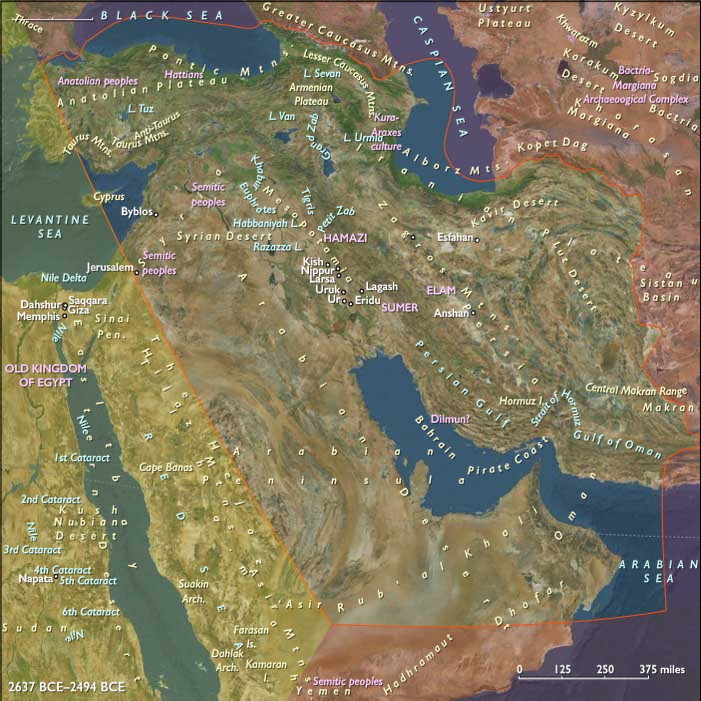
Cult centers such as Eridu, dating back to 5000 BCE, had served as important centers of pilgrimage and devotion even before the rise of Sumer.
Many of the most important Mesopotamian cities have emerged in areas surrounding the pre-Sumerian cult centers, thus reinforcing the close relationship between religion and government.
The Sumerians are pantheistic; their gods more or less personify local elements and natural forces.
The gods of Sumer are to provide the individual with security and prosperity in exchange for sacrifice and adherence to an elaborate ritual.
A powerful priesthood emerges to oversee ritual practices and to intervene with the gods.
Sumerian religious beliefs also have important political aspects.
Decisions relating to land rentals, agricultural questions, trade, commercial relations, and war are determined by the priesthood, because all property belongs to the gods.
Cult centers such as Eridu, dating back to 5000 BCE, had served as important centers of pilgrimage and devotion even before the rise of Sumer.
Many of the most important Mesopotamian cities have emerged in areas surrounding the pre-Sumerian cult centers, thus reinforcing the close relationship between religion and government.
The Sumerians are pantheistic; their gods more or less personify local elements and natural forces.
The gods of Sumer are to provide the individual with security and prosperity in exchange for sacrifice and adherence to an elaborate ritual.
A powerful priesthood emerges to oversee ritual practices and to intervene with the gods.
Sumerian religious beliefs also have important political aspects.
Decisions relating to land rentals, agricultural questions, trade, commercial relations, and war are determined by the priesthood, because all property belongs to the gods.
Locations
Groups
Topics
Commodoties
Subjects
Regions
Subregions
Years: 2637BCE - 2494BCE
Locations
Groups
Topics
Commodoties
Subjects
Regions
Subregions