
Anne Hutchinson, born Anne Marbury in Alford, …
Years: 1636 - 1636
September
Anne Hutchinson, born Anne Marbury in Alford, Lincolnshire, England, and baptized there on July 20, 1591, was the daughter of Francis Marbury, a dissident Puritan clergyman, and Bridget (Dryden) Marbury.
Anne was educated at home and read from her father's library.
Anne had married William (Will) Hutchinson at St. Mary Woolnoth, London on August 9, 1612 at the age of twenty-one.
She and her family had followed the sermons of John Cotton, a Protestant minister whose teachings echoed those of her father's.
Cotton had left England because of his persecution by the bishops.
Anne and her family had likewise emigrated from England to Massachusetts in 1634, together with other colonists.
Extremely outspoken about some of her most controversial views, Anne Hutchinson is an avid student of the Bible, which she freely interprets in the light of what she terms her "divine inspiration."
She generally adheres to the principles of Puritan orthodoxy.
Notably, however, she holds enormously progressive, ahead-of-her-times notions about the equality and rights of women, in contradiction of both Puritan and prevailing cultural attitudes.
She is forthright and compelling in proclaiming these beliefs, which put her in considerable tension not only with the Massachusetts Bay Colony's government, who are accountable to the established Church of England (Anglicans), but also with other Puritans, especially the clergy.
She had begun conducting informal Bible studies and discussion groups in her home, something that gives scope to Puritan intellects.
Hutchinson invites her friends and neighbors, at first all of them women.
Participants felt free to question religious beliefs and to decry racial prejudice, including enslavement of Native Americans.
In particular, Hutchinson constantly challenges the standard interpretation of the story of Adam and Eve.
This is a vital text for the Puritans, key to the doctrine of original sin, but it is regularly cited to assign special blame to women as the source of sin and to justify the extremely patriarchal structure of Puritan society.
As word of her teachings spread, she attracts new followers, including many men.
Among them are men like Henry Vane, the Younger, who becomes the governor of the Massachusetts Bay Colony in 1636 as a short-tenured successor to John Haynes.
Attendance at her home study group grows to upwards of eighty people and has to be moved to the local church.
Locations
People
Groups
- Anglicans (Episcopal Church of England)
- Puritans
- England, (Stuart) Kingdom of
- Massachusetts Bay Colony (sometimes called the Massachusetts Bay Company, for its founding institution)
Topics
Commodoties
Subjects
Regions

Subregions
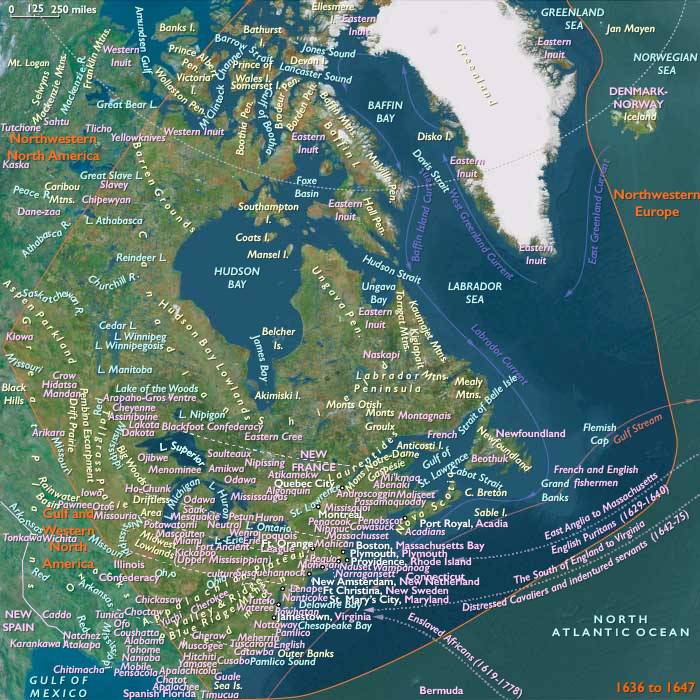
Years: 1636 - 1636
September
Locations
People
Groups
- Anglicans (Episcopal Church of England)
- Puritans
- England, (Stuart) Kingdom of
- Massachusetts Bay Colony (sometimes called the Massachusetts Bay Company, for its founding institution)
Topics
Commodoties
Subjects
Regions
Subregions